Compound Guide
BPC-157 + TB-500 blend: what's actually in the vial
A plain explanation of the BPC-157 and TB-500 combination product, sometimes called the "Wolverine Stack" in community shorthand, including exactly what's in it, why it's studied as a pair, and what a genuine blend price looks like compared to two singles sold together. Research use only.
What this product is
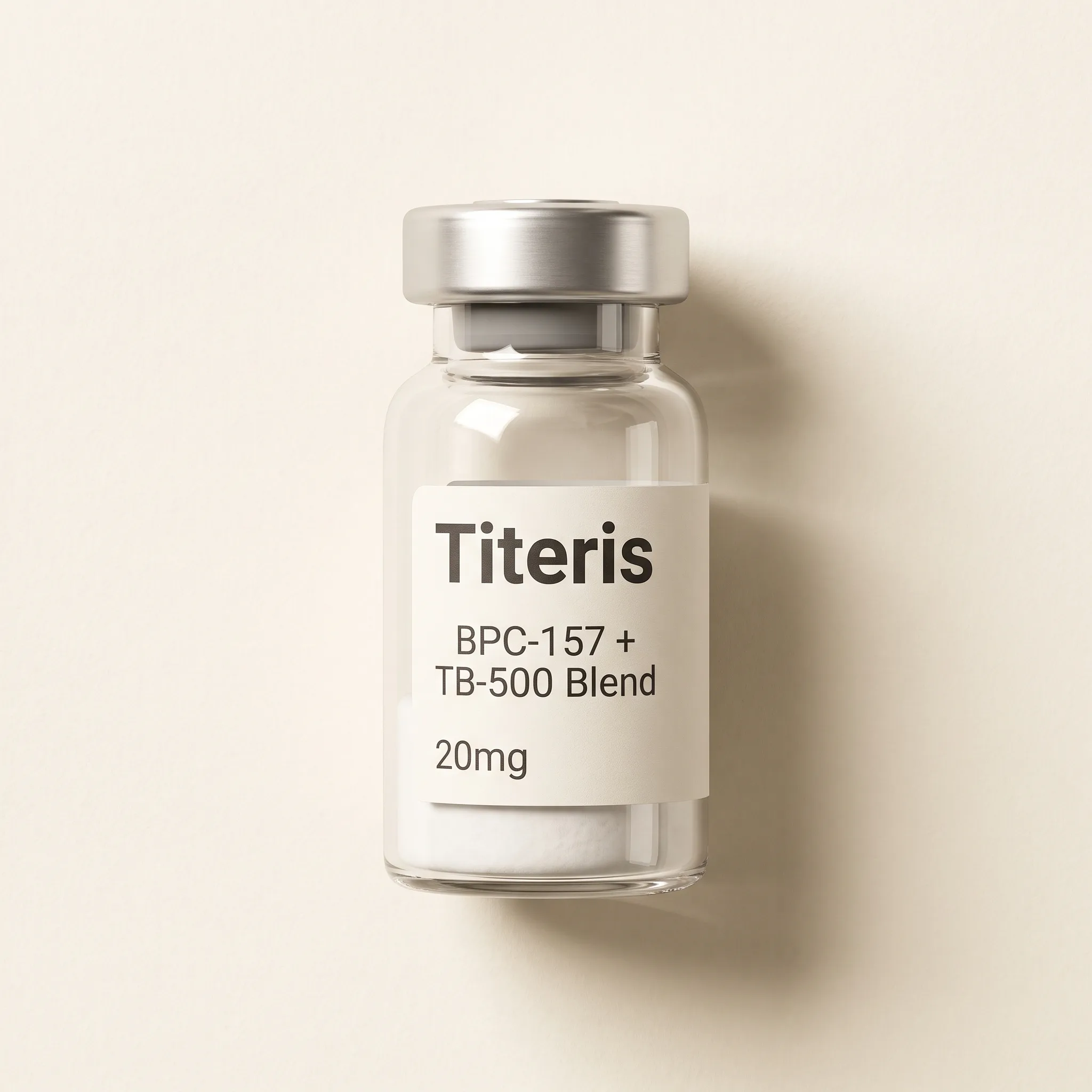
Our BPC-157 + TB-500 blend is a single vial containing 10mg of BPC-157 and 10mg of TB-500, 20mg total, combined during manufacture rather than mixed by the customer from two separate vials. It's the same two compounds documented on their own individual pages on this site, supplied together for convenience, at a price reflecting an actual combined product rather than two single-vial prices added together with a discount label stuck on top.
The nickname "Wolverine Stack" comes from the research and biohacking communities that discuss this combination, a reference to the X-Men character's rapid-healing ability. We didn't invent the name and don't use it as our own product branding, but it's the term you'll most often encounter searching for this combination, so it's worth naming plainly rather than pretending it doesn't exist.
Why these two compounds are studied together
BPC-157 and TB-500 are structurally unrelated. BPC-157 is derived from a gastric-juice protein fragment; TB-500 is a synthetic fragment related to Thymosin Beta-4. What draws them together in research and community discussion is that animal studies propose complementary, rather than identical, tissue-repair mechanisms: BPC-157's research background leans toward gut-lining protection, tendon and ligament repair, and angiogenesis, while TB-500's leans toward cell migration and actin regulation, also tied to angiogenesis. The working idea in community and some preclinical discussion is that a compound supporting cells getting to an injury site (TB-500) and a compound supporting what happens once they arrive (BPC-157) could plausibly complement each other.
It's important to be precise about what that idea rests on. No controlled human trial has tested the combination against either compound alone, or against a placebo, in humans. The complementary-mechanism theory is a reasonable hypothesis grounded in separate strands of animal research, not a demonstrated combined effect. We're explaining the reasoning behind why this product exists and why people search for it, not asserting that the combination has been proven superior to using either compound on its own.
It's also worth being honest about a related gap: even within the individual research literature on each compound, most of what's studied concerns each peptide administered on its own. Studies specifically examining BPC-157 and TB-500 dosed together, rather than each compound reviewed independently and the reader left to infer a combined effect, are limited. That's a genuine hole in the evidence base for this specific product, not just for human trials generally, and it's one we'd rather name directly than paper over with confident-sounding marketing language borrowed from either compound's individual research.
Why blend pricing matters, and what to watch for
A genuine issue in this category, worth naming directly: some sellers market a "bundle" that is really just several single vials sold at their normal individual prices, sometimes even labelled as a discount when the maths shows no discount at all. A real blend, where the two compounds are combined into one vial during manufacture, is a different product with its own real cost basis, and it should be priced as one. Our blend is priced as a genuine combined product. If you compare it against buying a 10mg BPC-157 vial and a 10mg TB-500 vial separately from our own catalogue, you can check the maths yourself rather than take a marketing claim on faith. We'd rather you did that comparison than trust a label saying "you save" a figure that doesn't actually hold up under scrutiny.
Reconstitution, and why the ratio matters
Because this vial contains two compounds rather than one, reconstitution arithmetic works slightly differently from a single-compound vial. Adding a given volume of diluent produces a solution where both compounds are present at their own individual concentration, in the same fixed 1:1 ratio they were combined in, 10mg BPC-157 to 10mg TB-500. That ratio doesn't change no matter how much diluent is added; only the total concentration of both compounds together scales with volume.
This is arithmetic, not usage guidance, and it's worth understanding correctly independent of any other question. Our BPC-157 dosage page includes a general reconstitution calculator for mass and volume; the same underlying maths applies here, just with two compounds present in the vial instead of one.
UK legal status
Both BPC-157 and TB-500 are, individually and combined, outside the controlled substances listed under the Misuse of Drugs Act 1971, and legal to buy, sell, and possess as research-use-only laboratory materials in the UK. Marketing or selling either for human consumption or therapeutic use is prohibited under the Human Medicines Regulations 2012, which governs how every listing on this site, including this blend, is written and described. Combining two individually legal research materials into one vial doesn't change that legal analysis; the product is still assessed the same way, as a research-use laboratory material, not as a new or different category requiring separate treatment. Full detail is on our UK legal status page.
In our catalogue
 BB-10
BB-10BPC-157 + TB-500 blend, 10mg
5mg BPC-157 + 5mg TB-500, combined in a single vial for laboratory research use.
£28.99 Contact us to orderBB-20BPC-157 + TB-500 blend, 20mg
10mg BPC-157 + 10mg TB-500, combined in a single vial for laboratory research use.
£49.99 Contact us to orderBB-40BPC-157 + TB-500 blend, 40mg
20mg BPC-157 + 20mg TB-500, combined in a single vial for laboratory research use.
£94.99 Contact us to orderPrefer the compounds individually? See BPC-157 and TB-500 on their own pages.
Frequently asked
Is this the same as buying BPC-157 and TB-500 separately?
The compounds themselves are the same. The difference is that this product is combined into one vial during manufacture and priced as a genuine 20mg blend, rather than being two separate vials sold together with a bundle label. Check our individual BPC-157 and TB-500 listings if you'd prefer to buy them apart, or in different ratios than 10mg/10mg.
Has the combination itself been studied?
Not in a controlled human trial. The reasoning behind studying them together comes from separate strands of animal research into complementary tissue-repair mechanisms, not from a trial testing the specific combination against either compound alone.
Why is it called the "Wolverine Stack"?
It's a nickname that originated in research and biohacking communities, referencing the X-Men character's rapid-healing ability. It's not a name we invented, and we don't use it as our own branding, but it's the term most people search for, so we're naming it plainly rather than pretending we don't know what visitors are actually looking for.
Do you test every batch of the blend?
We publish our supplier's own third-party documentation for each batch where it exists, credited to the lab that produced it, and state plainly on the listing if a batch doesn't currently have one. See our documentation policy for the full, current answer, including for blend products specifically.