Compound Guide
Tesamorelin: the research compound, and how it differs from the prescription drug Egrifta
Tesamorelin is unusual on this site: it's also the active ingredient in a prescription medicine holding FDA approval. This page explains that distinction clearly, since confusing the two is a real, common mistake.
What tesamorelin is
Tesamorelin is a synthetic growth hormone-releasing hormone (GHRH) analogue. Rather than being a growth hormone itself, it signals the pituitary gland to release the body's own growth hormone in a more natural, pulsed pattern. That mechanism, stimulating an existing biological pathway rather than replacing it directly, is what distinguishes GHRH analogues like tesamorelin from direct synthetic growth hormone.
Structurally, tesamorelin is based on the 44-amino-acid sequence of human GHRH, with an N-terminal modification designed to improve its stability once administered, since natural GHRH itself is broken down very quickly in the body. That modification is what makes tesamorelin usable as an injectable compound with a workable half-life, rather than being degraded before it can act on the pituitary at all. This kind of stabilising modification is a common pattern across GHRH-analogue peptides generally, not something unique to tesamorelin specifically.
Downstream of stimulating the pituitary, the released growth hormone in turn raises IGF-1 (insulin-like growth factor 1) levels, which is the pathway believed to drive tesamorelin's studied effect on fat metabolism, specifically lipolysis, the breakdown of stored fat. This growth-hormone-then-IGF-1 signalling cascade is the same general pathway other GHRH-analogue and growth-hormone-secretagogue compounds discussed on this site, including CJC-1295, are also studied through, even though each compound achieves it via a different specific mechanism.
The important distinction: Egrifta is a real, approved drug
Unlike most compounds on this site, tesamorelin has actually completed the clinical trial and approval process, in the United States. Under the brand names Egrifta and Egrifta SV, it holds FDA approval to reduce excess visceral fat in HIV-associated lipodystrophy, typically dosed at 2mg by daily subcutaneous injection, prescribed and monitored by a doctor.
That approval does not extend to the UK or EU. Tesamorelin does not hold MHRA or EMA marketing authorisation, which means it is not a licensed medicine here, and it cannot be legally prescribed in the UK the way Egrifta is in the US. What we sell is the research-grade compound, supplied strictly as a laboratory research material, not a prescription medicine, and not a substitute for one.
We're naming this distinction directly because it's the single most important thing to understand about tesamorelin specifically: a real prescription drug exists using this compound, with real published clinical trial data behind it, in a country where it's approved. That doesn't change our own product's legal status here, or turn our RUO listing into something it isn't.
It's also worth being clear about why a compound can be a licensed medicine in one country and an unlicensed research material in another, since that surprises people. Drug approval is a jurisdiction-by-jurisdiction process. A manufacturer submits clinical trial data to a specific regulator, the FDA for the US market, the MHRA for the UK, the EMA for the EU, and each regulator makes its own independent decision. A company can pursue approval in one market and not another for purely commercial reasons, without that choice implying anything about the compound's underlying safety or efficacy data. Tesamorelin's UK status reflects the absence of a UK-specific approval submission and decision, not a UK-specific safety finding against it.
What the clinical trial data (for Egrifta) reports
Because tesamorelin actually went through real clinical trials for its approved indication, more is publicly documented about it than most compounds on this site. Published trial data reported roughly a 15-18% reduction in visceral adipose tissue over 26 weeks in the approved patient population, alongside common side effects including injection-site reactions, joint and muscle pain, and effects on glucose and lipid metabolism that warrant monitoring in people with diabetes risk factors. This is real, human trial data, but it applies specifically to Egrifta's approved use in HIV-associated lipodystrophy under medical supervision, not to unsupervised use of an unlicensed research-grade compound for an unrelated purpose.
The trial follow-up period is worth noting specifically. Data extending to 52 weeks in patients who continued treatment showed the visceral fat reduction climbing toward 18%, while patients switched to placebo after the initial 26-week period saw the effect reverse relatively quickly. That pattern, benefit tied closely to continued use rather than a lasting one-off change, is common across metabolic and hormone-pathway interventions generally, and it's a genuinely useful piece of real trial data to understand on its own terms, independent of anything it might or might not suggest about unsupervised use of an unlicensed research compound.
It's also worth being precise that this trial data describes Egrifta specifically, manufactured, dosed, and administered under pharmaceutical-grade conditions with medical monitoring throughout. It does not describe, and cannot be assumed to transfer directly onto, an unlicensed research-grade vial sourced outside that same manufacturing and monitoring framework, even where the underlying peptide sequence is identical.
UK legal status
As a research compound, tesamorelin is not controlled under the Misuse of Drugs Act 1971, so it's legal to buy, sell, and possess as a research-use-only laboratory material in the UK. It is illegal to market or sell it for human use under the Human Medicines Regulations 2012, the same framing that applies to every other compound on this site. This applies fully to tesamorelin despite Egrifta's US approval; a foreign approval does not create a UK exception. Full detail is on our UK legal status page.
How this compares to other growth-hormone-pathway research peptides
Tesamorelin isn't the only compound on this site studied through the growth-hormone-releasing pathway. CJC-1295 works through a related but distinct mechanism, also acting as a GHRH analogue but engineered for a longer duration of action, and is frequently studied and discussed alongside Ipamorelin, which acts through a different receptor entirely, the ghrelin receptor, as a growth-hormone secretagogue rather than a GHRH analogue. The shared thread across this group is the downstream target, an increase in the body's own growth hormone and IGF-1 output, reached via genuinely different upstream mechanisms depending on the specific compound. Understanding that tesamorelin, CJC-1295, and Ipamorelin aren't interchangeable, despite sharing a broad category, is useful context whether or not you're specifically interested in tesamorelin itself.
Tesamorelin in our catalogue
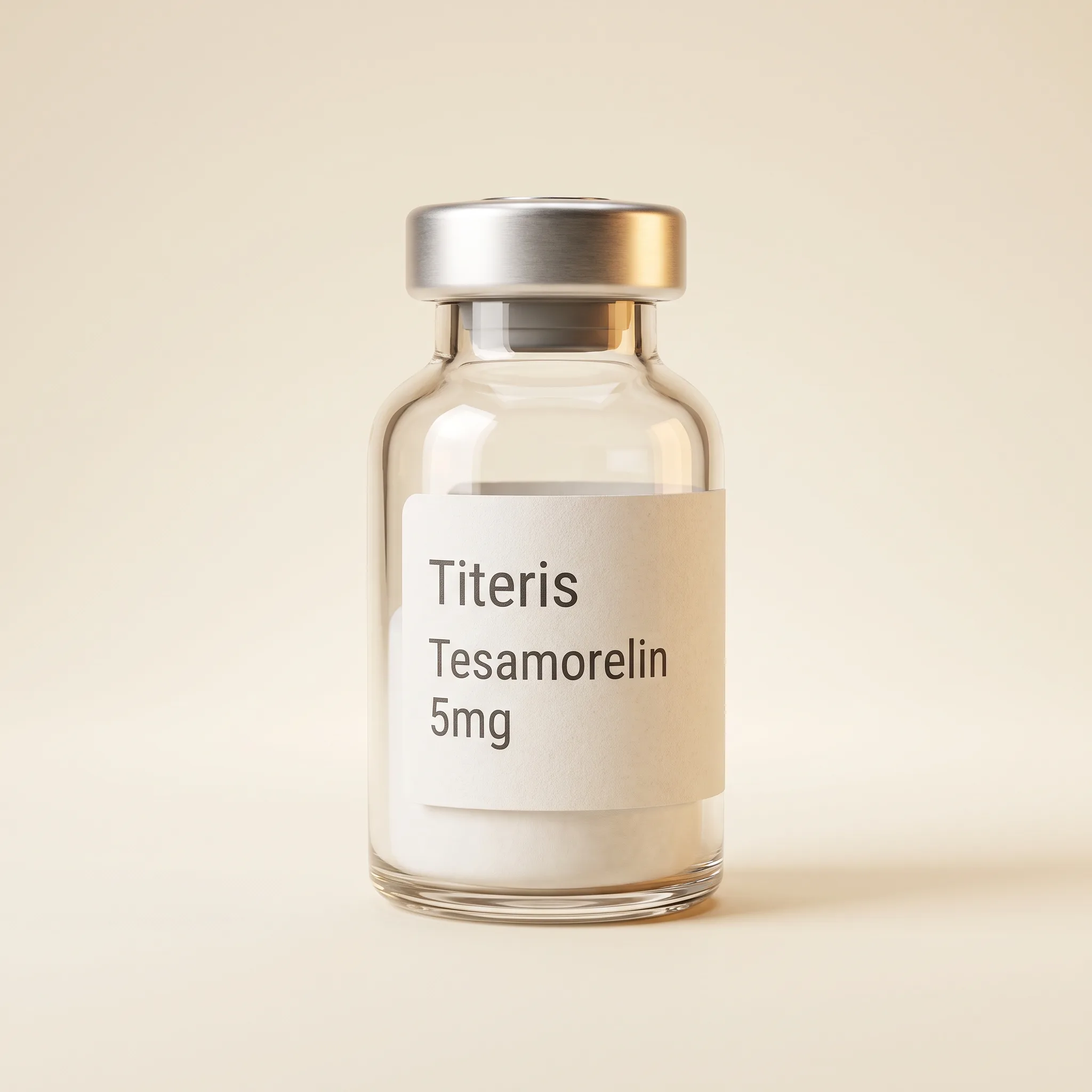 TE-5
TE-5Tesamorelin, 5mg
Supplied as a lyophilised vial for laboratory research use.
£29.99 Contact us to orderTE-10Tesamorelin, 10mg
Supplied as a lyophilised vial for laboratory research use.
£49.99 Contact us to orderTE-20Tesamorelin, 20mg
Supplied as a lyophilised vial for laboratory research use.
£99.99 Contact us to orderFrequently asked
Is your tesamorelin the same as Egrifta?
It's the same underlying compound, but sold as an unlicensed research-grade material, not as the licensed prescription medicine Egrifta, which holds FDA approval. Egrifta involves pharmaceutical manufacturing standards, regulatory oversight, and medical supervision that a research compound listing does not.
Can I get tesamorelin on prescription in the UK?
Tesamorelin does not currently hold MHRA marketing authorisation, so it is not available as a licensed UK prescription medicine through the ordinary NHS or private prescribing route. If you have a genuine medical need related to its approved US indication, that's a conversation for a doctor familiar with unlicensed-medicine import rules, not something a research-compound website can meaningfully advise on.
Do you test every batch?
We publish our supplier's own third-party documentation where it exists, credited to the lab, and state plainly when a batch lacks current documentation. See our documentation policy.