Compound Guide
5-Amino-1MQ: what the NNMT inhibitor is and what the research actually shows
A plain explanation of 5-Amino-1MQ: what nicotinamide N-methyltransferase (NNMT) is and why it is a research target, how this compound works as an NNMT inhibitor in laboratory settings, what the research literature has examined so far, and where 5-Amino-1MQ stands under UK law. For research use only. Nothing here is instruction for human use.
5-Amino-1MQ sold here is a research reference compound for in vitro and laboratory research purposes only. It is not licensed for human administration, is not a pharmaceutical product, and has not been approved by the MHRA for any clinical or therapeutic use. It is not a vitamin, supplement, or food product. Nothing on this page should be read as instruction or encouragement for human use of this compound.
What 5-Amino-1MQ is
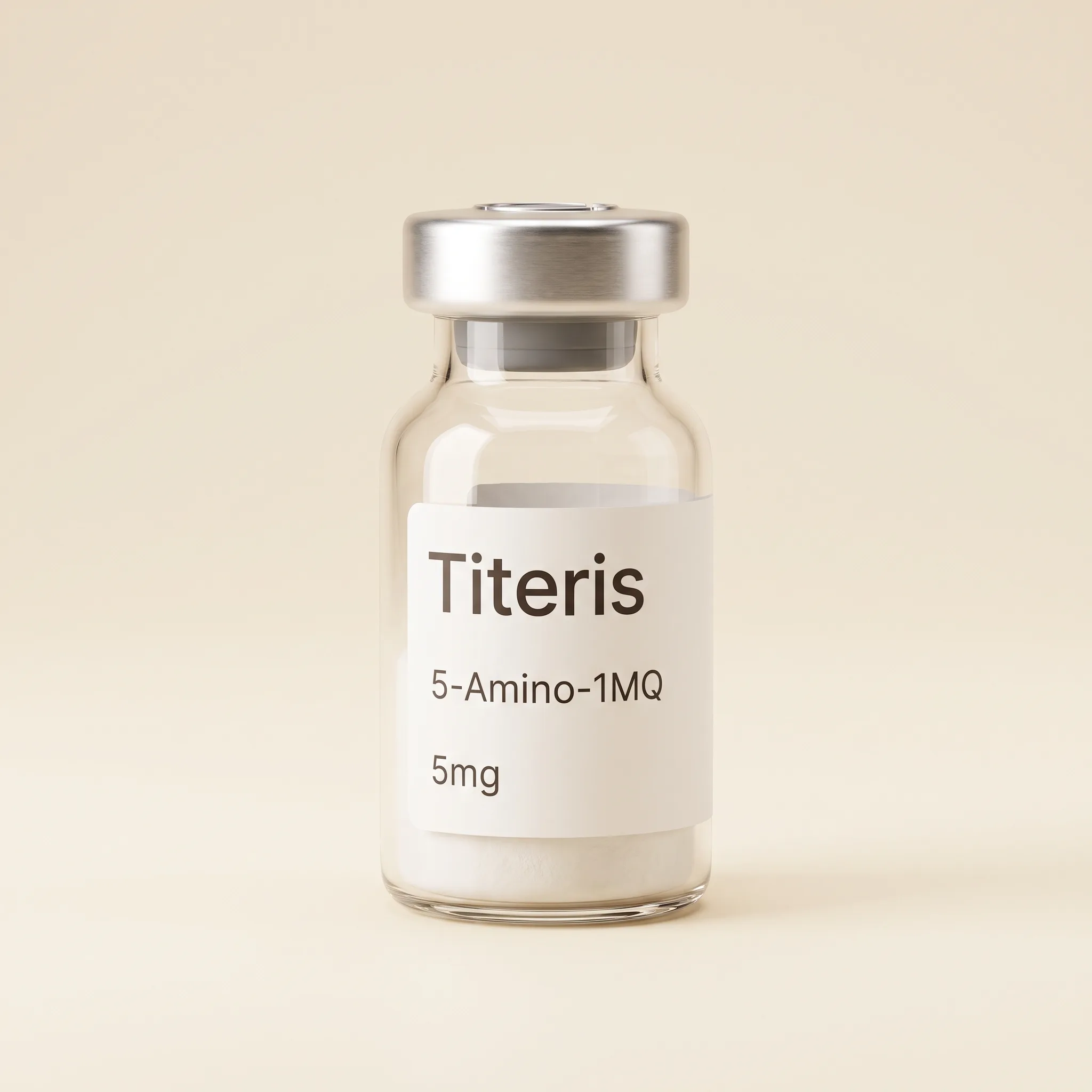
5-Amino-1MQ (5-amino-1-methylquinolinium) is a small-molecule, membrane-permeable compound developed as an inhibitor of nicotinamide N-methyltransferase (NNMT). The compound belongs to the quinolinium class of small molecules and has structural features that allow it to cross cell membranes and access NNMT within the cell.
NNMT is an enzyme that catalyses the transfer of a methyl group from S-adenosylmethionine (SAM) to nicotinamide, producing 1-methylnicotinamide (MNA) and S-adenosylhomocysteine (SAH). This enzymatic reaction sits at an intersection of several metabolic pathways that have attracted increasing research interest.
The research interest in NNMT stems from its role as a metabolic switch point between one-carbon metabolism, NAD+ biosynthesis, and epigenetic methylation processes. NNMT consumes both SAM (the universal methyl group donor) and nicotinamide (a NAD+ precursor), meaning its activity has downstream effects on cellular methylation capacity and NAD+ availability.
5-Amino-1MQ is not a vitamin, not a dietary supplement, and not a licensed medicine. It is a chemically defined small molecule for laboratory research into NNMT biology and related metabolic questions. Its membrane permeability distinguishes it from some other NNMT inhibitors that have difficulty entering intact cells, making it a useful tool for cell biology experiments.
As a research compound, 5-Amino-1MQ is relatively recently developed compared to some established peptide research tools. The published literature on this specific compound is more limited than for long-established research reagents, which is a relevant consideration for researchers assessing evidence quality.
What NNMT is and why it is studied
Understanding 5-Amino-1MQ as a research tool requires understanding what NNMT does and why inhibiting it is of research interest.
NNMT (nicotinamide N-methyltransferase) is an enzyme expressed in several tissues including liver, adipose tissue, and various cancer cell lines. Its primary reaction methylates nicotinamide, which has two significant downstream consequences. First, it consumes SAM, reducing the availability of methyl groups for DNA methylation, histone methylation, and other epigenetic modifications. Second, it diverts nicotinamide away from the NAD+ biosynthesis pathway, because nicotinamide is a substrate for NAMPT (nicotinamide phosphoribosyltransferase), the rate-limiting enzyme in the salvage pathway for NAD+ synthesis.
The connection to one-carbon metabolism is the source of much of the research interest. One-carbon metabolism refers to the network of reactions that transfer single-carbon units, centred on folate and methionine cycles. SAM, the methyl donor consumed by NNMT, is produced in this network. When NNMT activity is high, SAM is depleted, which in principle could affect the availability of methyl groups for epigenetic modifications throughout the cell.
NNMT expression varies substantially across tissues and metabolic states. It is overexpressed in various cancer cell lines and has been studied in the context of adipogenesis (fat cell formation), energy metabolism in adipose tissue, and the biochemistry of proliferating cells in culture. The variation in NNMT expression across conditions makes it an interesting research target for understanding metabolic regulation.
Inhibiting NNMT with compounds like 5-Amino-1MQ is a research strategy to understand what happens when this enzyme's activity is reduced. By blocking NNMT, nicotinamide becomes more available for the NAD+ salvage pathway, and SAM is conserved for methylation reactions. The effect of this intervention in cell models is what researchers study when using 5-Amino-1MQ.
What the research literature has examined
5-Amino-1MQ has been used as a research tool in the following areas:
NNMT and adipogenesis
Laboratory studies have examined the relationship between NNMT activity and fat cell formation. NNMT expression in adipose tissue and its potential role in adipocyte differentiation and metabolism has been a subject of cell biology research. 5-Amino-1MQ has been used as a tool in these experiments to modulate NNMT activity and observe downstream effects in adipocyte cell models.
NAD+ metabolism research
Because NNMT consumes nicotinamide that would otherwise enter the NAD+ biosynthesis pathway, NNMT inhibition is studied as one approach for investigating NAD+ level regulation in cells. NAD+ is a coenzyme central to cellular energy metabolism and substrate for enzymes including sirtuins and PARPs. Research into NAD+ metabolism has expanded considerably, and NNMT inhibition represents one mechanistic approach within that field.
Epigenetic regulation research
NNMT's consumption of SAM connects it to epigenetic methylation capacity. In cell models, altered NNMT activity has been studied for its potential effects on DNA and histone methylation patterns. 5-Amino-1MQ has been used as a research tool to modulate NNMT in these epigenetic studies.
Cancer cell biology
NNMT is overexpressed in a range of cancer cell lines. Research examining NNMT inhibitors in cancer cell models is an active area of basic cell biology research. These are in vitro studies using cell lines, not clinical research, and should be understood as mechanistic investigations rather than evidence of any therapeutic application.
How 5-Amino-1MQ differs from NAD+ precursors
A distinction worth clarifying: NAD+ precursors like nicotinamide mononucleotide (NMN) and nicotinamide riboside (NR) work by providing additional substrate for NAD+ biosynthesis. 5-Amino-1MQ works through a different mechanism, inhibiting the enzyme that consumes nicotinamide and SAM. The two approaches operate at different points in the metabolic network and are not equivalent as research tools. For researchers studying NNMT-specific biology, 5-Amino-1MQ is the appropriate reference compound; for researchers studying NAD+ precursor pathways, NMN or NR would be the relevant tools.
UK regulatory status
5-Amino-1MQ is not a licensed medicine in the UK. It has no MHRA approval for any indication. It is not a controlled substance. As a research reference compound for in vitro laboratory research, it is supplied for legitimate scientific purposes only.
Nothing on this site constitutes an instruction or invitation to administer 5-Amino-1MQ to a human or animal. For research use only means exactly that: use in a research laboratory context with appropriate oversight, not personal experimentation. Our UK legal status page provides further context on the regulatory framework for research compounds.
Storage and handling notes
5-Amino-1MQ as a lyophilised research compound should be stored at -20°C in dry conditions, protected from light. Allow the vial to reach room temperature in closed condition before opening to prevent moisture condensation. After opening, use promptly or reseal carefully.
As a small molecule rather than a peptide, 5-Amino-1MQ has different reconstitution characteristics from peptide research compounds. Researchers should consult the technical literature and their institutional protocols for appropriate solvents and concentrations for their specific application.
Standard laboratory precautions apply for compounds with potential biological activity. As a research reference material, it does not carry pharmaceutical safety data sheets. Researchers operate under their institutional safety guidelines and follow appropriate handling procedures for compounds of this class.
5-Amino-1MQ in our catalogue
5A55-Amino-1MQ, 5mg
Supplied as a lyophilised vial for laboratory research use only.
£27.99 Contact us to order5A105-Amino-1MQ, 10mg
Supplied as a lyophilised vial for laboratory research use only.
£49.99 Contact us to order5A505-Amino-1MQ, 50mg
Supplied as a lyophilised vial for laboratory research use only.
£74.99 Contact us to orderFor laboratory use only. Not for human or veterinary consumption. See our documentation policy and UK legal status page.
Frequently asked
What is NNMT?
NNMT (nicotinamide N-methyltransferase) is an enzyme that methylates nicotinamide using SAM (S-adenosylmethionine) as the methyl donor, producing 1-methylnicotinamide and S-adenosylhomocysteine. Its activity sits at the intersection of one-carbon metabolism, NAD+ biosynthesis, and epigenetic methylation processes. It is expressed in various tissues including liver and adipose tissue, and is overexpressed in several cancer cell lines.
How does 5-Amino-1MQ differ from NMN or NR?
NMN (nicotinamide mononucleotide) and NR (nicotinamide riboside) are NAD+ precursors that work by providing additional substrate for NAD+ synthesis. 5-Amino-1MQ is an enzyme inhibitor that blocks NNMT, the enzyme that competes with the NAD+ biosynthesis pathway for nicotinamide substrate. These are fundamentally different mechanisms operating at different points in the metabolic network. For research specifically examining NNMT biology, 5-Amino-1MQ is the appropriate tool; for NAD+ precursor pathway research, NMN or NR are the relevant compounds.
Is 5-Amino-1MQ a peptide?
No. Unlike most compounds in this catalogue, 5-Amino-1MQ is a small molecule (a quinolinium compound) rather than a peptide. This distinction matters for reconstitution, storage, and the type of cell biology research it is suited for. Its membrane permeability as a small molecule is one of its useful properties for cell-based assays.
How is 5-Amino-1MQ supplied?
As a lyophilised powder in a sealed glass vial, supplied for laboratory research use only. Available in 5mg, 10mg, and 50mg vials. Not for human or veterinary use.