Compound Guide
Acetic Acid 0.6%: what the reconstitution solution is and when it is used in the lab
A factual explanation of 0.6% acetic acid solution: why certain peptides need a mildly acidic solvent for reconstitution, how acetic acid and bacteriostatic water complement each other, and when each is the appropriate choice for laboratory peptide work. Supplied for research use only. Nothing on this page is instruction for human use.
Acetic acid 0.6% sold here is a research reference material supplied for in vitro and laboratory research purposes only. It is not a licensed pharmaceutical product and has not been approved by the MHRA for any clinical or therapeutic application. Our products are not intended to diagnose, treat, cure, or prevent any disease or condition. Nothing on this page is instruction or invitation to administer this material to a human or animal.
What acetic acid 0.6% is
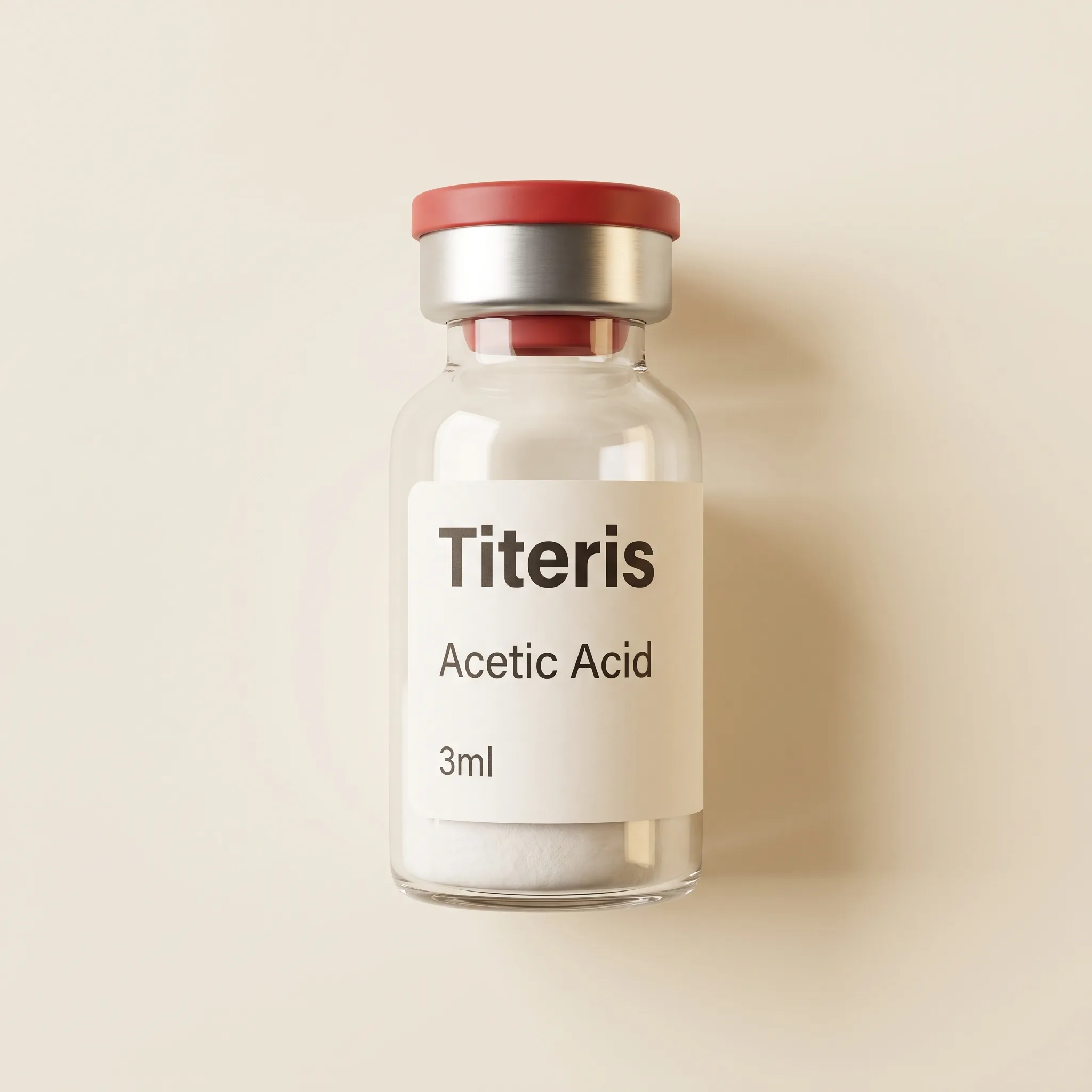
Acetic acid solution at 0.6% concentration is a mildly acidic aqueous solution used for reconstituting certain lyophilised peptides in the laboratory context. Its pH sits in the region of 3 to 4, which makes it suitable for peptides that are poorly soluble or unstable at neutral pH. In this concentration range, acetic acid is a weak acid and the solution is not corrosive at normal handling volumes, though standard laboratory precautions apply.
Acetic acid itself is the carboxylic acid found in vinegar in dilute form. At 0.6%, the solution is far more dilute than household vinegar, which typically contains around 5% acetic acid. The laboratory-grade 0.6% concentration is selected specifically for peptide reconstitution because it provides the pH benefit without introducing excessive acidity that could interfere with downstream experimental assays or destabilise sensitive compounds.
Certain peptides, particularly those with basic amino acid residues or with a tendency toward aggregation at neutral pH, dissolve considerably better in mildly acidic solution. The protonation of basic side chains at lower pH values increases the electrostatic repulsion between peptide molecules, which helps prevent the aggregation that reduces solubility and experimental reproducibility. This is the core rationale for using acetic acid rather than bacteriostatic water for this class of compounds.
Acetic acid 0.6% is not a medicine and is not a food product. It is a laboratory auxiliary substance supplied for reconstituting lyophilised research compounds. It has no pharmacological activity in the research sense; its function is entirely as a vehicle that makes other compounds soluble and stable for laboratory use.
Laboratory use: when to choose acetic acid over bacteriostatic water
The choice of reconstitution solvent is a research decision based on the properties of the specific peptide being dissolved. There is no universal solvent for all peptides; the literature and technical data sheets for each compound are the appropriate guide. The key practical distinctions are:
- Peptides with solubility problems at neutral pH. Certain peptides show aggregation or poor solubility at pH 7. In mildly acidic solution, solubility improves through protonation of basic side chains, which increases intermolecular electrostatic repulsion and prevents aggregation. For these compounds, bacteriostatic water is not the right choice and acetic acid is standard.
- Growth factors and related peptides. IGF-1 and related growth factors are conventionally reconstituted in dilute acetic acid. This is standard practice described throughout the biochemical research literature. Using the wrong solvent for these compounds can result in poor solubility, aggregation, and unreliable experimental results.
- Stability at acidic pH. Some peptides are more stable against aggregation and in vitro enzymatic degradation at acidic pH. The selection of pH for reconstitution is a research decision that should be informed by the compound's known stability profile.
- Combining with bacteriostatic water. After initially dissolving a peptide in acetic acid, the solution can be diluted with sterile water or bacteriostatic water to reach the target concentration for the experiment, which also shifts the pH toward more neutral conditions if the experimental system requires it. This two-step approach is sometimes used when the compound dissolves poorly in neutral aqueous solution but downstream assay conditions are better suited to a higher pH.
Common peptides reconstituted with acetic acid
IGF-1 LR3 is the most commonly cited compound requiring acetic acid reconstitution. Its structure includes regions that are poorly soluble at neutral pH, and the standard laboratory protocol for IGF-1 LR3 uses dilute acetic acid as the initial reconstitution solvent. After dissolution, the stock solution may be diluted with aqueous buffer or culture medium depending on the experimental requirements.
Certain GHRP-class compounds and some other growth factor analogues also benefit from acidic reconstitution. The product page for each compound in our catalogue notes whether acetic acid or bacteriostatic water is the conventional reconstitution approach, so researchers do not need to determine this from first principles when ordering.
Peptides that are already soluble and stable at neutral pH, including BPC-157, TB-500, semaglutide, tirzepatide, and most nootropic peptides, are conventionally reconstituted with bacteriostatic water. Using acetic acid for these compounds is not incorrect in all cases, but it introduces unnecessary acidity and lacks the antimicrobial preservative benefit that bacteriostatic water provides for multi-draw use.
Limitations of acetic acid as a reconstitution solvent
Acetic acid does not contain an antimicrobial preservative. This means a reconstituted peptide solution in acetic acid does not have the same multi-access sterility window that bacteriostatic water provides. For multi-draw use, diluting the acetic acid-reconstituted stock into bacteriostatic water is one approach, or preparing single-use aliquots from the initial stock is another. The specific protocol is a research decision.
The acidity of a 0.6% acetic acid solution may interfere with some pH-sensitive assay systems if the peptide solution is added directly without dilution. Researchers should account for the contribution of the reconstitution solvent to the final pH of their experimental system when designing protocols.
UK regulatory status
Acetic acid 0.6% supplied as a laboratory auxiliary substance for in vitro research purposes is not a licensed medicine. It is not regulated by the MHRA as a medicinal product when supplied strictly for laboratory research use, and it is not a controlled substance. The regulatory distinction between a laboratory research material and a pharmaceutical product matters, and Titeris supplies this material only under the research use only framework.
Nothing on this site markets acetic acid 0.6% for human use. Purchasers are required to confirm they are acquiring it for legitimate laboratory research purposes, and use is restricted to those aged 18 and over. Our UK legal status page provides a general overview of the regulatory framework relevant to research materials.
Storage, handling, and stability
Acetic acid 0.6% solution is stable at room temperature and does not require refrigerated storage in the sealed vial. After opening, the solution should be handled with standard laboratory precautions: protective gloves, lab coat, and eye protection. At 0.6% concentration, acetic acid is not classified as a corrosive, but it is still an acid and should be treated as such in the laboratory setting.
Once a peptide has been reconstituted in acetic acid, the resulting solution should be stored at 4 degrees Celsius and used within the stability window appropriate for that compound. Repeated freeze-thaw cycles of the reconstituted solution should be avoided where possible, as they can cause structural degradation of sensitive peptides. Preparing aliquots and freezing them individually for single-use thaw is the recommended approach for longer-term storage of reconstituted peptide stocks.
Disposal of unused acetic acid solution should follow institutional guidelines for chemical waste. Acetic acid in dilute aqueous solution at laboratory quantities is generally managed as standard chemical waste. Specific disposal procedures should be confirmed with the institution's chemical safety officer in accordance with UK environmental regulations.
As a research reference material, acetic acid 0.6% does not carry a pharmaceutical-grade safety data sheet. Researchers operate according to their institutional safety protocols and professional judgement about the specific experimental context.
Research context: the role of reconstitution solvents in reproducible laboratory work
In laboratory research with peptide compounds, the reconstitution protocol is part of the experimental methodology. The solvent, the volume used, the order of mixing, the storage conditions after reconstitution, and the time elapsed before use all contribute to the quality and reproducibility of the results. Acetic acid 0.6% is not a trivial detail; it is the standard for a specific set of compounds where the alternative would result in poor solubility and unreliable data.
In vitro experiments using poorly reconstituted peptide stocks introduce a confounding variable that is difficult to detect and control for. A peptide that has partially aggregated during reconstitution presents a different effective concentration than the nominal amount, and the aggregated fraction may have different biological activity from the soluble monomer. Using the correct solvent eliminates this source of experimental error.
Titeris stocks both bacteriostatic water and acetic acid 0.6% specifically because the peptide catalogue spans compounds requiring both reconstitution conditions. Where a compound's product page indicates acetic acid is the appropriate solvent, this reflects the established protocol for that compound class in the research literature. We describe what is known about each compound without making claims beyond what can be supported.
Laboratory findings with peptide research materials are documented in peer-reviewed literature and subject to scrutiny and replication by other researchers. The quality of that literature depends in part on consistent, correct experimental practice, including the use of appropriate reconstitution solvents. Titeris supplies laboratory materials to support rigorous research, and the acetic acid we supply is a contribution to that infrastructure, not an endpoint in itself.
Acetic acid in our catalogue
AA3Acetic Acid 0.6%, 3ml
Supplied as a sealed vial for laboratory reconstitution use.
£12.99 Contact us to orderAA5Acetic Acid 0.6%, 5ml
Supplied as a sealed vial for laboratory reconstitution use.
£14.99 Contact us to orderFor laboratory use only. Not for human or veterinary consumption. See our UK legal status page and our documentation policy.
Frequently asked
Why 0.6% acetic acid and not other concentrations?
0.6% corresponds to a concentration that is appropriate for the majority of peptides conventionally reconstituted in acetic acid. Higher concentrations can denature peptides or disrupt experiments through excessive acidity. Lower concentrations may not provide enough pH shift to meaningfully improve solubility for the compounds that require acidic conditions. The 0.6% concentration is the accepted standard across the relevant research literature.
Can I use acetic acid instead of bacteriostatic water for all peptides?
No. Acetic acid is appropriate for peptides that show improved solubility at acidic pH. For peptides that are stable and soluble at neutral pH, bacteriostatic water is the better choice because it provides antimicrobial preservation for multi-draw use without introducing unnecessary acidity. The choice depends on the properties of the specific peptide, and the product pages in our catalogue note which solvent is conventional for each compound.
Is this acetic acid solution suitable for human use?
No. It is a laboratory auxiliary material, not a pharmaceutical product. It does not meet GMP requirements for pharmaceutical applications and is not supplied for any purpose other than in vitro laboratory research. Nothing on this site should be read as instruction or endorsement for human use.
How should I store an acetic acid-reconstituted peptide solution?
Once a peptide has been reconstituted in acetic acid, the resulting solution should be stored at 4 degrees Celsius and used within the stability window for that specific compound. For longer-term storage, prepare aliquots and freeze them at minus 20 degrees Celsius to avoid repeated freeze-thaw cycles of the main stock. Specific stability data for each compound is the researcher's responsibility and should be drawn from the primary literature or technical data sheets.