Compound Guide
Adamax: what the Semax-related ACTH fragment peptide is and what the research shows
A plain explanation of Adamax: what this compound is structurally, how it relates to Semax and the ACTH fragment research tradition, and what the literature on ACTH-derived cognitive peptides actually demonstrates. UK regulatory context included. For research use only. Nothing here is instruction for human use.
Adamax sold here is a research reference compound for in vitro and laboratory research purposes only. It is not licensed for human administration, is not a pharmaceutical product, and has not been approved by the MHRA for any clinical or therapeutic use. The research applications discussed on this page are from published scientific literature and are referenced for scientific context only. They are not an endorsement of human use of this compound. If you have questions about cognitive function or neurological health, consult a registered healthcare professional.
What Adamax is
Adamax is a synthetic peptide derived structurally from the ACTH(4-7) fragment, the same peptide scaffold as Semax. Semax itself is a synthetic heptapeptide corresponding to the ACTH-MSH(4-10) fragment and was developed in Russia, where it holds approval as a nasal pharmaceutical product for cognitive disorders and ischaemic conditions. Adamax shares this ACTH fragment origin but has its own distinct sequence or modification profile that differentiates it from Semax.
The class of ACTH-derived peptides has a research history extending back several decades in neuroscience. Fragments of adrenocorticotropic hormone, particularly the 4-10 region, were found in early research to have effects on learning and memory in animal models, independent of their role in adrenocortical stimulation. This observation drove the development of multiple synthetic analogues designed to enhance or prolong the cognitive effects observed with the natural fragment, of which Semax is the most clinically developed example in the Russian pharmaceutical tradition.
Adamax contains the basic ACTH fragment sequence and may include additional modifications, such as an N-terminal adamantyl group or other structural changes, that could influence its receptor interactions or stability profile. As a research reference material, it is used for investigations into melanocortin receptor pharmacology, cognitive signalling pathways, and related neuroprotective mechanisms in preclinical systems.
The mechanism of action of Semax and related peptides is not fully characterised. The published literature describes effects on BDNF (Brain-Derived Neurotrophic Factor), NGF (Nerve Growth Factor), and other neurotrophins, as well as interactions with melanocortin receptors in the central nervous system. These mechanistic claims are based on preclinical data and should be evaluated accordingly.
What the research on the ACTH fragment scaffold shows
The relevant research literature covers both the ACTH fragment scaffold generally and Semax specifically:
- ACTH(4-7) scaffold and cognitive functions. Peptides based on the ACTH(4-7) type have been studied in neuroscience for decades because of their mnemonic and cognitive properties in animal models. This preclinical literature is broad and forms the mechanistic backdrop for the interest in Semax and related compounds as research tools.
- Semax as a pharmaceutical. Semax has Russian regulatory approval as a nasal spray for ischaemic stroke and cognitive enhancement. This approval is based on Russian clinical studies and does not extend to the UK or EU. MHRA has not approved Semax for any indication. The existence of this approval in another regulatory system does not confer approved status in the UK.
- Neurotrophin regulation. Preclinical studies in animal models describe effects of Semax on BDNF and NGF expression in the hippocampus. These preclinical data are the subject of active basic research. They cannot be directly extrapolated to human clinical outcomes.
- Neuroprotective research. Various ACTH fragment peptides have been investigated in animal ischaemia models for neuroprotective properties. These preclinical data inform the mechanistic hypothesis underlying Semax's Russian clinical development, but do not constitute independent evidence of clinical efficacy in the UK regulatory context.
For researchers using Adamax as a laboratory reference material, the Semax literature provides the closest mechanistic context, while recognising that Adamax may differ from Semax in ways that could affect its experimental profile. Independent comparative characterisation is the appropriate scientific approach.
Melanocortin receptor biology and ACTH fragment pharmacology
The melanocortin receptor family comprises five receptors, MC1R through MC5R, distributed across the brain and peripheral tissues. MC4R is expressed in the hypothalamus and has roles in energy balance regulation, while MC3R and MC4R in other brain regions are relevant to mood and cognitive function research. The ACTH fragment portion of peptides like Semax and Adamax is understood to interact with melanocortin receptors, though the specific receptor subtype selectivity of different analogues varies.
The connection between melanocortin signalling and neurotrophic factors is an area of active basic research. BDNF signalling via TrkB receptors is well established in memory consolidation and neuroplasticity, and some studies have linked melanocortin receptor activation to changes in neurotrophin expression. Whether this link operates in a causal, direct way or reflects correlated downstream events is a question that remains under investigation in the basic science literature.
For researchers designing experiments with Adamax, understanding the melanocortin receptor landscape in the chosen cell system is important for interpreting results. Receptor expression profiles differ substantially between cell lines, primary cultures, and in vivo models. Experiments that include receptor subtype-selective agonists and antagonists as controls provide better mechanistic resolution than peptide treatment alone.
The adamantyl modification implied by the Adamax name, if present, would represent a structural change that confers greater proteolytic stability and potentially alters membrane interaction properties. Adamantane-containing peptides have been studied in various contexts precisely because the hydrophobic adamantyl group can modify peptide behaviour in biological systems. This makes Adamax of interest to researchers studying how structural modifications to ACTH fragment peptides affect their pharmacological profile.
UK regulatory status
Adamax is not a licensed medicine in the UK. It has not received MHRA approval for any indication. Semax, the most closely related compound with clinical data, holds Russian regulatory approval that does not extend to the UK or EU. As a research reference compound for in vitro laboratory use, Adamax is provided under a research-use-only framework and cannot be marketed or supplied for human use.
See our UK legal status page for the broader regulatory framework that applies to research peptide compounds in the UK.
Adamax in our catalogue
ADMXSee our documentation policy for what supplier batch documentation covers, and our UK legal status page for the regulatory framing every listing follows.
Laboratory context: how Adamax is used in basic research
Adamax is a research reference material for laboratory use. Controlled in vitro experiments with Adamax are relevant for researchers investigating melanocortin receptor pharmacology, ACTH fragment biology, or neurotrophin regulation by short neuropeptides. Results from these experiments must be interpreted within the specific model system and cannot be extrapolated to human physiology without substantial further validation.
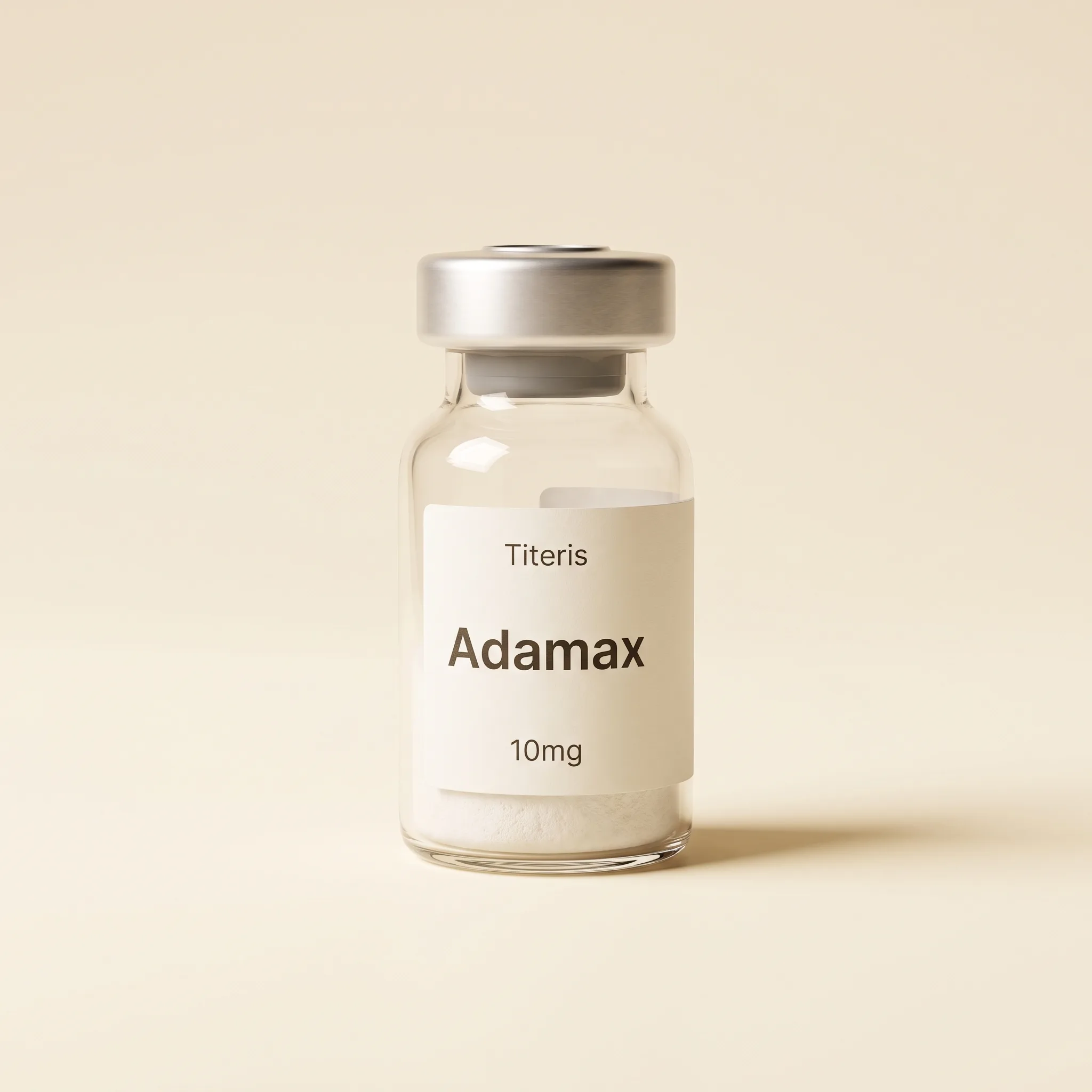
Titeris supplies Adamax as a lyophilised peptide in a sealed glass vial. Storage at -20 degrees Celsius in the dry state is recommended. After reconstitution in bacteriostatic water or sterile water, the solution should be used promptly or stored at 4 degrees Celsius for short-term use. Aliquoting before freezing is recommended to avoid repeated freeze-thaw cycles that degrade peptide quality.
For researchers comparing Adamax with Semax, the two compounds share the same general scaffold but differ in specific structural features. Parallel experiments using both compounds in the same system, with appropriate controls, are the right approach for establishing whether observed effects are scaffold-dependent or specific to one modification.
Research reference materials like Adamax are not clinical investigational products and have not been reviewed by the MHRA for any therapeutic application. Handling should follow institutional laboratory safety guidelines. Standard protective equipment and disposal under institutional chemical waste guidelines under UK environmental regulations apply.
Frequently asked
What is the difference between Adamax and Semax?
Semax is a specific heptapeptide, Met-Glu-His-Phe-Pro-Gly-Pro, based on the ACTH(4-7) scaffold, and is approved in Russia as a pharmaceutical nasal spray. Adamax is a related compound on the same ACTH fragment scaffold with a different specific sequence or structural modification, which may include an adamantyl group at the N-terminus. Semax has Russian pharmaceutical approval; Adamax does not hold approval anywhere and is for research use only.
Is Semax available in the UK?
Semax is not a licensed medicine in the UK. It holds a Russian pharmaceutical approval that is not recognised by the MHRA. It is not available through the UK healthcare system. Research reference materials related to the Semax scaffold are supplied strictly for in vitro laboratory research under the research-use-only framework.
How is Adamax supplied as a research reference material?
As a lyophilised peptide in a sealed glass vial, available in 10mg size. Supplied without solvent; reconstitution for laboratory use requires bacteriostatic water or sterile water depending on the specific research application.
What are melanocortin receptors?
Melanocortin receptors are a family of five G-protein-coupled receptors (MC1R through MC5R) that are activated by peptides derived from POMC, including alpha-MSH and ACTH fragments. They are distributed across the brain and peripheral tissues and have roles in pigmentation, energy balance, inflammation, and cognitive function. ACTH fragment peptides like Semax and Adamax are understood to engage these receptors, which is the basis for their research interest in neuroscience.