Compound Guide
AHK-Cu: what the copper tripeptide is and what the research shows
A plain explanation of AHK-Cu (Alanine-Histidine-Lysine copper tripeptide): what the compound is, how it relates to GHK-Cu, and what the research literature has explored in the copper tripeptide class. Research use only. Nothing here is guidance for human use.
AHK-Cu sold here is a research reference compound for in vitro and laboratory research purposes only. It is not licensed for human administration, is not a pharmaceutical product, and has not been approved by the MHRA for any clinical or therapeutic use. Alanine-histidine-lysine copper tripeptide, research use only. Nothing on this page constitutes medical advice or instruction for use on humans or animals.
What AHK-Cu is
AHK-Cu, full name Alanyl-Histidyl-Lysine copper complex, is a copper-binding tripeptide composed of the amino acids alanine, histidine, and lysine in that sequence. It belongs to the broader class of copper-complexing peptides that have attracted research interest because of their ability to coordinate copper(II) ions with high affinity and their potential roles as copper signalling molecules in biological systems.
The key structural comparison is with GHK-Cu (Glycyl-Histidyl-Lysine copper), the more extensively studied copper tripeptide in this class. The two compounds share the histidine-lysine C-terminal sequence but differ in the N-terminal amino acid: AHK-Cu has alanine where GHK-Cu has glycine. This single amino acid substitution at the N-terminus changes the three-dimensional geometry of the peptide and may influence its binding affinity for specific receptors or enzymes. Whether and how this structural difference translates to functionally different pharmacological profiles is an active area of basic research investigation.
Copper is an essential trace element and a cofactor for numerous enzymes, including superoxide dismutase, cytochrome c oxidase, and lysyl oxidase. The latter is relevant to connective tissue: lysyl oxidase catalyses the cross-linking of collagen and elastin. Copper-binding peptides that can deliver or modulate copper in biological systems are therefore relevant to several active research areas, from bioinorganic chemistry to skin and connective tissue biology.
AHK-Cu is not a cosmetic product, not a pharmaceutical, and not a dietary supplement. It is a research reference compound supplied for laboratory investigation of copper-peptide complexes and the cell biology relevant to that research field.
What the research has examined
The research literature on AHK-Cu is narrower than for GHK-Cu, which has been the more extensively studied copper tripeptide since its identification in the 1970s. AHK-Cu has appeared in the following research contexts:
- Copper-binding properties. Like GHK-Cu, AHK-Cu has high affinity for copper(II) ions. The coordination chemistry of these peptide-copper complexes is studied in bioinorganic chemistry to understand how short peptide sequences can selectively bind and deliver trace metals in biological contexts. The histidine residue plays a central role in copper coordination in both compounds.
- Hair follicle research models. AHK-Cu has appeared in laboratory studies examining copper-peptide effects on hair follicle cell biology. These in vitro studies use cell culture models, not clinical protocols, and the findings cannot be directly translated to human applications.
- Comparison with GHK-Cu. A portion of the AHK-Cu literature directly compares its biochemical properties with GHK-Cu, aiming to understand which structural features of copper tripeptides determine their interactions with specific cellular targets. These comparative studies contribute to structure-activity relationship mapping in the copper-peptide field.
- Antioxidant research. Copper peptides have been studied in the context of antioxidant research because copper is a cofactor for superoxide dismutase, an enzyme that neutralises superoxide radicals. AHK-Cu as a copper carrier is relevant to laboratory studies examining copper-mediated antioxidant activity in cell models.
- Bioinorganic chemistry. At the most fundamental level, copper-binding tripeptides like AHK-Cu are studied as model systems for understanding protein-metal interactions in biological chemistry. The small, defined size of the tripeptide makes it tractable for spectroscopic and computational approaches that would be difficult with larger proteins.
AHK-Cu versus GHK-Cu: the structural distinction
Both AHK-Cu and GHK-Cu are copper-binding tripeptides with the sequence X-His-Lys-Cu, where X is the N-terminal amino acid. In GHK-Cu, X is glycine, the smallest amino acid with no side chain. In AHK-Cu, X is alanine, which has a methyl side chain.
This methyl group at the N-terminus creates a small but potentially significant difference in the three-dimensional structure of the peptide-copper complex. The N-terminal amino group is one of the copper-coordinating atoms in these complexes, and the presence of a side chain on the adjacent carbon can influence the geometry of copper coordination and the resulting affinity for different biological binding partners.
GHK-Cu has a substantially larger research literature spanning several decades, including work on its natural occurrence in human plasma at concentrations that decline with age, its role in wound healing signalling, and a broad body of in vitro data on cellular responses. AHK-Cu is a more recently studied compound in comparison, and its research literature is correspondingly smaller. For researchers wanting the compound with the most established reference literature in the copper tripeptide class, GHK-Cu is the better-documented choice; for those specifically interested in how the N-terminal substitution changes the pharmacological profile, AHK-Cu in comparison with GHK-Cu is a relevant research question.
UK regulatory status
AHK-Cu is not a licensed pharmaceutical product and has no MHRA approval for clinical use. It is not on the WADA prohibited list as a copper tripeptide. As a research reference compound for laboratory use, it occupies a category distinct from both pharmaceutical medicines and regulated cosmetic actives. It cannot be marketed for human use and is supplied strictly for in vitro and preclinical laboratory research.
Our UK legal status page covers the regulatory framework that applies to research compounds of this type.
Laboratory context and handling
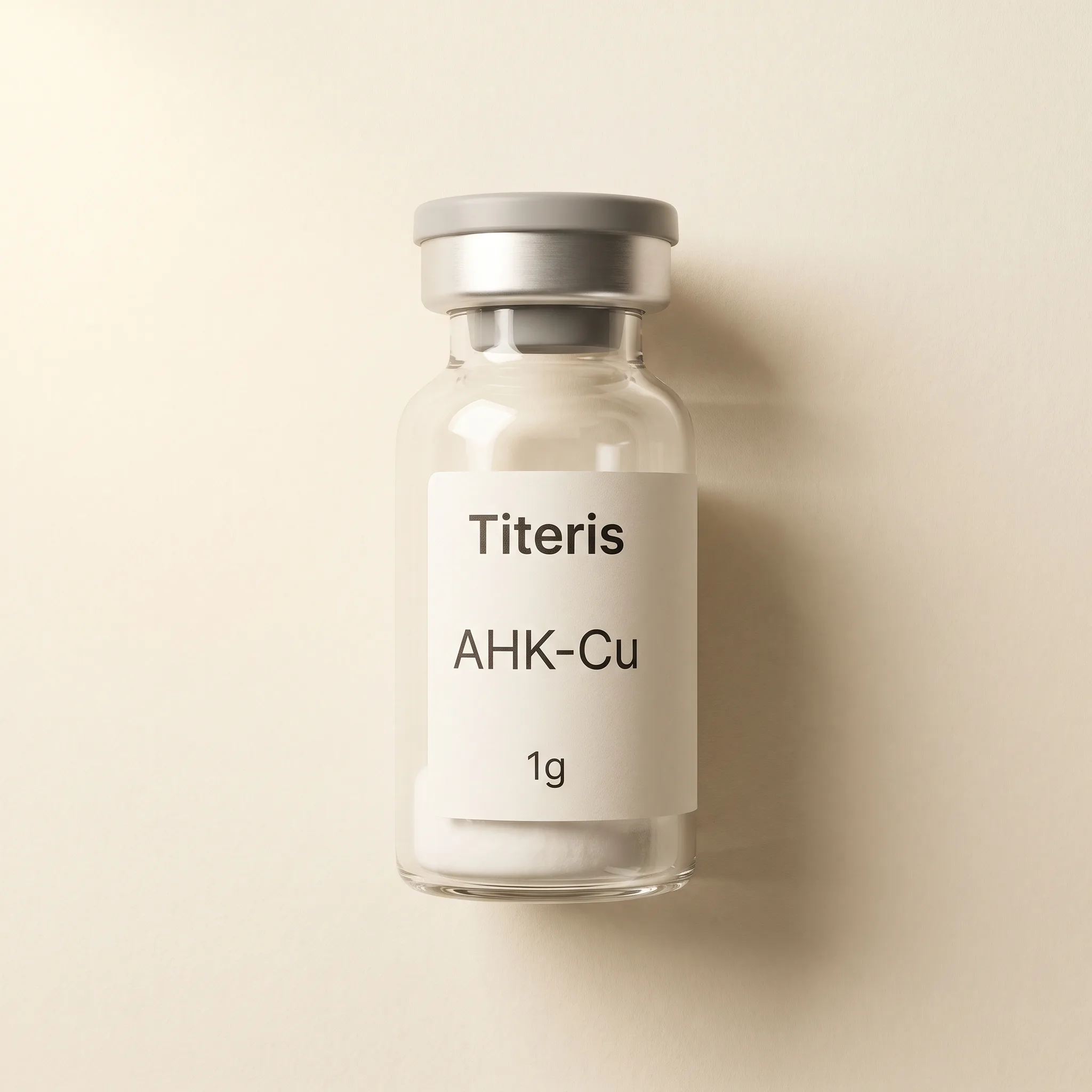
AHK-Cu is supplied in a 1g format, which reflects the typical scale of laboratory and formulation research applications for copper tripeptides. Formulation research and stability studies with copper-complexing peptides often require gram-scale quantities for meaningful experimental work, whereas typical peptide vials in the 5mg to 10mg range are sized for cell biology assays.
For in vitro work, AHK-Cu can be dissolved in sterile water or appropriate buffer systems depending on the assay. Copper peptide complexes are generally water-soluble at the concentrations used in cell biology studies. The researcher should verify pH and solubility conditions for their specific experimental system.
Storage should follow standard practice for amino acid-containing compounds: dry, away from light, and cool. Copper complexes can be sensitive to light and oxidising conditions, so sealed storage under inert atmosphere is preferable where possible. The lyophilised form is more stable than a solution and should be stored under appropriate conditions to preserve integrity over time.
Handling should follow standard laboratory safety protocols for compounds with potential biological activity: gloves, lab coat, and eye protection where relevant. Disposal should follow institutional chemical waste procedures.
Researchers should be clear in publications that AHK-Cu as used in their experiments is a research reference material, not a pharmaceutical-grade substance, and that results obtained in in vitro models are not directly applicable to human biology without further work.
AHK-Cu in our catalogue
AHKSee our documentation policy for what supplier batch documentation covers, and our UK legal status page for the regulatory framing every listing follows.
Frequently asked
What is the difference between AHK-Cu and GHK-Cu?
The structural difference is in the N-terminal amino acid: AHK-Cu has alanine, GHK-Cu has glycine. Both bind copper(II) ions. GHK-Cu has a far broader research literature, having been studied since the 1970s as a naturally occurring peptide in human plasma. AHK-Cu is more recently studied and has a smaller published evidence base. For researchers wanting a copper tripeptide with the most established reference data, GHK-Cu is more thoroughly characterised; for those specifically studying the effect of the N-terminal amino acid on copper tripeptide properties, AHK-Cu versus GHK-Cu comparisons are the relevant experimental design.
Why is AHK-Cu available in a 1g format?
Copper tripeptide research, particularly in formulation and stability studies, often requires gram-scale quantities. Laboratory work on cosmetic actives and copper-complexing compounds frequently uses larger material amounts than typical peptide receptor assays. The 1g format is designed to serve that laboratory and formulation research scale.
Is AHK-Cu the same as copper peptide in hair care products?
Copper peptide is a general marketing term. AHK-Cu is a specific chemical compound. Commercial hair care products using a copper peptide claim use various copper-complexing compounds at proprietary concentrations in formulated products. Those products are not directly comparable to the research reference compound sold here, which is an unformulated material for laboratory use.