Compound Guide
AOD-9604: what the growth hormone fragment is and what the research actually shows
A plain explanation of AOD-9604: how the C-terminal fragment of human growth hormone was identified and synthesised for research, what the clinical development programme for obesity examined, how AOD-9604 differs from full-length growth hormone, and where it stands under UK law. For research use only. Nothing here is instruction for human use.
AOD-9604 sold here is a research reference compound for in vitro and laboratory research purposes only. It is not licensed for human administration, is not a pharmaceutical product, and has not been approved by the MHRA for any clinical or therapeutic use. Clinical data referenced on this page relates to investigational pharmaceutical programmes, not to the research reference material supplied here. If you have questions about weight management or metabolic health, consult a registered healthcare professional.
What AOD-9604 is
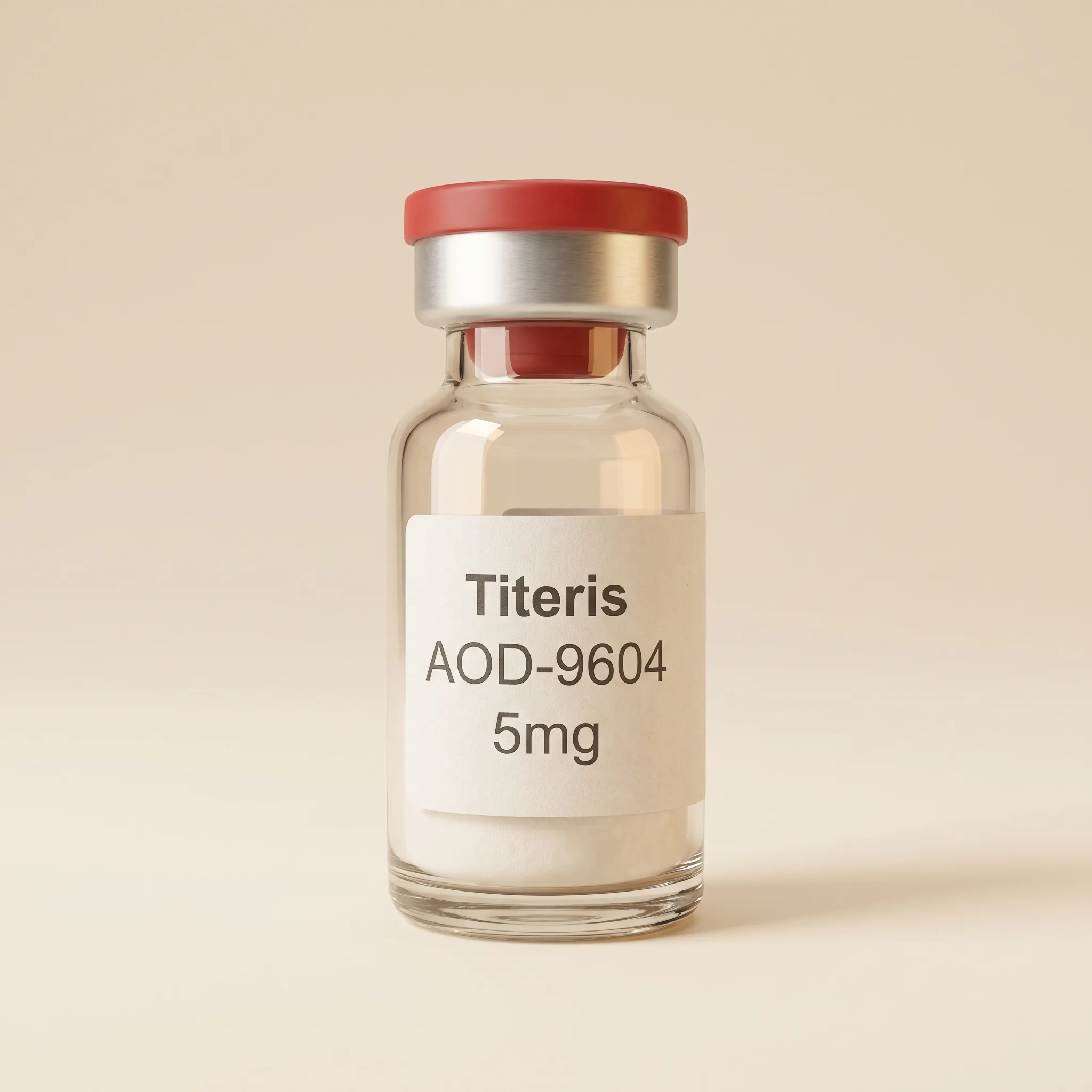
AOD-9604 is a synthetic peptide corresponding to the C-terminal fragment of human growth hormone (hGH) at positions 176 to 191. The name reflects its origin in anti-obesity drug development research: AOD stands for "anti-obesity drug," and 9604 is a research designation.
Human growth hormone is a 191-amino-acid protein with multiple functional domains. The full hGH molecule has both anabolic effects, mediated through IGF-1 stimulation and direct receptor binding at the growth hormone receptor, and lipolytic effects on fat metabolism. The lipolytic activity of hGH has long been understood to be concentrated in the C-terminal region of the protein.
The concept behind AOD-9604 was to isolate the lipolytic domain of hGH while excluding the anabolic and diabetogenic effects associated with the rest of the molecule. The fragment covers amino acid positions 176 to 191 and contains a disulfide bond between Cys182 and Cys189, which is important for the structural stability and biological activity of the fragment. The disulfide bridge differentiates AOD-9604 from a simple linear 16-amino-acid peptide and contributes to its stability relative to native peptides of that length.
AOD-9604 is not a licensed medicine in the UK. It underwent a clinical development programme for obesity that did not result in regulatory approval from the FDA or EMA. In Australia, AOD-9604 has a regulatory status that permits certain non-prescription applications, but this does not affect its status in the UK, where it is not an approved medicine.
As a research reference compound, AOD-9604 is a chemically defined molecule for laboratory studies. It is not growth hormone, does not contain growth hormone activity beyond the fragment's specific chemistry, and should not be conflated with hGH replacement or synthetic GH products.
What the research literature has examined
AOD-9604 has a defined research history that includes both preclinical and clinical work:
Lipolysis research
In preclinical models including adipocyte cell studies and animal experiments, lipolytic effects of AOD-9604 were examined. The research interest was based on the hypothesis that isolating the lipolytic domain of GH could produce a compound with fat-mobilising activity without the insulin-resistance and growth-promoting effects of full-length GH. Adipocyte cell models are the standard in vitro tool for initial characterisation of putative lipolytic compounds.
Clinical obesity programme
AOD-9604 was taken into clinical trials for obesity. The clinical development programme was conducted by Metabolic Pharmaceuticals and examined the compound in human participants. The programme concluded without achieving FDA or EMA approval. Clinical trial data from that programme relate to the investigational pharmaceutical product under controlled conditions, not to the research reference compound supplied here. The relevant regulatory decisions reflect the outcome of that development programme.
Safety profile studies
The clinical programme included safety studies that examined whether AOD-9604 produced IGF-1 elevation or other GH-typical effects at the doses being studied. The data from these studies showed that the fragment did not appear to cause the IGF-1 increases associated with full-length GH administration, consistent with the hypothesis that the fragment isolates the lipolytic domain from the growth-promoting domain.
Cartilage and joint research
More recent preclinical research has examined AOD-9604 in cartilage cell models. This represents a separate line of research from the original obesity programme and is at an early stage. Cell model results from cartilage studies are preclinical and do not constitute evidence of clinical efficacy.
Laboratory context
In a laboratory setting, AOD-9604 is used as a research tool for studying lipolytic signalling, adipocyte biology, and related metabolic questions. As with all research reference compounds, results from in vitro experiments are interpreted within the constraints of the model system and are not directly transferable to human physiology. The chemical identity of the reference material, including the disulfide bridge between Cys182 and Cys189, is important for reproducibility of research results.
Lyophilised AOD-9604 should be stored at -20°C in dry conditions. Reconstitution for laboratory purposes typically uses bacteriostatic water or sterile water. Reconstituted solutions should be kept at 4°C and used promptly, with aliquoting to single-use portions for any extended storage needs.
How AOD-9604 differs from full-length growth hormone
The distinction between AOD-9604 and hGH matters both scientifically and regulatorily. Human growth hormone is a 191-amino-acid protein with complex receptor interactions at the growth hormone receptor (GHR). Full-length hGH activates GHR, stimulates hepatic IGF-1 production, and has both anabolic (muscle and bone growth, protein synthesis) and metabolic (lipolytic, diabetogenic at higher doses) effects.
AOD-9604 is a 16-amino-acid fragment covering only the C-terminal region. It does not bind GHR with the same interaction profile as full-length hGH. The preclinical rationale was that the lipolytic effects of hGH could be isolated at this fragment level. Whether the fragment's activity profile in vitro accurately predicts what a full pharmaceutical product would do in clinical use is precisely the question the clinical development programme attempted to answer, with the outcome of not reaching regulatory approval.
For research purposes, the distinction is methodologically significant. Studies examining the GH-axis, IGF-1 signalling, or full GHR biology would not use AOD-9604 as a proxy for hGH. Studies specifically examining the C-terminal lipolytic domain of GH, or studying adipocyte responses to that specific peptide fragment, would use AOD-9604 as the appropriate research tool.
Full-length synthetic hGH and its analogues are prescription-only medicines in the UK. AOD-9604 is not a licensed medicine, is not classified as a controlled substance, and is supplied here as a research reference compound for laboratory research only.
UK regulatory status
AOD-9604 is not a licensed medicine in the UK. It has no MHRA approval for any indication. Human growth hormone and its pharmaceutical analogues are prescription-only medicines; AOD-9604 is a fragment and is not classified in the same category, but it is also not a licensed product and cannot be marketed or supplied for human use.
As a research reference compound for in vitro laboratory research, AOD-9604 occupies a different regulatory position. Every listing here is for research use only. Nothing on this site is an instruction or invitation to administer AOD-9604 to a human or animal. The distinction between research compound supply and unlicensed medicine supply is one Titeris does not blur.
For a fuller explanation of UK medicines law as it applies to research compounds, see our legal status page.
AOD-9604 in our catalogue
AOD5AOD-9604, 5mg
Supplied as a lyophilised vial for laboratory research use only.
£34.99 Contact us to orderAOD10AOD-9604, 10mg
Supplied as a lyophilised vial for laboratory research use only.
£64.99 Contact us to orderFor laboratory use only. Not for human or veterinary consumption. See our documentation policy and UK legal status page.
Frequently asked
What is the difference between AOD-9604 and full-length growth hormone?
Human growth hormone is a 191-amino-acid protein with multiple functional domains including anabolic, metabolic, and other effects mediated through GHR activation and IGF-1 stimulation. AOD-9604 is the C-terminal fragment at positions 176 to 191 of hGH, containing a disulfide bridge, developed to isolate the putative lipolytic domain from the anabolic effects. Full-length synthetic hGH is a prescription-only medicine. AOD-9604 is not a licensed medicine.
Did AOD-9604 receive any regulatory approval?
No. The clinical development programme for obesity did not result in FDA or EMA approval. In Australia, AOD-9604 has a regulatory status permitting certain applications, but this does not affect its position in the UK, where it is not a licensed medicine. Every listing here is for research use only.
What makes AOD-9604 different from other GH fragments?
AOD-9604 specifically covers positions 176 to 191 of human growth hormone and contains a disulfide bond between Cys182 and Cys189. The disulfide bridge is structurally important for the fragment's stability and its specific activity profile. Other GH fragments covering different regions would have different structural and receptor interaction properties.
How is AOD-9604 supplied?
As a lyophilised (freeze-dried) peptide powder in a sealed glass vial, supplied without solvent. Reconstitution for laboratory use requires bacteriostatic water or sterile water. Available in 5mg and 10mg vials.