Compound Guide
Bacteriostatic Water: what it is and how it is used in the laboratory
A factual explanation of bacteriostatic water (0.9% benzyl alcohol): what it is, why it is used for reconstituting lyophilised laboratory peptides, how it differs from other sterile water formats, and how it sits within UK regulatory frameworks. Supplied for research use only. Nothing here is instruction for human use.
Bacteriostatic water sold here is a research reference material supplied for in vitro and laboratory research purposes only. It is not a licensed pharmaceutical product and has not been approved by the MHRA for any clinical or therapeutic application. Our products are not intended to diagnose, treat, cure, or prevent any disease or condition. Nothing on this page is instruction or invitation to administer this material to a human or animal.
What bacteriostatic water is
Bacteriostatic water (commonly abbreviated BAC water) is sterile water for injection-grade purposes that contains 0.9% benzyl alcohol as an antimicrobial preservative. The benzyl alcohol inhibits the growth of bacteria and fungi, which means a vial can be accessed multiple times without the rapid sterility loss that occurs with unpreserved sterile water after the first puncture.
In the laboratory context, bacteriostatic water is used as a solvent for reconstituting lyophilised peptides and other laboratory compounds. It is the standard reconstitution solution for peptides that are stable at acidic to neutral pH and where the benzyl alcohol preservative does not destabilise the compound being dissolved. This covers the majority of commonly researched peptides, including those in the GLP-1, tissue repair, and growth hormone axis categories.
Bacteriostatic water is not a medicine in the therapeutic sense. It is a laboratory auxiliary substance used for reconstitution and storage of lyophilised research compounds. Its utility is entirely procedural: it provides a sterile, multi-access aqueous environment that preserves the integrity of the reconstituted peptide between laboratory uses.
The 0.9% benzyl alcohol concentration is well-established in laboratory practice. Concentrations significantly above this threshold can cause protein denaturation or interfere with experimental results; concentrations below it provide insufficient antimicrobial preservation for multi-draw use. The 0.9% standard has been the accepted benchmark in reconstitution protocols for decades.
Laboratory use: reconstituting lyophilised peptides
Correct reconstitution is essential for the integrity of laboratory samples. The choice of reconstitution solvent depends on the specific peptide's chemical properties, particularly its solubility and stability profile at various pH values. Bacteriostatic water sits at a near-neutral pH, which makes it appropriate for a broad range of peptides.
- Reconstituting lyophilised peptides. Lyophilised (freeze-dried) peptides must be dissolved in a suitable solvent before laboratory use. Bacteriostatic water is appropriate for most peptides at neutral to mildly acidic pH, including BPC-157, TB-500, semaglutide, tirzepatide, and a wide range of other research compounds in our catalogue.
- Multi-draw storage. The benzyl alcohol preservative allows multiple draws from a reconstituted vial without rapid sterility loss, which is practical for laboratory series experiments where small volumes are required at different time points.
- When acetic acid is the better choice. Some peptides, particularly certain growth hormone releasing peptides and growth factors such as IGF-1 LR3, have improved solubility at mildly acidic pH. For these, 0.6% acetic acid is the more appropriate reconstitution solvent rather than bacteriostatic water. The choice is a research decision based on the compound's known properties.
- Post-reconstitution storage. Reconstituted peptide solutions should generally be stored at 2 to 8 degrees Celsius and used within the stability window applicable to the specific compound. Specific stability data for each peptide is the responsibility of the researcher and depends on the compound's amino acid sequence and any chemical modifications it carries.
Compatibility with common research peptides
Bacteriostatic water is compatible with the majority of peptides used in laboratory research. Peptides with cysteine residues capable of forming disulfide bonds may require additional considerations to prevent oxidation during reconstitution. Peptides containing methionine can be susceptible to oxidation in the presence of dissolved oxygen, so working quickly and storing reconstituted solutions promptly is advisable. Peptides with asparagine or glutamine may undergo deamidation over time in aqueous solution, which is a general stability consideration regardless of the reconstitution solvent.
For peptides where long-term stability in aqueous solution is a concern, preparing aliquots from the reconstituted stock and storing them at minus 20 degrees Celsius avoids repeated freeze-thaw cycles of the main vial. Each aliquot is thawed once and discarded after use, which preserves the remaining aliquots from degradation.
What bacteriostatic water does not do
Bacteriostatic water is not a pharmaceutical product. It does not meet GMP standards for injectable pharmaceutical preparations. It is not sterile water for injection as defined by pharmacopoeial standards for clinical use. It is supplied as a laboratory auxiliary substance, and its use is confined to the laboratory research context. It is not suitable for human administration and should not be treated as equivalent to clinical-grade sterile water for injection.
UK regulatory status
Bacteriostatic water supplied as a laboratory auxiliary substance for in vitro research purposes falls under a different regulatory category from pharmaceutical products. It is not a licensed medicine, is not subject to prescription requirements, and is not regulated by the MHRA as a medicinal product when supplied strictly for laboratory research use.
The distinction between a laboratory research material and a pharmaceutical product is one the MHRA takes seriously. Titeris supplies bacteriostatic water only as a research material, and nothing on this site markets or presents it for human use. Every purchaser is required to confirm they are acquiring it for legitimate laboratory research purposes, and use is restricted to those aged 18 and over.
This page does not constitute legal advice. For specific legal questions about the regulatory classification of laboratory substances in the UK, consultation with a solicitor experienced in medicines regulation is recommended. Our UK legal status page provides a general overview of the regulatory framework relevant to research compounds.
Storage, handling, and stability
Correct storage of laboratory research materials is important for maintaining their chemical integrity over time. The lyophilisation process removes water from the compound and leaves a dry, stable matrix that remains stable for considerably longer than an aqueous solution when stored under appropriate conditions. The general principle is: dry, protected from light, and at low temperature.
For bacteriostatic water as supplied, storage at minus 20 degrees Celsius in the dry state is appropriate. The vial should be allowed to reach room temperature before opening to prevent condensation forming inside. Opening in a humid atmosphere should be avoided, as moisture can initiate rehydration of the lyophilised matrix prematurely.
After reconstitution, the solution should be stored at 4 degrees Celsius and used promptly. Repeated freeze-thaw cycles of a reconstituted solution degrade quality through mechanical stress on the dissolved compound's structure. If multiple uses over time are anticipated, preparing smaller aliquots from the reconstituted stock and freezing them individually is the preferred approach.
In the laboratory, standard precautions for compounds with potential biological activity should be observed. Protective gloves, a lab coat, and eye protection where appropriate are standard practice. As a research reference material, bacteriostatic water does not have a pharmaceutical-grade safety data sheet. Researchers operate according to their institutional safety guidelines and their own professional judgement regarding the specific experimental context.
Disposal of any unused bacteriostatic water should follow institutional guidelines for laboratory chemical waste, in accordance with the applicable UK environmental regulations. Specific disposal instructions should be confirmed with the institution's chemical safety officer.
Research context: how bacteriostatic water fits into laboratory work
Bacteriostatic water is a support material for research, not a research compound in its own right. It does not itself have pharmacological activity in the research sense. Its role is entirely to provide the aqueous medium in which the active research peptide is dissolved and kept stable for experimental use.
In laboratory settings, controlled in vitro experiments are conducted where compounds are applied in defined concentrations to cell cultures or other model systems. Results from such laboratory experiments are not directly transferable to the human organism. The bacteriostatic water serves as the vehicle that makes this experimental process possible in a reproducible way.
For research laboratories, the chemical identity and consistency of all materials used, including the reconstitution solvent, matters for reproducibility. A consistent reconstitution protocol using a defined solvent is part of the experimental rigour that allows results to be interpreted and, where appropriate, replicated. Using the correct solvent for each peptide is as much a part of sound methodology as any other aspect of experimental design.
Laboratory results are typically published in peer-reviewed literature, where they can be critically assessed by other researchers. The reproducibility of laboratory experiments with peptide compounds depends on factors including peptide quality, storage conditions, cell model authenticity, and protocol details, of which the reconstitution solvent is one component. Titeris supplies research materials to support this kind of rigorous laboratory work.
Where documentation for available batches is provided by our supplier, it is stated directly on the listing. Documentation is associated with specific batches, not with the product line as a whole. See our documentation policy for further detail on what supplier documentation covers.
Bacteriostatic water in our catalogue
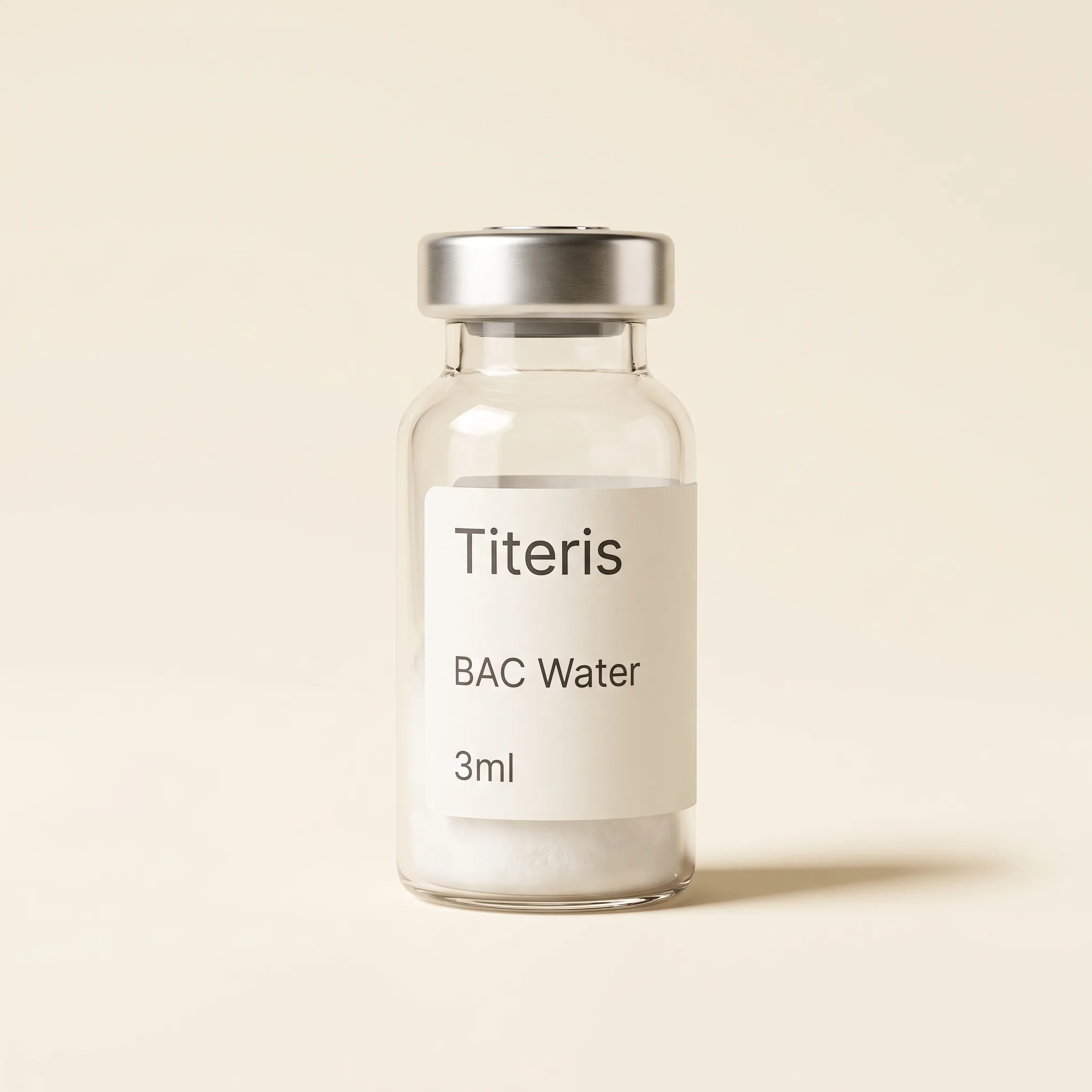
BA3Bacteriostatic Water, 3ml
Supplied as a sealed vial for laboratory reconstitution use.
£12.99 Contact us to orderFor laboratory use only. Not for human or veterinary consumption. See our UK legal status page and our documentation policy.
Frequently asked
What is the difference between bacteriostatic water and sterile water?
Sterile water without a preservative is intended for single use. Once the vial is punctured, microbial contamination can begin immediately, and the solution should be discarded after one draw. Bacteriostatic water contains 0.9% benzyl alcohol, which inhibits microbial growth after the initial puncture and allows multiple draws from the same vial. For laboratory work involving serial experiments over days or weeks, bacteriostatic water is the practical choice.
Which peptides are reconstituted with bacteriostatic water?
Most peptides at neutral pH, including BPC-157, TB-500, semaglutide, tirzepatide, and many others. Peptides with better solubility at acidic pH, such as IGF-1 LR3 and certain GHRP-class compounds, are better reconstituted with 0.6% acetic acid, which we also stock. The compound-specific product pages indicate the appropriate solvent for each.
How much bacteriostatic water is needed for reconstitution?
The volume depends on the target peptide concentration for the specific experiment and is part of the research planning process. Typical laboratory volumes for reconstituting a lyophilised peptide vial range from 1ml to 3ml, though this varies widely depending on the peptide quantity and the concentration required by the experimental protocol. The 3ml vial size we stock is practical for most standard reconstitution needs.
Is bacteriostatic water the same as saline?
No. Bacteriostatic water contains 0.9% benzyl alcohol in water. Normal saline (0.9% sodium chloride in water) is a different solution used for different purposes. Bacteriostatic saline also exists, which contains both sodium chloride and benzyl alcohol, but bacteriostatic water in the context of peptide reconstitution refers specifically to the benzyl alcohol in water formulation.
Can bacteriostatic water be used for all peptides?
Not for all peptides. Some peptides have poor solubility or reduced stability at neutral pH and require a mildly acidic reconstitution solvent such as 0.6% acetic acid. Additionally, some peptides with specific structural characteristics may be sensitive to benzyl alcohol. Researchers should consult the primary literature or technical data for the specific compound to confirm the appropriate reconstitution conditions before starting an experiment.