Compound Guide
Cagrilintide: what the GLP-1/amylin dual agonist is, and what the research shows
A plain explanation of cagrilintide: how its combined GLP-1 and amylin receptor mechanism works, what the published research literature has examined, how a research reference compound differs from a licensed medicine, and where it stands under UK law. Research use only. Nothing here is instruction for human use.
Cagrilintide sold here is a research reference compound for in vitro and laboratory research purposes only. It is a GLP-1/amylin dual agonist supplied strictly as a research reference compound. It is not licensed for human administration, is not a pharmaceutical product, and has not been approved by the MHRA for any clinical or therapeutic use. The clinical applications discussed on this page are from published research literature and are referenced for scientific context only. They are not an endorsement of human use of this compound. If you have questions about metabolic health or weight management, consult a registered healthcare professional.
What cagrilintide is
Cagrilintide is a long-acting synthetic analogue of amylin, a peptide hormone secreted by pancreatic beta-cells alongside insulin. Native amylin plays a role in slowing gastric emptying, suppressing glucagon secretion, and signalling satiety to the central nervous system. In its natural form, amylin has a very short half-life and a tendency to aggregate, which has historically limited its direct use as a research or therapeutic tool.
Cagrilintide overcomes these structural limitations through a modified amino acid sequence and an attached fatty acid chain that enables albumin binding, extending the half-life to several days. The research interest in cagrilintide sits at the intersection of two complementary axes of metabolic regulation: GLP-1 receptor pathways and amylin receptor complexes. This dual agonism is the primary context in which cagrilintide appears in the current scientific literature.
Amylin receptors are complexes formed from the calcitonin receptor and receptor activity-modifying proteins (RAMPs). Their distribution in hypothalamic regions makes them an active area of research for satiety signalling and energy homeostasis. Cagrilintide binds to these complexes with higher affinity and longer duration than native amylin, making it a useful tool for studying amylin receptor pharmacology in laboratory settings.
As a research reference material, cagrilintide is the lyophilised peptide intended for laboratory use. It is not a medicine, does not meet GMP standards for pharmaceutical manufacture, and must not be used for human administration. The molecule itself is manufactured for in vitro investigation of receptor biology and metabolic signalling pathways.
What the research has examined
The published literature on cagrilintide organises itself into two broad areas: the pharmacological characterisation of the amylin analogue itself, and the potential additive effect of combining it with GLP-1 receptor agonists.
Amylin receptor pharmacology
Amylin receptors are formed from the calcitonin receptor combined with one of several receptor activity-modifying proteins, producing receptor subtypes with different tissue distributions and binding profiles. Cagrilintide's higher binding affinity and extended duration at these receptor complexes relative to native amylin make it a research tool for studying amylin receptor biology. Receptor expression in hypothalamic areas is a focus for satiety signalling research, given amylin's known role in appetite regulation at the brainstem and hypothalamic level.
Preclinical work in animal models has examined cagrilintide's effects on gastric emptying rate and central satiety centres in the brainstem. These observations from animal experiments are the starting point for the clinical research programme, but preclinical results in animals are not directly applicable to human physiology and certainly not to a research reference compound used in laboratory conditions rather than in living subjects.
Combination research: CagriSema
The most prominent context in which cagrilintide appears in recent clinical literature is as one component of a combination with semaglutide, referred to in trials as CagriSema. The rationale is that GLP-1 receptor agonism and amylin receptor agonism work through different mechanisms that may be complementary in their combined effects on metabolic parameters. Clinical studies examining this combination use GMP-produced pharmaceutical-grade investigational materials under controlled conditions. Those trial data refer to the pharmaceutical combination, not to research reference compounds sourced from the laboratory supply chain.
The distinction matters because the quality standards, regulatory oversight, dosing precision, and supply chain for a clinical investigational medicinal product are entirely separate from those of a research reference compound. Citing trial results to characterise the molecule's mechanism is scientifically accurate; treating those results as a protocol guide for a research compound is not.
Preclinical metabolic models
In various preclinical models of metabolic function, researchers have examined effects on body weight, glucose homeostasis, and lipid parameters. This data comes from animal experiments and in vitro cell studies. None of it is directly transferable to a research reference compound used in a laboratory setting, and the regulatory frameworks governing clinical trials and research compound use are entirely distinct.
Gastric emptying and central satiety
One of the clearest mechanistic features of amylin and its analogues is an effect on gastric emptying rate. Slowing gastric emptying prolongs the sensation of fullness after eating and blunts postprandial glucose peaks. Central satiety signalling via the brainstem and hypothalamus is a separate but related line of research. Laboratory experiments examining these pathways use receptor-expressing cell lines, primary cell cultures, and animal models to characterise signalling cascades downstream of amylin receptor activation.
Mechanism: dual receptor targeting in metabolic research
What makes cagrilintide of particular interest as a research tool is the combination of two receptor-level mechanisms acting on different physiological pathways. GLP-1 receptors, which are the target of compounds like semaglutide, are expressed in the pancreas, brain, gut, heart, and kidneys. Amylin receptors, the primary target of cagrilintide, are expressed in the brainstem, hypothalamus, and peripheral tissues including the pancreas and kidneys.
In research settings, having two compounds that target complementary receptor systems allows investigators to examine additive or synergistic effects in cell cultures and animal models. The mechanistic question of whether simultaneous activation of both receptor systems produces outcomes that differ from single-receptor activation is a legitimate area of basic pharmacological research.
The fatty acid chain modification that extends cagrilintide's half-life through albumin binding also affects how the compound behaves in solution and in cell culture experiments. Researchers using cagrilintide in laboratory settings need to account for this when designing binding affinity assays, cell signalling experiments, or receptor characterisation studies. The albumin binding that extends in vivo half-life in animal models is relevant to how the compound partitions in protein-rich laboratory media.
Calcitonin receptor and RAMP interactions are an active area of structural biology. Understanding how cagrilintide binds to different RAMP-calcitonin receptor combinations provides mechanistic insight that informs broader amylin biology research. This is a context where a well-characterised research reference compound with known chemical identity is useful for reproducible experimental work.
UK regulatory status
Cagrilintide is not currently a licensed medicine in the UK. It has no MHRA marketing authorisation for any clinical indication. The compound is in clinical development by Novo Nordisk, primarily in the CagriSema combination programme, but those programmes are conducted with GMP-produced investigational medicinal products under a clinical trial framework, not with commercially available research reference compounds.
A research reference compound containing cagrilintide, synthesised for in vitro laboratory research and supplied strictly under a research-use-only framework, occupies a separate regulatory category. It is not a licensed medicine, is not subject to prescribing requirements, and cannot be marketed for human use. The MHRA takes enforcement action against businesses that blur this line. Titeris does not blur this line. Every listing on this site is for research use only, and nothing on this site constitutes instruction or invitation to administer cagrilintide to a human or animal.
Researchers working with cagrilintide as a research reference compound should be aware that the regulatory framework governing research compound use differs from the framework governing clinical trials. The appropriate regulatory guidance depends on the specific research setting, institutional framework, and intended use. Where institutional ethical oversight applies to research involving peptide reference materials, that framework should be followed.
Laboratory context: how cagrilintide is used in basic research
In a laboratory setting, cagrilintide is used as a research reference compound for controlled in vitro experiments. The laboratory context is fundamentally different from clinical or therapeutic applications. Experiments involve applying the compound at defined concentrations to cell cultures or other model systems. Results from such laboratory experiments are not directly applicable to the human organism and should not be interpreted as clinical data.
Common laboratory applications include binding affinity studies using transiently transfected cell lines expressing amylin receptor complexes, cell culture experiments examining downstream signalling pathways such as cAMP production and MAPK activation, and biochemical characterisation experiments. The selection of an appropriate model system and protocol is the responsibility of the researcher and their institution.
The chemical identity of the research reference material is important for reproducibility. Cagrilintide as a lyophilised research compound has a defined chemical structure. Researchers working with it should follow standard peptide handling protocols: reconstitution in appropriate solvent, storage at low temperature in the dry state before reconstitution, and avoidance of repeated freeze-thaw cycles after reconstitution. Specific storage conditions for a particular application depend on the laboratory's requirements and the researcher's judgement.
Research reference materials like cagrilintide are not clinical investigational products and have not undergone regulatory review by the EMA or MHRA for therapeutic use. Clinical trials use GMP-produced investigational products meeting strict quality standards. The difference between a research reference material and a GMP investigational product is important for researchers interpreting results and placing them in the appropriate scientific context.
Titeris supplies cagrilintide as a lyophilised powder in sealed glass vials. Supplier batch documentation, where available, covers the specific batch supplied. Our documentation policy is explained on the documentation page. Questions about research compound sourcing and documentation should be directed to our contact page.
Cagrilintide in our catalogue
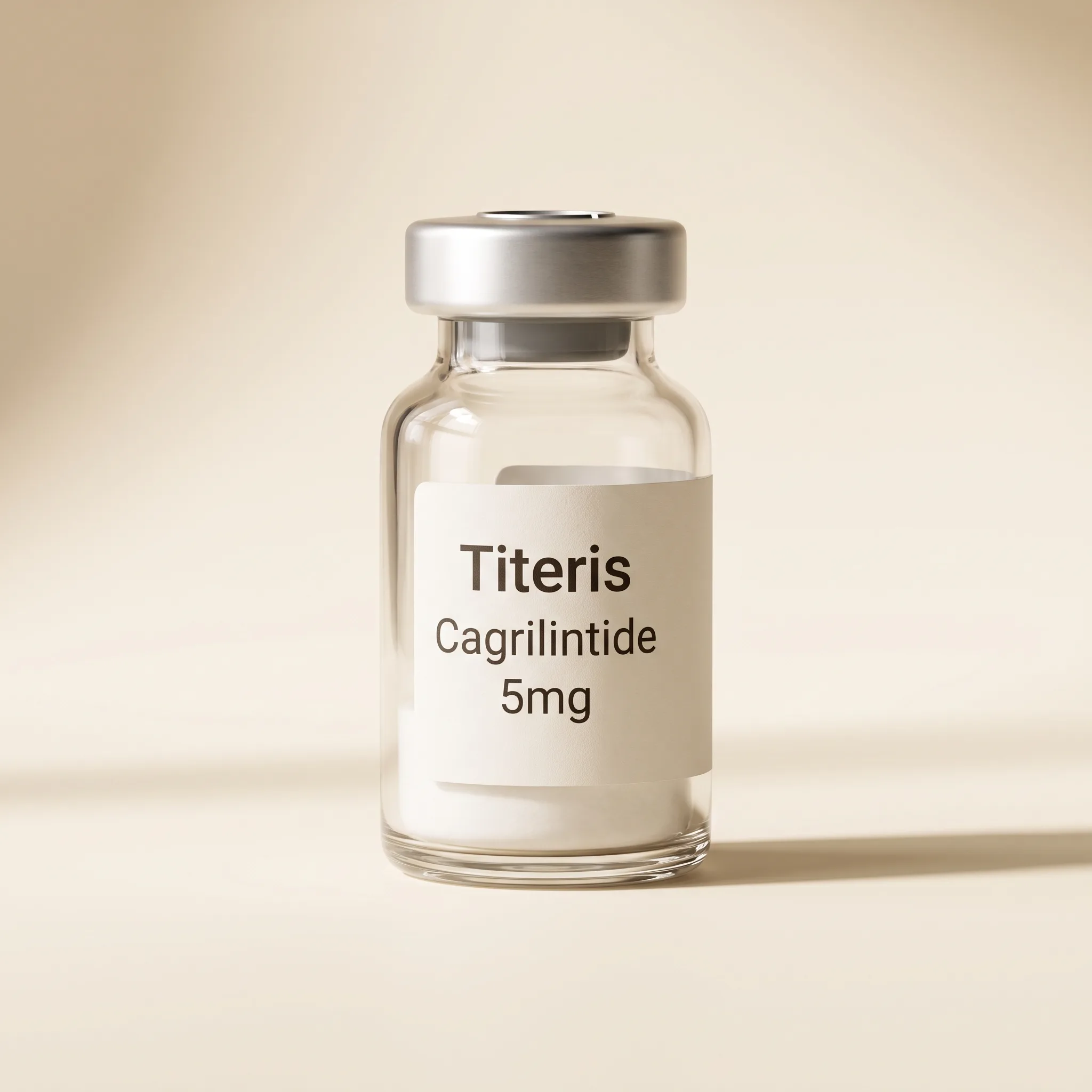 CGL5
CGL5Cagrilintide, 5mg
Supplied as a lyophilised vial for laboratory research use.
£59.99 Contact us to orderCGL10Cagrilintide, 10mg
Supplied as a lyophilised vial for laboratory research use.
£89.99 Contact us to orderSee our documentation policy for what supplier batch documentation covers, and our UK legal status page for the regulatory framing every listing follows.
Frequently asked
What is the difference between cagrilintide and semaglutide?
Semaglutide is a GLP-1 receptor agonist that targets GLP-1 receptors in the pancreas, brain, and gut. Cagrilintide is a long-acting amylin analogue that targets amylin receptor complexes formed from the calcitonin receptor and receptor activity-modifying proteins. Both act on different receptor systems involved in metabolic regulation, which is why their combination is being studied under the CagriSema programme. As research reference compounds, they are distinct molecules with different receptor targets and different applications in laboratory experiments.
What is CagriSema?
CagriSema is the clinical term for a combination of cagrilintide and semaglutide being studied in clinical trials by Novo Nordisk. Those trials use GMP-produced pharmaceutical-grade investigational materials under controlled clinical conditions. The trial data refers to the pharmaceutical combination, not to research reference compounds. The distinction between a clinical investigational product and a laboratory research reference compound is regulatory, not merely semantic.
Is cagrilintide legal to buy in the UK?
Cagrilintide is not a licensed medicine in the UK and does not require a prescription in the same way that licensed pharmaceutical products do. As a research reference compound for in vitro laboratory use, it occupies a different regulatory category and cannot be marketed, sold, or supplied for human use. Every listing on this site is for research use only. Our UK legal status page provides a fuller explanation of the regulatory framework.
How is cagrilintide supplied?
As a lyophilised (freeze-dried) white powder in a sealed glass vial. Supplied without solvent; reconstitution for laboratory use requires bacteriostatic water or a similar diluent appropriate to the specific research application. Available in 5mg and 10mg vials.
Why does cagrilintide have a long half-life compared to native amylin?
Native amylin has a very short circulating half-life because it is rapidly cleared and prone to aggregation. Cagrilintide is modified with a fatty acid chain that enables reversible albumin binding. This extends its effective half-life from minutes to days in animal models, making it more practical as both a research tool and as the basis of pharmaceutical development. In laboratory experiments, this modification affects how the compound behaves in protein-rich culture media and needs to be accounted for in experimental design.
Storage and handling notes
Lyophilised research peptides should be stored dry, away from light, and at low temperature. For cagrilintide as a research reference material, storage at -20°C in the dry state is appropriate for maintaining chemical integrity over time. The vial should be allowed to reach room temperature before opening to prevent condensation from entering. Opening in humid conditions should be avoided.
After reconstitution in a suitable solvent such as bacteriostatic water, the solution should be stored at 4°C and used promptly. Repeated freeze-thaw cycles of the reconstituted solution degrade quality through mechanical stress on the peptide structure. Where multiple aliquots are needed, freezing individual aliquots after reconstitution is preferable to repeated freeze-thaw of a single vial.
Standard laboratory protective measures apply when handling research compounds with potential biological activity: gloves, lab coat, and appropriate eye protection. Disposal of surplus material should follow your institution's chemical waste guidelines under the relevant UK waste regulations.