Compound Guide
CJC-1295 No DAC: what the short-acting GHRH analogue is and what the research actually shows
A plain, factual explanation of CJC-1295 without Drug Affinity Complex: how it differs from the DAC variant, what GHRH mechanisms have been studied in the research literature, and where the compound sits under UK law. GHRH analogue without drug affinity complex for short half-life research. Research use only. Nothing on this page is instruction for human use.
CJC-1295 No DAC sold here is a research reference compound for in vitro and laboratory research purposes only. It is a GHRH analogue without drug affinity complex, supplied strictly for research use only with a short half-life profile suitable for pulsatile GH axis research. It is not licensed for human administration, is not a pharmaceutical product, and has not been approved by the MHRA for any clinical or therapeutic use. GHRH analogues appear on the WADA prohibited list. If you have health concerns, consult a registered healthcare professional.
What CJC-1295 No DAC is
CJC-1295 is a modified version of Growth Hormone-Releasing Hormone (GHRH), the hypothalamic peptide that stimulates growth hormone (GH) secretion from the anterior pituitary. Native GHRH is rapidly inactivated by dipeptidyl peptidase IV (DPP-4), limiting its half-life to a few minutes in circulation.
CJC-1295 extends this half-life through chemical modification: substitution of the second position alanine with D-alanine provides DPP-4 resistance, along with further sequence modifications. The No DAC variant lacks an attached maleimide group for albumin coupling. Its half-life in animal models is approximately 30 minutes to a few hours, depending on conditions. This makes the No DAC variant more relevant to research questions where a pulsatile growth hormone signal is being studied, mimicking the natural episodic pattern of GH secretion.
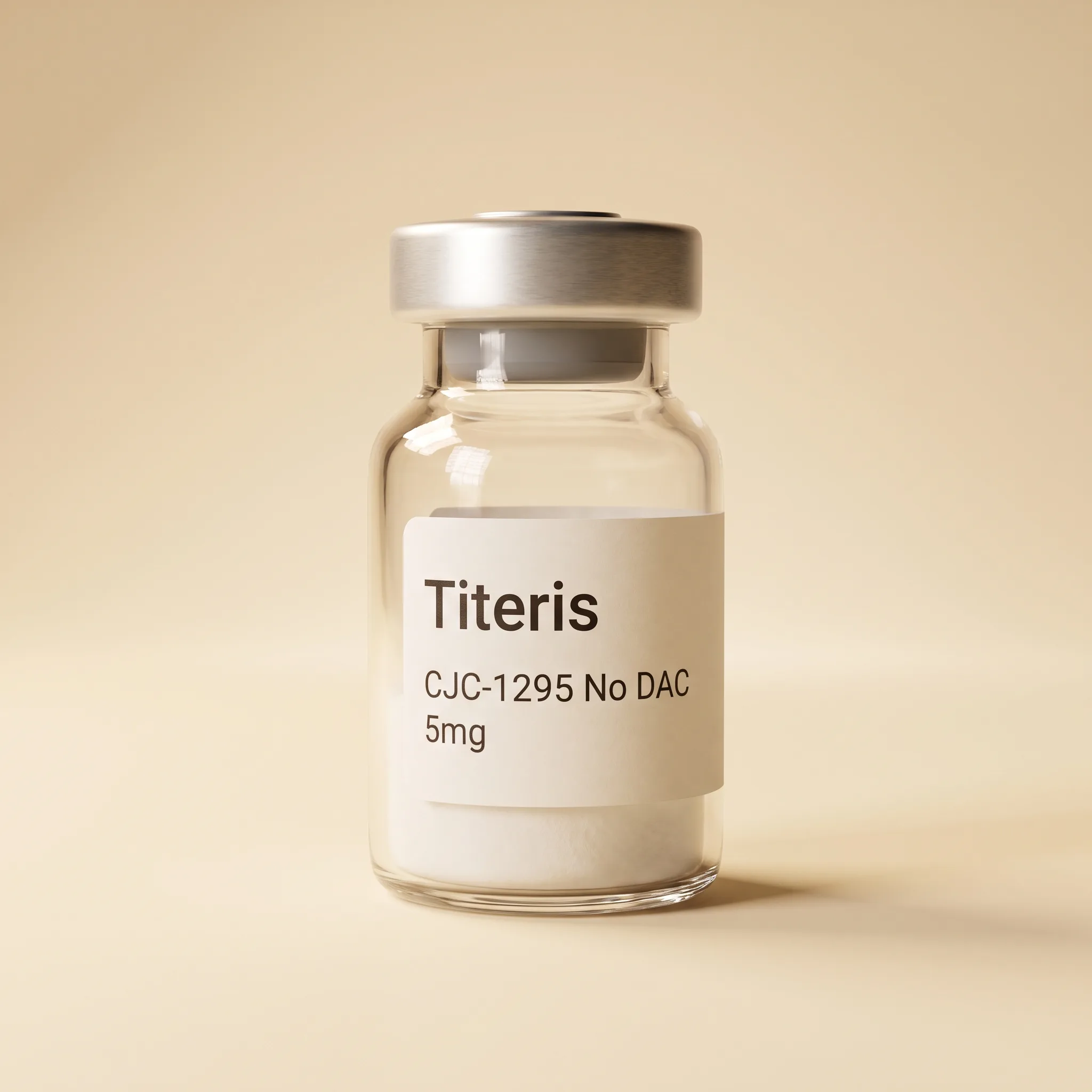
CJC-1295 No DAC is also referred to in the research literature as Mod-GRF(1-29), reflecting its status as a modified GHRH sequence spanning positions 1 to 29. As a research reference material, it is the lyophilised peptide for laboratory use. It is not a medicine and must not be used for human administration.
Mechanism: GHRH receptor pharmacology and the GH axis
GHRH acts on GHRH receptors (GHRHRs) located on somatotroph cells in the anterior pituitary. Receptor activation stimulates GH synthesis and secretion. GH is then released into circulation, where it acts directly on target tissues and also stimulates hepatic production of insulin-like growth factor 1 (IGF-1), which mediates many of GH's anabolic effects.
The natural pattern of GH secretion is pulsatile: large pulses of GH are released approximately every 2 to 3 hours, with near-baseline levels between pulses. This pulsatile pattern is physiologically important: continuous GH stimulation and pulsatile stimulation produce different effects on gene expression in target tissues such as the liver and muscle. The No DAC variant of CJC-1295, with its shorter half-life, produces GH pulses in animal models that more closely mimic this natural pulsatile pattern compared to the long-acting DAC variant.
DPP-4 resistance through D-alanine substitution at position 2 is a pharmacological modification that has been extensively studied in the context of GHRH analogues. The enzyme DPP-4 cleaves the first two amino acids from GHRH, rapidly inactivating native GHRH. The D-alanine modification prevents this cleavage, extending the window during which the peptide can bind and activate its receptor.
The GH axis involves multiple regulatory inputs beyond GHRH: somatostatin (which inhibits GH secretion) and ghrelin/growth hormone releasing peptides (GHRPs, which synergise with GHRH to amplify GH pulses) are the primary additional components. Researchers studying GHRH analogues in laboratory settings often examine them in the context of this broader neuroendocrine regulatory network.
What the research has examined
GHRH analogues are an active research area because the GH axis is involved in numerous physiological processes including body composition, bone metabolism, lipid metabolism, and immune function.
GH secretion patterns
The No DAC variant produces shorter, more pulsatile GH releases in animal models compared to the DAC variant. This is relevant for research questions where natural pulsatile GH signalling needs to be approximated rather than replaced with sustained, non-pulsatile stimulation. Researchers studying the differential effects of pulsatile versus sustained GH stimulation on target tissues use the two CJC-1295 variants as complementary experimental tools.
Combination with GHRP compounds
In basic research practice, CJC-1295 No DAC is frequently studied in combination with growth hormone releasing peptides (GHRPs) such as Ipamorelin, because GHRH and GHRPs act synergistically on GH secretion through different receptor mechanisms. GHRH acts via the GHRH receptor to increase GH synthesis and the amplitude of GH pulses; GHRPs act via the GHS-R1a receptor to amplify pulsatile release and suppress somatostatin. Combining both types of compound in a laboratory experiment allows researchers to study the full synergistic mechanism of GH axis stimulation.
Neuroendocrine basic research
The GH axis, involving GHRH, somatostatin, and their respective receptors, is a complex regulatory system. GHRH analogues with DPP-4 resistance and defined pharmacokinetic profiles are useful tools for researchers studying how the hypothalamic-pituitary axis integrates multiple signalling inputs to produce pulsatile GH secretion. This type of neuroendocrine basic research uses cell culture models, primary pituitary cell preparations, and animal models.
Body composition and metabolic models
GH has well-characterised effects on lipolysis, protein synthesis, and bone metabolism. Research models using GHRH stimulation examine these downstream effects in animal experiments. These are preclinical data that characterise the biology of the GH axis in laboratory models, not clinical data about human pharmacological effects.
UK regulatory status
CJC-1295 is not a licensed medicine in the UK. As a GHRH analogue, it appears on the WADA prohibited list (S2 Peptide Hormones, Growth Factors and Related Substances), which has implications for competitive athletes. This is relevant sporting context, not a general legal restriction on research compound procurement.
As a research reference compound for in vitro laboratory use, CJC-1295 No DAC occupies a different regulatory category from a pharmaceutical product. It is not a licensed medicine, is not subject to prescribing requirements, and cannot be marketed or supplied for human use. Titeris operates strictly within the research-use-only framework. Every listing on this site is for research use only.
Our UK legal status page provides an overview of the applicable regulatory framework. Specific legal questions, including about WADA compliance for athletes, should be addressed with the relevant sporting authority or a solicitor specialising in the applicable regulations.
Laboratory context: how CJC-1295 No DAC is used in basic research
In the laboratory, CJC-1295 No DAC is used as a research reference compound for controlled in vitro and ex vivo experiments. Common applications include receptor binding affinity assays at the GHRH receptor using pituitary-derived cell lines or transfected cells expressing GHRH receptors, GH secretion assays using primary pituitary cell preparations, synergy experiments combining GHRH analogues with GHRP compounds to examine additive receptor mechanisms, and comparative pharmacokinetic studies contrasting the No DAC and DAC variants.
A methodological note for researchers comparing the two CJC-1295 variants: the key experimental variable is the duration of GHRH receptor occupancy. The No DAC variant's shorter effective duration makes it appropriate for experiments examining acute, pulsatile GH stimulation; the DAC variant's albumin-binding extension makes it appropriate for sustained, prolonged receptor activation studies. Choosing between the two depends on which physiological GH secretion pattern the research question is addressing.
Proper storage of the lyophilised reference material maintains chemical integrity. Storage at -20°C in the dry state is appropriate. After reconstitution, the compound should be stored at 4°C and used promptly. Repeated freeze-thaw cycles of the reconstituted compound degrade quality and should be avoided.
Standard laboratory safety protocols apply: gloves, lab coat, and appropriate eye protection. Disposal follows institutional chemical waste guidelines.
CJC-1295 No DAC in our catalogue
CND5CJC-1295 No DAC, 5mg
Supplied as a lyophilised vial for laboratory research use only.
£29.99 Contact us to orderCND10CJC-1295 No DAC, 10mg
Supplied as a lyophilised vial for laboratory research use only.
£59.99 Contact us to orderSee our documentation policy for what supplier batch documentation covers, and our UK legal status page for the regulatory framing every listing follows.
Frequently asked
What is the difference between CJC-1295 with and without DAC?
The DAC (Drug Affinity Complex) variant has an attached maleimide group that covalently binds to albumin in circulation, extending the effective half-life to several days. The No DAC variant lacks this group and has an active duration of approximately 30 minutes to a few hours in animal models. For research examining pulsatile GH signalling patterns, the No DAC variant is the more appropriate tool; for sustained, prolonged GH axis stimulation research, the DAC variant is more suitable.
Is CJC-1295 No DAC the same as Mod-GRF(1-29)?
Yes, both names are used for the same modified GHRH analogue. Mod-GRF(1-29) refers to the modified N-terminal sequence of natural GHRH, highlighting its structural basis as a modified form of the first 29 amino acids of GHRH. CJC-1295 without DAC is the commercial designation for the same compound.
Why is CJC-1295 No DAC often studied with Ipamorelin?
GHRH and growth hormone releasing peptides (GHRPs) like Ipamorelin act on different receptors that synergise in stimulating GH secretion. GHRH acts via the GHRH receptor to stimulate GH synthesis and increase the amplitude of GH pulses; Ipamorelin acts via the GHS-R1a ghrelin receptor to amplify GH release and suppress somatostatin. In laboratory research models, combining both types of compound allows study of the full synergistic mechanism, with each compound representing one arm of the dual-receptor stimulation that characterises natural GH axis regulation.
Is CJC-1295 No DAC legal to buy in the UK?
As a research reference compound for in vitro laboratory use, CJC-1295 No DAC occupies a different regulatory category from a licensed medicine. It cannot be marketed, sold, or supplied for human use. GHRH analogues appear on the WADA prohibited list, which is relevant for athletes subject to sports anti-doping rules. Our UK legal status page provides more detail on the applicable regulatory framework.