Compound Guide
CJC-1295 with DAC: what the long-acting GHRH analogue is and what the research actually shows
A plain, factual explanation of CJC-1295 with Drug Affinity Complex: how the albumin-binding strategy extends half-life, what this means for GH axis research models, and where the compound sits under UK law. GHRH analogue with drug affinity complex for extended half-life. Research use only. Nothing on this page is instruction for human use.
CJC-1295 with DAC sold here is a research reference compound for in vitro and laboratory research purposes only. It is a GHRH analogue with drug affinity complex for extended half-life, supplied strictly for research use only. It is not licensed for human administration, is not a pharmaceutical product, and has not been approved by the MHRA for any clinical or therapeutic use. GHRH analogues appear on the WADA prohibited list. If you have health concerns, consult a registered healthcare professional.
What CJC-1295 with DAC is
CJC-1295 with DAC is the same modified GHRH analogue as the No DAC variant, with one key addition: a Drug Affinity Complex (DAC), specifically a maleimide group that covalently binds to free thiol groups in biological fluids. In practice, this means the maleimide group binds to Cys-34 of serum albumin. This bond transforms the pharmacokinetics of the compound: instead of a half-life measured in hours, the albumin-bound form circulates for several days in animal models, with the peptide being slowly released as albumin undergoes normal protein turnover.
The research concept is a depot effect: the peptide binds albumin in circulation and is released gradually, creating sustained GHRH receptor stimulation rather than the pulsatile signal produced by the No DAC variant. For certain research questions, this sustained stimulation is specifically what is needed; for others, the pulsatile profile of the No DAC variant is more appropriate.
CJC-1295 with DAC is not a medicine and not a therapeutic product. It is a research reference material for laboratory experiments examining sustained GHRH receptor stimulation and the GH axis effects of prolonged, non-pulsatile growth hormone secretion. It must not be used for human or veterinary administration.
Mechanism: albumin binding and extended GHRH receptor stimulation
The Drug Affinity Complex mechanism relies on the maleimide group's reactivity with free thiol groups. In blood, the primary thiol source is Cys-34 of serum albumin, which has a free sulfhydryl group that reacts with maleimides under physiological conditions. The resulting thioether bond is stable, creating a covalent albumin-peptide conjugate that circulates with the pharmacokinetics of albumin rather than the free peptide.
Albumin has a half-life of approximately 19 days in humans and corresponding values in laboratory animal species. The CJC-1295-albumin conjugate is gradually hydrolysed or the peptide released as albumin is catabolised, providing a slow-release depot. In animal models, this results in sustained GHRH receptor stimulation over multiple days from a single application.
The physiological consequence of sustained versus pulsatile GHRH receptor stimulation is a key research question. Natural GH secretion is pulsatile; the liver and other target tissues respond to GH pulses through receptors that undergo desensitisation and resensitisation cycles. Chronic, non-pulsatile GHRH receptor activation produces different downstream effects than pulsatile stimulation, and studying this difference is one reason the DAC variant is a distinct experimental tool from the No DAC variant.
An important methodological note for researchers: because the maleimide group reacts with free thiols, the presence of thiol-containing compounds in laboratory media or cell culture can potentially compete with albumin binding. This is a consideration when designing in vitro experiments with the DAC variant that differ from the in vivo context where albumin is the dominant thiol source.
What the research has examined
CJC-1295 with DAC is used in basic GH axis research where sustained, prolonged GHRH receptor activation is required, in contrast to the pulsatile profile of the No DAC variant.
Chronic GH axis stimulation
In animal models, CJC-1295 DAC has been used to examine the effects of sustained GHRH receptor stimulation on IGF-1 levels, body composition parameters, and metabolic variables over extended experimental periods. The prolonged duration of action makes it useful for studies examining chronic GH axis activation without the need for repeated compound administration.
Pulsatile versus sustained GH stimulation comparison
One of the most relevant research applications of the two CJC-1295 variants is as a paired experimental system for comparing pulsatile and sustained GH secretion. The liver, muscle, and bone have different gene expression responses to pulsatile versus continuous GH stimulation, and this distinction has physiological relevance for understanding sex-specific differences in GH signalling (where males tend to have more pulsatile patterns and females more continuous patterns in many species). The two CJC-1295 variants provide complementary tools for this comparative research.
Albumin-binding drug delivery research
Independently of GHRH, the maleimide-albumin binding strategy is a drug delivery approach of interest in medicinal chemistry research. CJC-1295 DAC has been cited as a model system for this approach, relevant to researchers studying how albumin binding can be used to extend the effective half-life of short peptides more generally.
GH/IGF-1 axis investigations
Because GH stimulates hepatic IGF-1 production, sustained GH stimulation via CJC-1295 DAC allows examination of the GH/IGF-1 axis in animal models over extended experimental time courses. These downstream IGF-1 effects and their tissue-specific gene regulation are a relevant area of basic hormone physiology research.
UK regulatory status
CJC-1295 with DAC is not a licensed medicine in the UK. As a GHRH analogue, it appears on the WADA prohibited list (S2 Peptide Hormones, Growth Factors and Related Substances), with implications for competitive athletes. This is relevant sporting context, not a general legal restriction on research compound procurement for laboratory use.
As a research reference compound for in vitro laboratory use, CJC-1295 with DAC occupies a different regulatory category from a pharmaceutical product. It is not a licensed medicine, is not subject to prescribing requirements, and cannot be marketed or supplied for human use. Titeris operates strictly within the research-use-only framework. Every listing on this site is for research use only.
Our UK legal status page provides an overview of the applicable regulatory framework. Questions about WADA compliance for athletes should be directed to the relevant sporting authority.
Laboratory context: how CJC-1295 with DAC is used in basic research
In the laboratory, CJC-1295 with DAC is used as a research reference compound for experiments where sustained GHRH receptor stimulation is required over an extended experimental duration. Common applications include animal model experiments examining chronic GH axis activation, comparative studies contrasting the GH pulse profiles produced by the DAC and No DAC variants, receptor stimulation studies in pituitary-derived cell preparations, and drug delivery research examining the albumin-binding mechanism.
A key methodological consideration specific to the DAC variant is the thiol reactivity of the maleimide group. In cell culture media containing reducing agents such as beta-mercaptoethanol or dithiothreitol, or in serum-containing media with abundant thiol sources, the maleimide group may react before reaching its target in an in vivo model. Researchers designing in vitro experiments should account for this by using serum-free or defined media conditions, or by pre-reacting the compound with purified albumin before adding to the culture system.
Proper storage of the lyophilised reference material is important for maintaining the integrity of the maleimide group, which can hydrolyse on prolonged exposure to moisture. Storage at -20°C in the dry state is appropriate. Reconstitution should be done promptly before use in laboratory experiments. Avoid repeated freeze-thaw cycles of the reconstituted compound.
Standard laboratory safety protocols apply: gloves, lab coat, and appropriate eye protection. Disposal follows institutional chemical waste guidelines.
Choosing between CJC-1295 No DAC and CJC-1295 with DAC
The choice between the two CJC-1295 variants depends on the research question being addressed. The core distinction is the duration of GHRH receptor stimulation each variant produces.
CJC-1295 No DAC is appropriate for: studies examining pulsatile GH secretion patterns, experiments where a short, defined window of GHRH receptor activation is required, combination experiments with GHRPs examining the synergistic mechanism of acute GH pulse generation, and experiments where the No DAC variant's shorter duration more closely mimics natural GHRH biology.
CJC-1295 with DAC is appropriate for: studies examining the effects of sustained, prolonged GHRH receptor stimulation, chronic animal model experiments where extended GHRH receptor activation over days is required, comparative studies examining the differential effects of pulsatile versus sustained GH secretion on target tissue gene expression, and drug delivery research examining the albumin-binding mechanism as a half-life extension strategy.
Both variants are available in the Titeris catalogue, and researchers requiring both for comparative experiments can order them together. See our contact page for multi-compound orders.
CJC-1295 with DAC in our catalogue
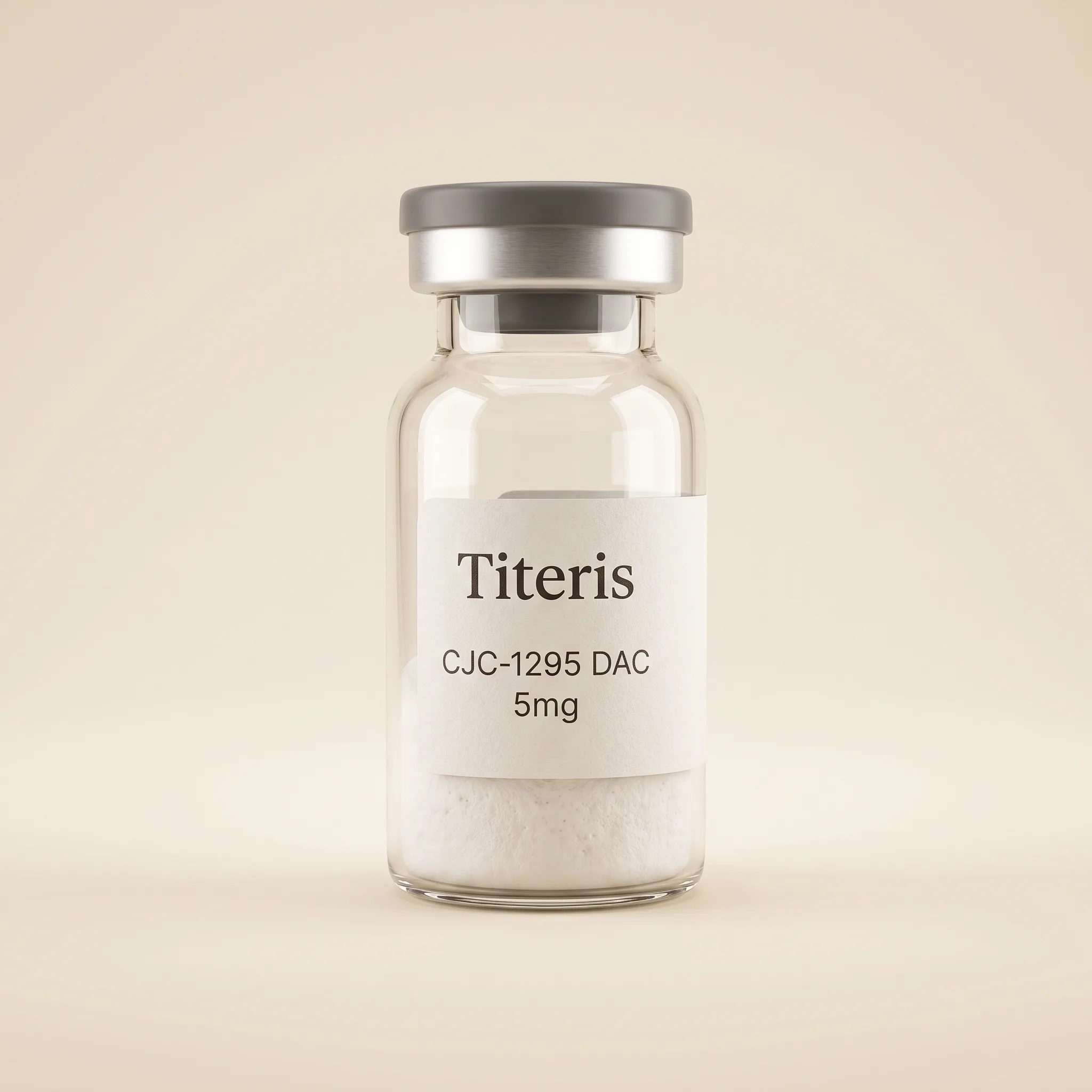
CD5CJC-1295 DAC, 5mg
Supplied as a lyophilised vial for laboratory research use only.
£59.99 Contact us to orderSee our documentation policy for what supplier batch documentation covers, and our UK legal status page for the regulatory framing every listing follows.
Frequently asked
What does DAC stand for and how does it work?
DAC stands for Drug Affinity Complex. It refers to an attached maleimide group that covalently binds to Cys-34 of serum albumin under physiological conditions. The resulting stable bond means the peptide circulates as an albumin conjugate, with the effective duration extended from hours (without DAC) to several days in animal models, as albumin undergoes slow natural turnover.
Which variant is better for research: with or without DAC?
Neither is universally better; the choice depends on the research question. The No DAC variant is appropriate for studies of pulsatile, short-duration GHRH receptor stimulation. The DAC variant is appropriate for studies of sustained, prolonged GH axis activation. Both variants are legitimate research tools for different experimental contexts.
Can CJC-1295 DAC interact with other compounds in laboratory media?
Yes. The maleimide group reacts with free thiol groups. Reducing agents commonly used in cell culture, such as beta-mercaptoethanol, and thiol-containing amino acids like cysteine in serum-containing media can compete with the intended albumin-binding target. Researchers designing in vitro experiments with the DAC variant should account for this by using serum-free or defined media conditions, or by pre-conjugating to purified albumin before addition to the culture system.
Is CJC-1295 with DAC legal to buy in the UK?
As a research reference compound for in vitro laboratory use, CJC-1295 with DAC occupies a different regulatory category from a licensed medicine and cannot be marketed, sold, or supplied for human use. GHRH analogues appear on the WADA prohibited list for athletes. Our UK legal status page provides a fuller explanation of the applicable framework for research compounds.
How is CJC-1295 with DAC supplied?
As a lyophilised powder in a sealed glass vial, in 5mg size. Supplied without solvent; reconstitution for laboratory use requires bacteriostatic water or another appropriate diluent. The maleimide group is reactive with free thiols; handle and store accordingly to maintain integrity before use.