Compound Guide
DSIP: what the delta sleep-inducing peptide is and what the research actually shows
A plain explanation of DSIP (Delta Sleep-Inducing Peptide): what the nonapeptide is, how it was isolated in 1977, and what the complex and at times contradictory research literature actually demonstrates. UK regulatory context included. For research use only. Nothing here is instruction for human use.
DSIP sold here is a research reference compound for in vitro and laboratory research purposes only. It is not licensed for human administration, is not a pharmaceutical product, and has not been approved by the MHRA for any clinical or therapeutic use. The research applications discussed on this page are from published scientific literature and are referenced for scientific context only. They are not an endorsement of human use of this compound. If you have questions about sleep or sleep disorders, consult a registered healthcare professional.
What DSIP is
DSIP, standing for Delta Sleep-Inducing Peptide, is a nonapeptide with the amino acid sequence Trp-Ala-Gly-Gly-Asp-Ala-Ser-Gly-Glu, abbreviated as WAGGDASE. It was isolated in 1977 by Marcel Monnier and colleagues from the venous dialysate of sleeping rabbits. The original description reported delta-sleep-inducing properties in cats following intravenous infusion of the dialysate fraction containing the peptide, which gave it its name.
The research literature on DSIP is unusually heterogeneous. Some studies report sleep-promoting effects; others have failed to replicate these findings. Adding to this complexity, DSIP has an extremely short plasma half-life and is rapidly degraded by endogenous enzymes, which limits the interpretability of studies using exogenous DSIP in living systems. Whether the peptide's rapid degradation affects its observable activity is itself a methodological question of relevance to researchers in this area.
As a research reference material, DSIP is used for in vitro investigations into sleep-wake regulation mechanisms and peptidergic modulation of sleep. The inconsistencies in the published literature make reproducible laboratory experiments particularly relevant, as establishing controlled conditions becomes important when the existing evidence base is mixed.
DSIP is not a drug, not a licensed medicine, and not approved for any human therapeutic application. It has no clinical development programme. It is a laboratory research compound supplied for in vitro and preclinical investigation.
What the research has examined
The DSIP research literature spans several decades and includes findings across multiple systems, with varying degrees of replication:
- Original isolation and sleep studies. The 1977 Monnier isolation study and early replication attempts produced inconsistent results. Not all laboratories that attempted to reproduce the sleep-inducing effects reported in the original paper were able to do so. This inconsistency has been a feature of the DSIP evidence base since the earliest publications.
- Neuroendocrine effects. Some studies describe effects of DSIP on ACTH, growth hormone, and other pituitary hormones in animal models. These data are preclinical and methodologically heterogeneous. The neuroendocrine effects represent a separate line of enquiry from the sleep biology that gave the peptide its name.
- Antioxidant activity. In cell models, DSIP has been investigated for antioxidant properties. These in vitro data represent a distinct research line that does not directly connect to the sleep biology context.
- Methodological heterogeneity as a research topic. The inconsistent DSIP literature has itself generated scientific interest in explaining the discrepancies. Peptide stability, dosing protocols, route of administration, and differences between animal models are all potential sources of variability that researchers in this field have discussed in the published literature.
- No clinical development. DSIP has not progressed through formal clinical trials in a regulatory context. Its evidence base is entirely preclinical and laboratory-based. There are no MHRA-approved applications and no ongoing clinical trials that this page is aware of from the published record.
The DSIP evidence base is an interesting case study in the challenges of neuropeptide research: a compound isolated under defined conditions, producing effects that proved difficult to replicate consistently, but which continued to attract research attention because of its potential relevance to sleep biology and neuroendocrinology.
The biological context of sleep peptide research
Sleep is regulated by a complex interaction of circadian processes and homeostatic sleep pressure. The identification of endogenous sleep-promoting substances, sometimes called somnogenic factors or hypnotoxins, has been an area of research since the early twentieth century. Experiments in which blood or cerebrospinal fluid from sleeping animals was transferred to awake animals and produced sleep-like states suggested that endogenous chemical mediators of sleep might exist. DSIP emerged from this tradition of somnogen research.
The difficulty with demonstrating specific sleep-promoting activity for any small peptide is substantial. Peptides are rapidly metabolised in plasma and in the CNS by ubiquitous peptidases. For a peripherally administered peptide to influence central sleep regulation, it would need either to cross the blood-brain barrier directly, which most peptides do not do efficiently, or to act peripherally on afferent pathways that relay signals to the central sleep regulation circuits. These barriers mean that activity demonstrated after direct CNS injection may not reproduce with peripheral administration, and vice versa.
The antioxidant research line for DSIP connects to a different mechanistic story: that short peptides derived from physiologically active proteins sometimes have cytoprotective properties in cell culture models. This is a recurring observation across the peptide research literature and does not require the peptide to act via its originally proposed mechanism. For researchers using DSIP as a laboratory tool, understanding which research questions the compound is suited for is an important starting point.
DSIP research remains a niche area with a historically mixed evidence base. For laboratories with specific interests in sleep peptide biology, neuroendocrine regulation, or the methodological challenges of neuropeptide research, DSIP is a compound with a documented history that provides context for further experimental investigation.
UK regulatory status
DSIP is not a licensed medicine in the UK. It has not received MHRA approval for any indication and has no approved therapeutic application anywhere. It is not a controlled substance under the Misuse of Drugs Act 1971. As a research reference compound for in vitro laboratory use, DSIP is provided under a research-use-only framework and cannot be marketed or supplied for human use.
See our UK legal status page for the broader regulatory framework that applies to research peptide compounds in the UK.
DSIP in our catalogue
DS5DS10See our documentation policy for what supplier batch documentation covers, and our UK legal status page for the regulatory framing every listing follows.
Laboratory context: how DSIP is used in basic research
DSIP is a research reference material for laboratory use. Controlled in vitro experiments using DSIP address specific mechanistic questions about neuropeptide biology, sleep-regulatory mechanisms, or antioxidant activity in cell systems. Given the heterogeneous published evidence base, methodological rigour is particularly important when designing experiments with DSIP.
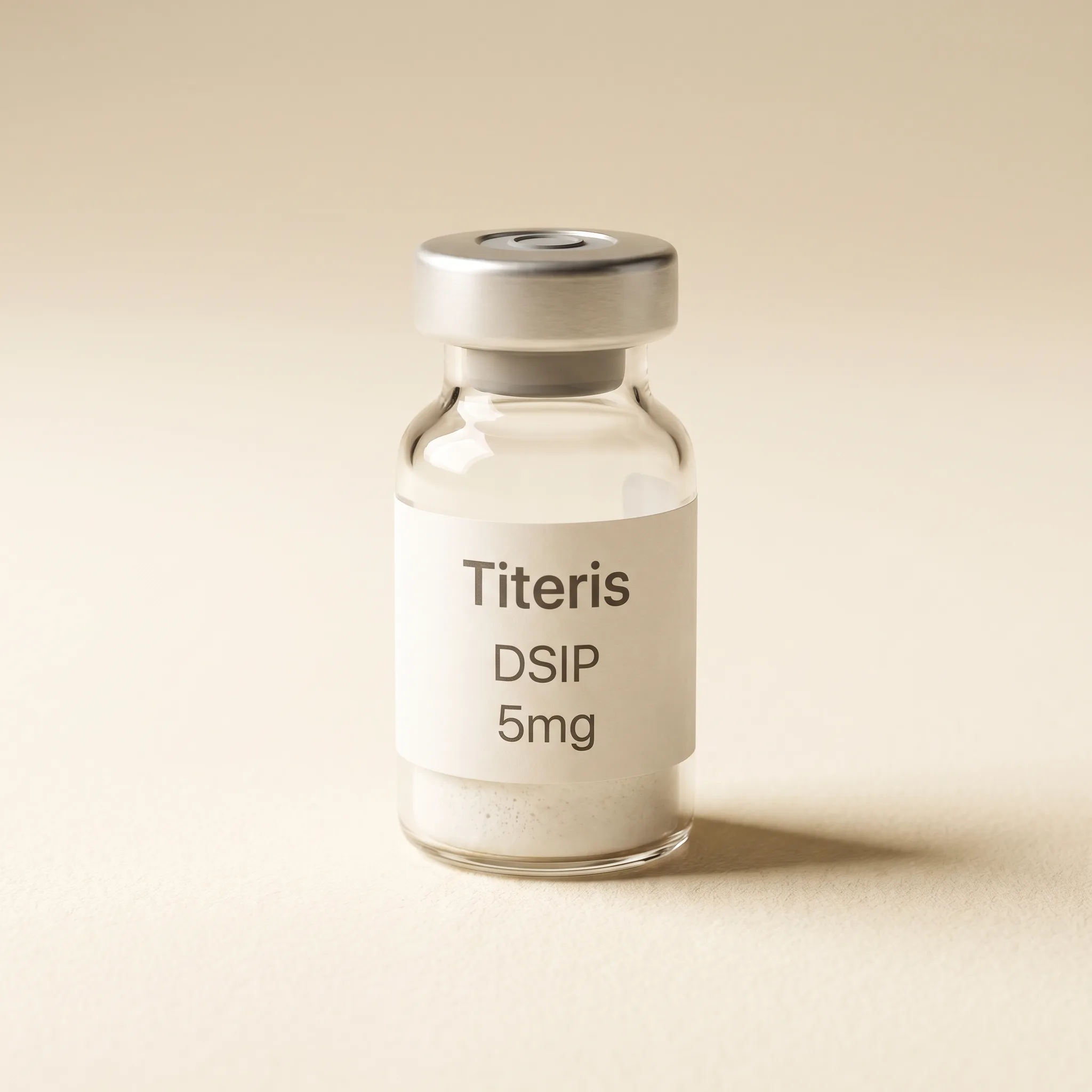
Titeris supplies DSIP as a lyophilised nonapeptide in a sealed glass vial. The defined chemical identity of the material, with the known WAGGDASE sequence, means researchers are working with a characterised compound rather than a biological extract. Storage at -20 degrees Celsius in the dry state is recommended. After reconstitution in bacteriostatic water, the solution should be used promptly. The short half-life of DSIP in aqueous conditions means that reconstituted solutions may degrade more quickly than for more stable peptides.
For researchers designing DSIP experiments, the stability issue is a key practical consideration. Degradation of the peptide in cell culture media or buffer systems may confound results, particularly in longer incubation experiments. Including time-matched controls and considering whether enzyme inhibitors are needed in the experimental system are relevant experimental design considerations.
Research reference materials like DSIP are not clinical investigational products and have not been reviewed by the MHRA for any therapeutic application. Handling should follow institutional laboratory safety guidelines. Standard protective equipment and disposal under institutional chemical waste guidelines under UK environmental regulations apply.
Frequently asked
How was DSIP discovered?
DSIP was isolated in 1977 by Marcel Monnier and colleagues in Basel from the venous dialysate of sleeping rabbits. The researchers described sleep-inducing effects in cats following intravenous infusion of the dialysate. Subsequent isolation of the active fraction yielded the nonapeptide with the sequence WAGGDASE, which was named delta sleep-inducing peptide based on the original observed activity.
Why is the DSIP research literature so inconsistent?
Several factors likely contribute to the inconsistencies. DSIP has a very short plasma half-life and is rapidly degraded by endogenous peptidases, which means that different studies using different delivery routes and preparations may be investigating quite different effective exposures. Additionally, studies used different doses, animal models, and behavioural paradigms, all of which affect comparability. Some studies may also have used preparations of varying purity.
How is DSIP supplied as a research reference material?
As a lyophilised nonapeptide in a sealed glass vial, available in 5mg and 10mg sizes. Supplied without solvent; reconstitution for laboratory use requires bacteriostatic water or sterile water depending on the specific research application. Given the compound's known stability challenges, fresh preparation before use is advisable.
Is DSIP legal to buy in the UK?
As a research reference compound for in vitro laboratory use, DSIP is not a controlled substance and can be supplied under a research-use-only framework. It cannot be marketed or supplied for human use. Every listing on this site is for research use only. See our UK legal status page for more detail.