Compound Guide
Epithalon: what the pineal tetrapeptide is and what the research actually shows
A plain explanation of Epithalon (also written Epitalon): what the synthetic tetrapeptide Ala-Glu-Asp-Gly is, what the research literature has actually examined, and how to read the data critically. This page covers UK regulatory context and the laboratory use of this compound. For research use only. Nothing here is instruction for human use.
Epithalon sold here is a research reference compound for in vitro and laboratory research purposes only. It is not licensed for human administration, is not a pharmaceutical product, and has not been approved by the MHRA for any clinical or therapeutic use. The research applications discussed on this page are from published scientific literature and are referenced for scientific context only. They are not an endorsement of human use of this compound. If you have questions about ageing or longevity, consult a registered healthcare professional.
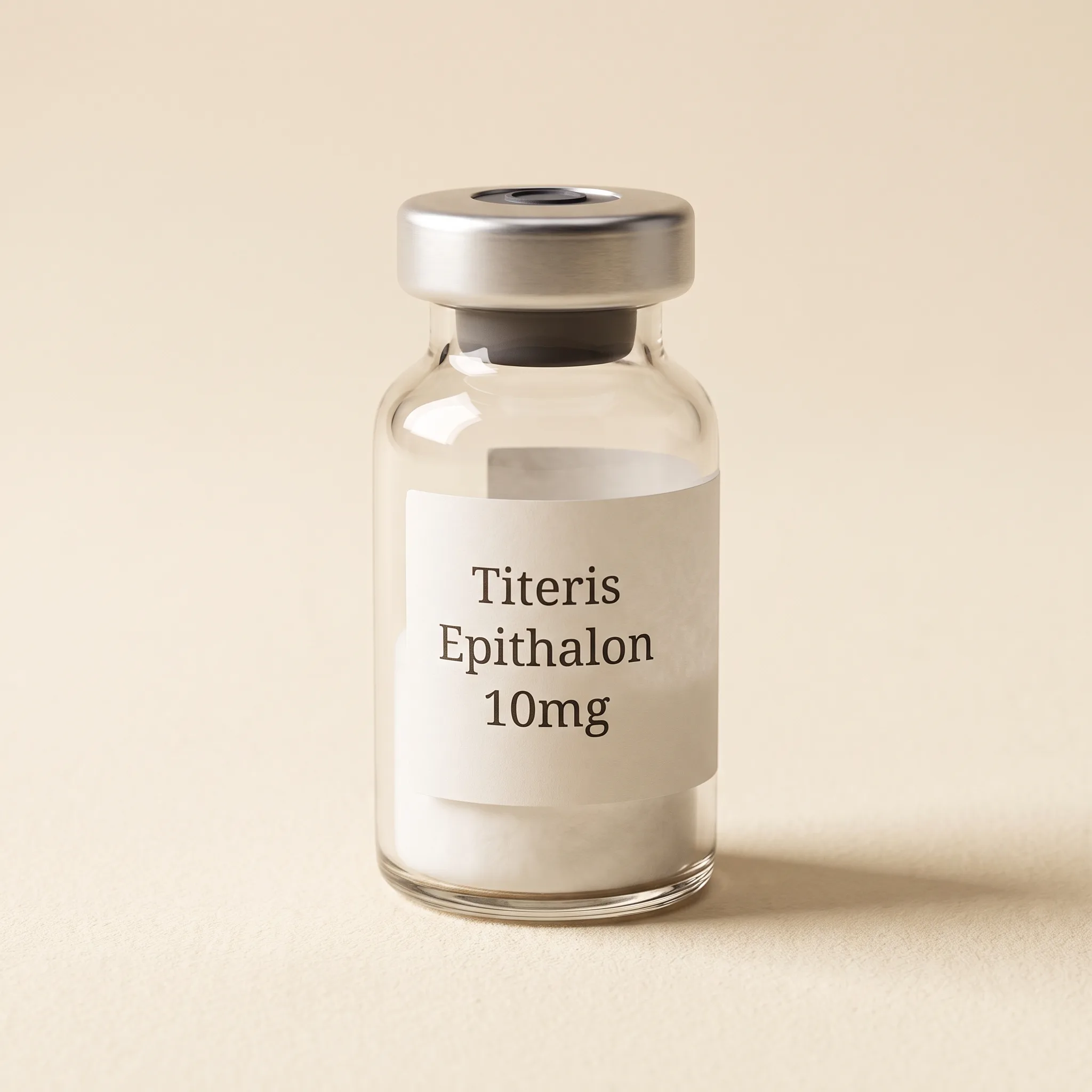
What Epithalon is
Epithalon, also written as Epitalon, is a synthetic tetrapeptide with the amino acid sequence Ala-Glu-Asp-Gly (AEDG). It was developed within the Soviet and Russian research tradition, derived from a natural polypeptide extract from the pineal gland called Epithalamin. The majority of the published research literature on Epithalon originates from Russian institutions, most notably the Saint Petersburg Institute of Biogerontology, where the compound was developed and studied over several decades by Vladimir Khavinson and his colleagues.
The primary research interest in Epithalon concerns its interaction with telomerase, the enzyme responsible for extending telomeres. In cell culture experiments, telomerase activation by Epithalon has been described. Telomeres are the protective caps located at the ends of chromosomes, and their progressive shortening over the lifetime of a cell is one of the recognised markers of cellular ageing. The theoretical interest in compounds that might influence telomerase activity follows from this biology.
Epithalon is not a drug, not a clinically validated anti-ageing agent, and not a hormone. It is a research tetrapeptide that has been studied primarily in preclinical laboratory settings. The distinction between laboratory research data and clinical evidence is an important one, and it applies with particular force to Epithalon, where the bulk of the evidence base is preclinical and concentrated within a single research tradition.
As a synthetic compound, Epithalon has a defined chemical identity: it is a short chain of four specific amino acids, reproducibly manufacturable to a known sequence. This defined identity is relevant for laboratory research because it allows researchers to work with a consistent, characterised material rather than a biological extract of variable composition. Research reference materials are supplied precisely because their chemical identity is fixed and verifiable.
What the research has examined
The research literature on Epithalon has specific methodological contexts that are important to understand before interpreting any findings:
- Telomerase activation in cell models. In cell culture experiments, Epithalon has been described as increasing telomerase activity in certain cell lines. These in vitro data are the most frequently cited finding in the Epithalon literature. In vitro results from cell cultures do not translate directly to whole organism biology, and replication of findings across independent laboratories is the standard test of robustness.
- Circadian rhythm and melatonin. Epithalon has been investigated in the context of pineal gland function and melatonin regulation. Animal model data describe effects on melatonin secretion in aged animals. Melatonin is produced by the pineal gland and plays a role in circadian rhythm regulation, which is why pineal-derived research has attracted interest in ageing biology.
- Russian longevity studies. A substantial portion of the Epithalon literature comes from Russian institutions and involves longevity experiments in mice. These studies are preclinical. They have not been replicated at scale by independent Western research groups, which is a methodological consideration for researchers evaluating the evidence.
- Methodological limitations. The Epithalon literature is predominantly published outside high-impact-factor English-language peer-reviewed journals. Independent replication of the core findings is limited. These are factual observations about the state of the evidence base, not a judgement on the compound itself. They are relevant to researchers who need to assess the strength of the available data before designing their own experiments.
These limitations are methodological facts, not a dismissal of Epithalon as a laboratory tool. Researchers working with Epithalon as a reference material need to understand what the existing literature can and cannot support, so that their own experimental designs are appropriately calibrated.
The telomerase mechanism and why it matters for ageing research
Telomerase is a reverse transcriptase enzyme that adds repetitive DNA sequences to the ends of chromosomes, maintaining telomere length. It is active in germ cells, stem cells, and certain other tissues, but largely inactive in most somatic cells in adults. As somatic cells divide, their telomeres shorten with each replication cycle. When telomeres reach a critically short length, cells enter a state of permanent growth arrest known as cellular senescence, or they undergo apoptosis.
The accumulation of senescent cells in tissues is associated with the functional decline seen in ageing. This observation has driven research interest in telomerase biology as one potential angle in ageing research. The theoretical rationale for studying compounds like Epithalon follows directly: if a compound can activate telomerase in cell models, it becomes a research tool for investigating the consequences of that activation on cellular behaviour.
It is worth being precise about what in vitro telomerase activation data shows and does not show. Cell culture experiments demonstrate a biochemical effect in a controlled, simplified system. They do not demonstrate that the same effect occurs in living organisms at relevant concentrations, or that any observed effect on cellular longevity in a dish corresponds to organismal ageing outcomes. Translating in vitro findings to in vivo biology requires a series of further experimental steps, each of which can produce unexpected results.
The pineal gland context matters for understanding why Epithalon was studied in the first place. The pineal gland produces melatonin and has long been associated in research with circadian regulation, seasonal adaptation, and, in some traditions, with broader neuroendocrine coordination. The Khavinson research tradition assigned certain short peptides to specific organ systems, working on the hypothesis that organ-specific peptide bioregulators exist and can be synthesised for research use. Epithalon sits within this theoretical framework, which helps explain the research questions it was originally designed to address.
UK regulatory status
Epithalon is not a licensed medicine in the UK. It has not been approved by the MHRA for any clinical or therapeutic indication. There are no pharmaceutical formulations of Epithalon available through the UK healthcare system, and it is not a prescription medicine.
As a research reference compound supplied for in vitro laboratory use, Epithalon occupies a different regulatory category from a licensed medicine. Research reference materials are not pharmaceutical products and cannot be marketed, sold, or supplied for human use. The MHRA is clear about the distinction between research chemicals and licensed medicines, and Titeris operates strictly within the research-use-only framework. Every product listed on this site is for laboratory research purposes only.
Researchers in the UK who are considering working with Epithalon should be aware that the compound does not have a regulatory pathway as a human therapeutic in the UK. Any use outside a licensed laboratory research context carries regulatory risk. Our UK legal status page covers the relevant regulatory framework in more detail.
Epithalon in our catalogue
ET10Epithalon, 10mg
Supplied as a lyophilised vial for laboratory research use.
£24.99 Contact us to orderET50Epithalon, 50mg
Supplied as a lyophilised vial for laboratory research use.
£64.99 Contact us to orderSee our documentation policy for what supplier batch documentation covers, and our UK legal status page for the regulatory framing every listing follows.
Laboratory context: how Epithalon is used in basic research
Epithalon is a research reference material for laboratory use. The laboratory context differs fundamentally from clinical or therapeutic applications. In the laboratory, controlled in vitro experiments are conducted in which the compound is applied in defined concentrations to cell cultures or other model systems. Results from such laboratory experiments do not directly transfer to whole human physiology.
For research laboratories, the chemical identity and consistency of the reference material matters. Titeris supplies Epithalon as a lyophilised tetrapeptide. Batch documentation, where available from our supplier, is stated on the relevant listing rather than applied as a blanket quality claim across the product line.
Proper storage of research peptides is important for maintaining their chemical integrity. Lyophilised peptides should generally be stored dry, protected from light, and at low temperatures. After reconstitution, stability times are significantly shorter. Specific storage recommendations for Epithalon depend on the laboratory conditions and the researcher's own protocols.
Laboratory protocols for using peptide research reference materials vary by research question. Common applications include binding affinity studies in transiently transfected cell lines, cell culture experiments investigating signal transduction pathways, enzyme activity assays, and biochemical characterisation experiments. The choice of appropriate model system and protocol is the responsibility of the researcher.
Research reference materials like Epithalon are not clinical investigational products and have not undergone regulatory review by the MHRA or EMA for therapeutic applications. Clinical trials use GMP-manufactured investigational products subject to strict quality standards. Understanding the difference between a research reference material and a GMP clinical product matters for correctly interpreting any laboratory results obtained.
Synthetic peptides as research reference materials allow laboratories to investigate mechanistic questions. Their defined chemical identity is a prerequisite for reproducible research. For Epithalon, this means researchers work with a known, fixed sequence rather than a biologically isolated extract of variable composition, which is an important methodological consideration when designing and reporting experiments.
Handling should follow standard laboratory procedures for compounds with potential biological activity. Protective gloves, a lab coat, and appropriate eye protection are standard. Safety data sheets in the pharmaceutical sense are not applicable to research reference materials; researchers act according to their own institutional safety guidelines.
Disposal of Epithalon residues should follow institutional guidelines for chemical waste. UK researchers should comply with the Environmental Protection Act 1990 and any applicable institutional chemical waste disposal policies. Specific disposal instructions should be confirmed with the relevant institutional safety officer.
Storage, handling, and stability notes for Epithalon
Correct storage of lyophilised research peptides is critical for maintaining chemical integrity over time. Lyophilisation, also called freeze-drying, removes water from the sample, leaving a dry, stable matrix that remains viable for longer under appropriate conditions than an aqueous solution. The general rule is: dry, protected from light, and at low temperature.
For Epithalon as a research reference material, storage at -20 degrees Celsius in the dry state is recommended. At this temperature, the lyophilised material remains stable for research purposes over an extended period. Opening the vial in a humid atmosphere should be avoided, as moisture can begin to rehydrate the lyophilised matrix. Allowing the closed vial to equilibrate to room temperature before opening prevents condensation inside the vial.
After reconstitution in a suitable solvent, bacteriostatic water or sterile water depending on the specific research application, the solution should be stored at 4 degrees Celsius and used within a short timeframe. Repeated freeze-thaw cycles of reconstituted solution degrade quality through mechanical stress on the peptide structure and should be avoided. Where needed, aliquots of the reconstituted solution can be frozen and thawed individually.
The storage stability of Epithalon depends on its amino acid sequence and any modifications. Peptides containing sensitive amino acid residues such as methionine, susceptible to oxidation, or asparagine, susceptible to deamidation, require particular attention. For compound-specific stability information, researchers should consult the primary literature or technical data from the manufacturer.
Inert gas backfill in the vial, nitrogen or argon, prevents oxidation of oxygen-sensitive residues. Titeris vials are sealed under appropriate conditions to maintain quality during transit. After first opening, this protective atmosphere is no longer present, so prompt use or careful re-sealing is advisable.
Frequently asked
What is telomerase and why does it matter for ageing research?
Telomerase is an enzyme, specifically a reverse transcriptase, that extends telomeres. It is active in germ cells, stem cells, and certain other tissues, but largely inactive in most adult somatic cells. Telomere length is a marker for the replicative age of cells. As cells divide, telomeres shorten, eventually triggering senescence or apoptosis. Research into compounds that may influence telomerase activity in cell models is one strand of ageing biology research.
Why does so much Epithalon research come from Russia?
Epithalon was developed by Vladimir Khavinson and colleagues at the Saint Petersburg Institute of Biogerontology. The Russian research tradition on peptide bioregulators, called cytomedines or cytomedins in that literature, is a distinct research school with its own publication infrastructure and theoretical framework. This concentration of research within one institution and country is a recognised feature of the Epithalon evidence base.
How is Epithalon supplied as a research reference material?
As a lyophilised tetrapeptide in a sealed glass vial, available in 10mg and 50mg sizes. Supplied without solvent; reconstitution for laboratory use requires bacteriostatic water or sterile water depending on the specific research protocol.
Is Epithalon legal to buy in the UK?
Epithalon is not a licensed medicine in the UK and is not a controlled substance. As a research reference compound for in vitro laboratory use, it is supplied under a research-use-only framework and cannot be marketed or supplied for human use. Every listing on this site is for research use only. See our UK legal status page for more detail.