Compound Guide
FOXO4-DRI: what the senolytic D-retro-inverso peptide is and what the research shows
A plain explanation of FOXO4-DRI: what the D-retro-inverso peptide of the transcription factor FOXO4 is, what role it plays in cellular senescence research, and what the published literature has actually demonstrated. UK regulatory context included. For research use only. Nothing here is instruction for human use.
FOXO4-DRI sold here is a research reference compound for in vitro and laboratory research purposes only. It is not licensed for human administration, is not a pharmaceutical product, and has not been approved by the MHRA for any clinical or therapeutic use. The research applications discussed on this page are from published scientific literature and are referenced for scientific context only. They are not an endorsement of human use of this compound. If you have questions about ageing or age-related conditions, consult a registered healthcare professional.
What FOXO4-DRI is
FOXO4-DRI is a D-retro-inverso peptide derived from the transcription factor FOXO4. D-retro-inverso peptides are a class of modified peptides in which all L-amino acids are replaced by their D-enantiomers and the sequence is reversed. This modification makes the peptide resistant to proteolytic degradation by the serine proteases that would normally break down standard peptide bonds. The practical consequence is extended stability compared to unmodified peptides, which is useful for certain research applications.
FOXO4 is a transcription factor from the Forkhead family that is upregulated in senescent cells, where it interacts with p53 to promote the survival of those cells. The theoretical basis of FOXO4-DRI is to disrupt this FOXO4-p53 interaction in senescent cells, an intervention which in laboratory models leads to apoptosis of the senescent cells. The compound is therefore classified as a senolytic: a compound that selectively targets senescent cells.
Cellular senescence is a state of permanent cell cycle arrest triggered by various stressors including DNA damage, oncogene activation, and telomere shortening. Senescent cells accumulate with age and secrete a range of inflammatory mediators collectively called the senescence-associated secretory phenotype, or SASP. The accumulation of senescent cells and the SASP they produce is associated with tissue dysfunction in ageing, which is what makes senolytic research an active area in ageing biology.
FOXO4-DRI is not a drug, not a clinically validated therapeutic, and not approved for any use in humans. It is a laboratory research tool for investigating cellular senescence mechanisms and the consequences of senescent cell clearance in preclinical model systems.
What the research has examined
FOXO4-DRI was described in a 2017 publication in the journal Cell, authored by Baar and colleagues. The key aspects of the evidence base are:
- Original Cell publication, 2017. Baar and colleagues described FOXO4-DRI as a senolytic peptide that, in mouse models, selectively triggers apoptotic signalling in senescent cells. This study is peer-reviewed and published in Cell, a high-impact journal. The findings are the foundational reference point for FOXO4-DRI in the research literature.
- Mouse models of ageing and tissue restoration. In the original senolytic peptide experiments, treated mice in various ageing models showed improvements in physical function and tissue homeostasis parameters. These data are preclinical and cannot be directly extrapolated to human outcomes.
- The senolytic research field. FOXO4-DRI belongs to a broader class of senolytics that also includes small molecules such as the combination of dasatinib and quercetin, and navitoclax, among others. These compounds approach senescent cell clearance through different mechanisms, and the field as a whole is still in a predominantly preclinical stage.
- Replication status. The core findings of the original 2017 publication have been confirmed to a limited extent by independent groups. The research is active, but the evidence base remains predominantly preclinical. There are no published clinical trials of FOXO4-DRI in humans.
FOXO4-DRI is not a clinically validated therapeutic and is not intended for human use. It is a research tool for senescence biology, useful for laboratories studying the mechanisms of senescent cell survival and the effects of their selective elimination in preclinical models.
Mechanism: disrupting the FOXO4-p53 interaction
The mechanistic logic of FOXO4-DRI is grounded in the biology of the FOXO4 transcription factor and its role in senescent cell survival. In normal cells, FOXO4 activity is modulated by the PI3K/Akt signalling pathway. In senescent cells, FOXO4 is upregulated and localises to the nucleus, where it forms a complex with p53. This complex is part of the molecular machinery that keeps senescent cells alive rather than allowing them to undergo apoptosis, which would normally be the cellular response to the levels of DNA damage present in a senescent cell.
FOXO4-DRI acts by competing with endogenous FOXO4 for binding to p53. The D-retro-inverso structure means that the peptide can engage the binding interface while resisting degradation by cellular proteases, extending its effective presence in the cell. By disrupting the FOXO4-p53 complex, FOXO4-DRI shifts the balance in senescent cells towards apoptosis. In laboratory models, this has been observed to reduce the senescent cell burden selectively, with less effect on non-senescent cells.
The selectivity aspect is significant from a research perspective. One of the key challenges in senolytic research is achieving specificity for senescent cells over healthy tissue. The published mouse model data suggested a degree of selectivity for FOXO4-DRI in the models studied, which is part of what makes this compound interesting as a research tool. Whether that selectivity holds in other experimental contexts, and what the mechanistic basis of any differential effect is, are active research questions.
For researchers using FOXO4-DRI as a laboratory reference material, understanding the proposed mechanism is important for designing appropriate controls and interpreting results. Relevant controls include comparing effects in senescent versus non-senescent cell populations, using scrambled peptide controls, and measuring downstream markers of apoptosis to confirm mechanism.
UK regulatory status
FOXO4-DRI is not a licensed medicine in the UK. It has not received MHRA approval for any indication and is not available through the UK healthcare system. As a synthetic peptide used in laboratory research, it has no approved human therapeutic application anywhere in the world at this time.
As a research reference compound supplied for in vitro laboratory use, FOXO4-DRI is provided under a research-use-only framework. It cannot be marketed, sold, or supplied for human use. Every listing on this site follows the research-use-only framework that Titeris applies to all its products.
See our UK legal status page for the broader regulatory framework that applies to research peptide compounds in the UK.
FOXO4-DRI in our catalogue
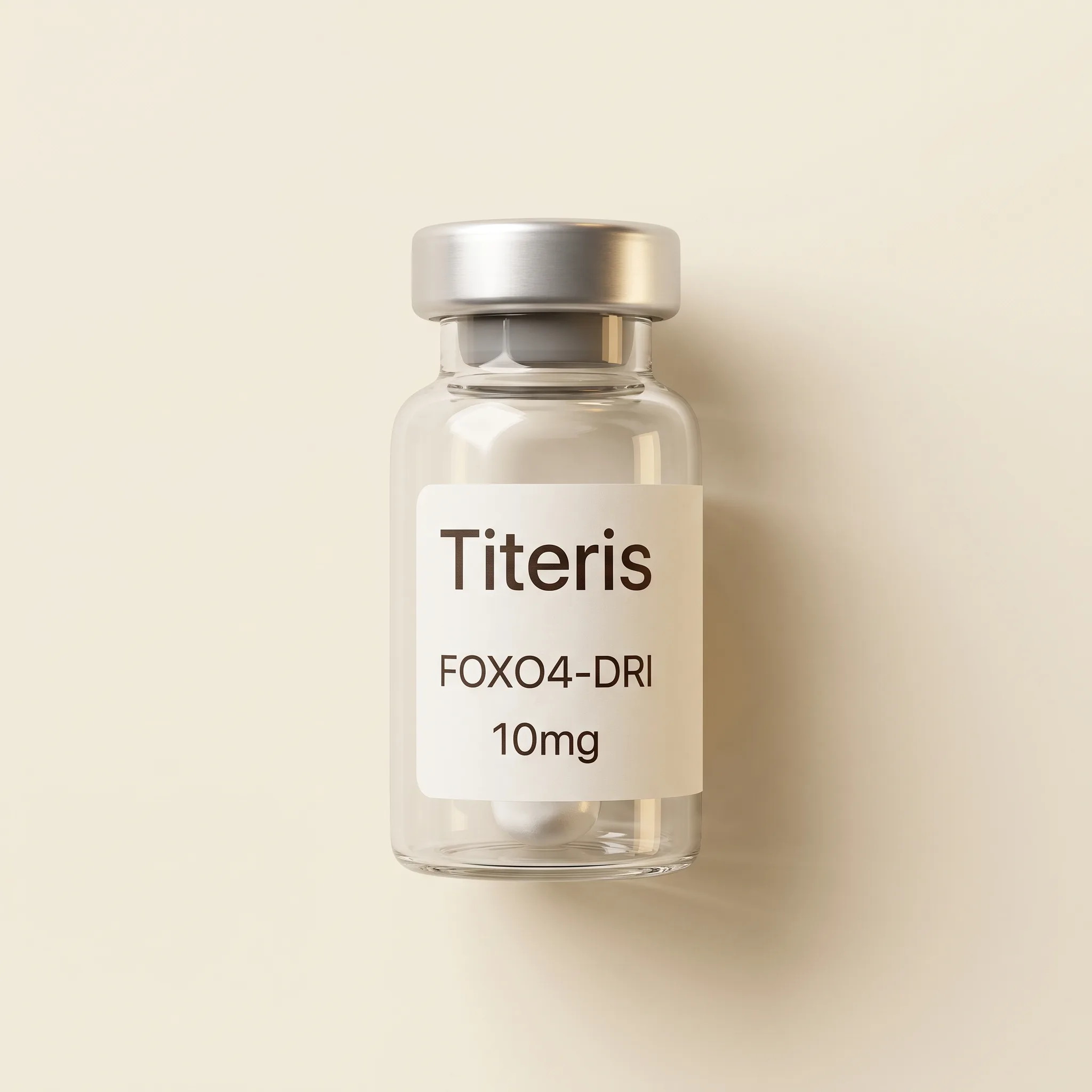
F04FOXO4-DRI, 10mg
Supplied as a lyophilised vial for laboratory research use.
£69.99 Contact us to orderSee our documentation policy for what supplier batch documentation covers, and our UK legal status page for the regulatory framing every listing follows.
Laboratory context: how FOXO4-DRI is used in basic research
FOXO4-DRI is a research reference material for laboratory use. The laboratory context differs fundamentally from any clinical or therapeutic application. Controlled in vitro experiments are designed to test specific mechanistic hypotheses in defined model systems. Results from such experiments do not directly translate to human physiology without substantial additional validation.
For senescence biology research, FOXO4-DRI is useful as a tool for studying the consequences of FOXO4-p53 pathway disruption in senescent cell populations. Typical experimental applications include treatment of induced-senescence cell cultures, comparison with non-senescent controls, measurement of apoptosis markers such as activated caspases, and quantification of SASP factor expression before and after treatment.
The D-retro-inverso modification gives FOXO4-DRI enhanced stability compared to standard L-peptides. This stability is relevant for experimental design because it means the compound is likely to remain active for longer in cell culture conditions, which needs to be accounted for in dosing and time-course experiments.
Storage at -20 degrees Celsius in the lyophilised state is recommended. After reconstitution in bacteriostatic water or a suitable buffer, aliquots should be stored at -80 degrees Celsius for longer-term storage or at 4 degrees Celsius for short-term use. Repeated freeze-thaw cycles should be minimised to preserve peptide integrity.
Research reference materials like FOXO4-DRI are not clinical investigational products and have not been reviewed by the MHRA or EMA for any therapeutic application. They are supplied for in vitro research under a strict research-use-only framework. Handling should follow institutional laboratory safety guidelines for compounds with potential biological activity.
Frequently asked
What is a senolytic?
Senolytics are compounds that selectively induce apoptosis in senescent cells (cells in a state of permanent cell cycle arrest) while sparing normal cells. FOXO4-DRI is a senolytic that disrupts the FOXO4-p53 interaction in senescent cells, shifting them towards apoptosis. The goal in senescence research is to understand whether selective clearance of senescent cells can reduce the tissue dysfunction associated with their accumulation.
What is cellular senescence?
Cellular senescence is a state of permanent cell cycle arrest that cells enter in response to various stressors including DNA damage, oncogene activation, and telomere shortening. Senescent cells stop dividing but do not die, and they secrete a range of inflammatory mediators called the SASP. Senescent cells accumulate in tissues with age and are associated with functional decline in ageing organisms.
How is FOXO4-DRI supplied as a research reference material?
As a lyophilised D-retro-inverso peptide in a sealed glass vial, available in 10mg size. Supplied without solvent; reconstitution for laboratory use requires bacteriostatic water or a suitable buffer depending on the specific research application. The D-amino acid composition gives the compound resistance to proteolytic degradation by standard serine proteases.
What does D-retro-inverso mean?
D-retro-inverso describes a class of peptide modifications in which the standard L-amino acids are replaced by their D-enantiomers and the sequence is written in reverse. This structural change means the peptide presents similar side-chain topology to the original L-peptide, allowing it to interact with the same binding sites, while being resistant to the proteases that degrade normal L-peptides in biological systems.