Compound Guide
GHK-Cu (Cosmetic Grade): what the copper tripeptide is and what the research shows
A plain explanation of GHK-Cu in cosmetic grade: how this copper-binding tripeptide is structured, what the research literature has studied over decades, and what the cosmetic-grade designation actually means. Research use only. Nothing here is guidance for human use.
GHK-Cu sold here is a research reference compound for in vitro and laboratory research purposes only. It is not licensed for human administration, is not a pharmaceutical product, and has not been approved by the MHRA for any clinical or therapeutic use. Glycine-histidine-lysine copper tripeptide, cosmetic grade, research use only. Nothing on this page constitutes medical advice or instruction for use on humans or animals.
What GHK-Cu (Cosmetic Grade) is
GHK-Cu, formally Glycyl-L-Histidyl-L-Lysine copper complex, is a naturally occurring copper-binding tripeptide. It was first identified in human plasma in the 1970s, where it appears at relatively high concentrations in younger individuals and at progressively lower concentrations with advancing age. This age-related decline pattern drew early research attention to GHK-Cu as a molecule potentially involved in biological processes that change with age, including tissue repair and cellular signalling.
The cosmetic-grade designation refers to a purity specification suited to formulation research and cosmetic laboratory applications. It indicates a level of chemical purity appropriate for in vitro research and cosmetic ingredient investigation, as distinct from pharmaceutical-grade manufacturing (GMP) that would be required for a substance intended for clinical use. Cosmetic-grade does not confer any regulatory approval for application to humans. It is a purity category, not a use endorsement.
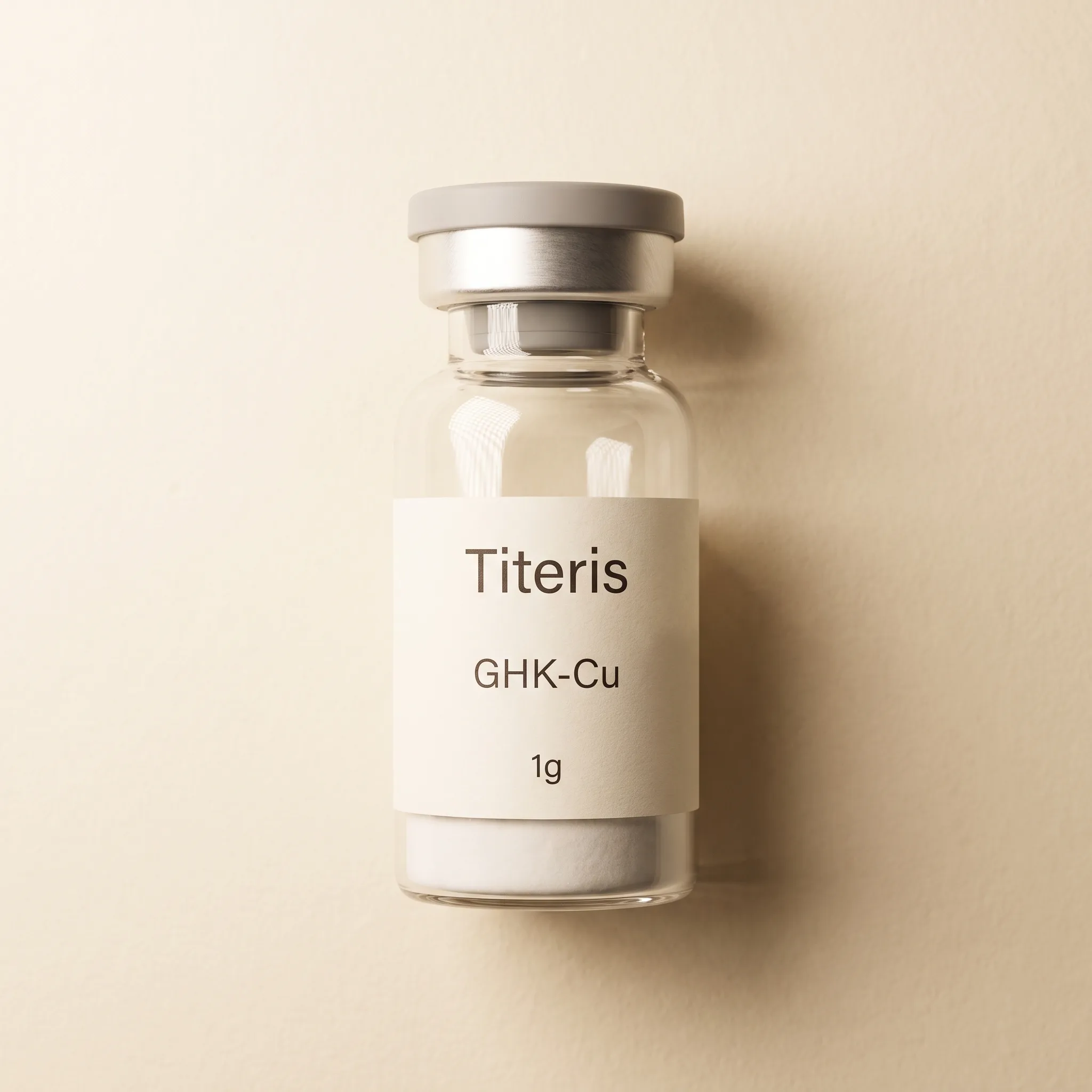
The 1g format is selected for the practical realities of formulation research. Investigating how a copper-complexing peptide behaves at different concentrations in different formulation matrices, or studying its stability under different pH and storage conditions, requires more material than the microgram to milligram quantities used in receptor binding assays. The gram-scale format is suited to this type of research work.
GHK-Cu is one of the more extensively studied copper peptides in the scientific literature. Unlike many research peptides that have a narrow evidence base from preclinical models only, GHK-Cu has accumulated data across several different research areas over multiple decades. That broader evidence base is part of why it remains a reference compound of interest in copper-peptide research.
What the research has examined
GHK-Cu has a comparatively broad and older research literature spanning several active areas:
- Skin biology and connective tissue research. GHK-Cu is one of the most studied copper peptides in skin biology, with laboratory investigations examining effects on fibroblast activity, collagen and elastin production, and related processes in cell culture models and cosmetic research contexts. This is in vitro and preclinical work; it does not constitute clinical evidence that the compound affects human skin biology in a predictable, therapeutic manner.
- Wound healing signalling. Older research literature examined GHK-Cu's role in tissue repair signalling, connected partly to its natural occurrence at higher concentrations in wound fluid than in normal plasma. These findings relate to the compound's presence as an endogenous biological signal, not to the therapeutic efficacy of an exogenous compound.
- Antioxidant and anti-inflammatory activity in cell models. Laboratory research has described GHK-Cu's effects on oxidative stress markers and inflammatory pathway mediators in cell models. These are in vitro observations from controlled experimental conditions and do not translate directly to clinical efficacy claims.
- Gene expression research. More recent laboratory work has examined GHK-Cu's effects on broader gene expression patterns in cell studies, an active but still developing research area. Some published work suggests influence on a wide range of gene pathways, though these data are primarily in cell models and the mechanistic interpretation is still being refined by the research community.
- Hair follicle biology. A smaller body of laboratory literature has examined GHK-Cu in the context of hair follicle cell biology. This work is in vitro and cannot be used to draw conclusions about clinical efficacy in humans.
The copper-binding property is central to all of these research areas. Copper is a biological cofactor, and GHK has unusually high, specific affinity for copper(II) ions. That affinity is the structural basis for the research interest in the compound across all these fields.
Mechanism: copper chelation and signalling
GHK-Cu forms a stable complex with copper(II) through coordination involving the N-terminal amino group, the imidazole nitrogen of histidine, and the amide nitrogen of the glycine-histidine peptide bond. This creates a square planar coordination geometry around the copper ion, which is typical for copper(II) complexes with biological ligands.
The high binding affinity of GHK for copper(II) makes the complex stable under physiological conditions, which is relevant to its potential role as a copper transport or delivery molecule in biological systems. Copper must be carefully chaperoned in living cells because free copper ions are toxic, generating reactive oxygen species through Fenton-type chemistry. Peptide complexation offers a way to mobilise copper in a less reactive form.
At the cellular level, research has proposed that GHK-Cu may interact with cell surface receptors or intracellular signalling components, but the specific molecular targets remain an active area of investigation. The gene expression effects seen in cell studies suggest downstream signalling consequences, though the upstream mechanisms by which the peptide-copper complex initiates those effects are not fully characterised.
Lysyl oxidase, a copper-dependent enzyme essential for collagen and elastin cross-linking, is relevant to some proposed mechanisms. If GHK-Cu acts as a copper donor that increases available copper for lysyl oxidase activity, that could connect it mechanistically to observed effects on connective tissue markers in cell culture. This is mechanistically plausible but the in vivo evidence is limited.
UK regulatory status
GHK-Cu is not a licensed pharmaceutical product and has no MHRA approval for clinical use. As a cosmetic-grade research reference material, it is not a regulated cosmetic product in finished form either; it is an unformulated ingredient sold for laboratory research use. It is not on the WADA prohibited list.
The compound does appear in EU and UK cosmetics ingredient listings (INCI name: Copper Tripeptide-1) as a permitted cosmetic ingredient when used in formulated cosmetic products within regulatory concentration guidelines. The research reference material sold here is not a formulated cosmetic product and is not supplied for any purpose other than laboratory research.
Our UK legal status page covers the regulatory framework that applies to research compounds of this type in more detail.
Laboratory context and handling
GHK-Cu in cosmetic-grade specification is typically used in laboratory formulation research, stability studies, and in vitro cell biology experiments. The 1g format serves the material needs of formulation and stability work better than typical peptide vial sizes of a few milligrams.
For cell biology assays, GHK-Cu is water-soluble and can be dissolved in cell culture media or buffer systems at the concentrations required for the specific assay. The researcher should confirm the pH and concentration range appropriate for their experimental system, as both affect copper speciation in solution.
Storage of the solid material should be dry, away from light, and cool. Copper complexes can be sensitive to light and humidity. The material should be handled with standard laboratory protective equipment, including gloves and a lab coat.
Disposal should follow institutional chemical waste procedures. GHK-Cu is not a hazardous compound under standard classification, but the copper content means it should not be disposed of in ways that could contribute to heavy metal contamination of water systems. Institutional waste management guidance should be followed.
GHK-Cu in our catalogue
GHKCSee our documentation policy for what supplier batch documentation covers, and our UK legal status page for the regulatory framing every listing follows.
Frequently asked
Is GHK-Cu the same as copper peptide in skincare?
Related, but not automatically identical. Copper peptide is a broad marketing term used in the skincare industry, sometimes referring to GHK-Cu specifically and sometimes to other copper-complexing formulations. The GHK-Cu sold here is an unformulated research reference material, not a finished cosmetic product. Commercial copper peptide skincare products are formulated at specific concentrations in cosmetic matrices and are regulated as cosmetics, not as research compounds.
What does cosmetic grade mean versus pharmaceutical grade?
Cosmetic grade describes a purity specification suited to formulation research and cosmetic laboratory applications. Pharmaceutical grade follows more stringent GMP requirements for pharmaceutical manufacturing. Both are purity categories; neither confers regulatory approval for application to humans in either case. The cosmetic-grade specification here means the material is suitable for laboratory and formulation research purposes.
Why the 1g format?
Formulation research and stability studies with copper-complexing peptides often require gram-scale material quantities. Testing a compound at multiple concentrations across different formulation matrices, pH conditions, and time points uses substantially more material than a standard cell biology assay. The 1g format is sized for that type of laboratory research work.