Compound Guide
GHRP-2: what the growth hormone releasing peptide is and what the research shows
A plain explanation of GHRP-2: how GHSR-1a agonism works, what the research literature has examined in this synthetic hexapeptide, and where it stands under UK law. This page is for research context only. Nothing here is guidance for human use.
GHRP-2 sold here is a research reference compound for in vitro and laboratory research purposes only. It is not licensed for human administration, is not a pharmaceutical product, and has not been approved by the MHRA for any clinical or therapeutic use. Growth hormone releasing peptide 2, research use only. The applications discussed on this page are drawn from published research literature and are provided for scientific context. They are not an endorsement of human use. If you have questions about endocrine health, consult a registered healthcare professional.
What GHRP-2 is
GHRP-2, also known by the clinical name Pralmorelin, is a synthetic hexapeptide that binds to the Growth Hormone Secretagogue Receptor 1a (GHSR-1a). GHSR-1a is the receptor for ghrelin, a peptide hormone produced mainly in the stomach lining that plays roles in appetite regulation and the stimulation of growth hormone secretion from the anterior pituitary.
GHRP-2 mimics ghrelin's activity at GHSR-1a selectively, without the full molecular size of native ghrelin. Compared to GHRP-6, the older compound in the same class, GHRP-2 produces a stronger GH-releasing effect in research models while having a less pronounced impact on appetite signalling. This profile makes it a useful research tool for studies focused specifically on the GH axis rather than combined appetite and GH effects.
As Pralmorelin, the compound has received regulatory approval as a diagnostic agent for GH stimulation tests in Japan. That approval applies to the pharmaceutical formulation used in that specific clinical context, not to a laboratory research compound. The molecule is the same; the regulatory category, manufacturing standards, and intended use are entirely different.
GHSR-1a receptors are expressed not only in the pituitary but also in the hypothalamus, stomach, heart, adipose tissue, and various other tissues. The receptor's broad expression profile is one reason GHRP compounds attract research interest beyond pure GH-axis questions, though much of that broader work remains at a preclinical stage.
The hexapeptide structure of GHRP-2 is small enough to be synthesised straightforwardly and is well-characterised from a chemistry standpoint. This is relevant for researchers: working with a defined, synthetic molecule means reproducibility is more tractable than with biological extracts of variable composition.
What the research has examined
GHRP-2 is one of the better-characterised compounds in the GHRP class, with a documented research literature spanning several decades:
- GH stimulation testing. In Japan, Pralmorelin is approved as a diagnostic agent for GH stimulation tests. The clinical data from that application relate to the pharmaceutical medicine, not to a research reference material. The approval demonstrates that the compound's GH-releasing activity is reproducible and quantifiable enough to underpin a diagnostic protocol.
- GHSR-1a pharmacology. GHRP-2 is used as a standard tool in GHSR-1a basic science because of its high selectivity for that receptor and its well-documented pharmacological properties. It has been used in binding affinity studies, receptor internalisation assays, and signalling pathway investigations in cell models.
- GH-axis research in animal models. GHRP-2 has been used in rodent and other animal models to study the GH-IGF-1 axis, including effects on body composition, bone metabolism, and insulin sensitivity. These animal model findings do not translate automatically to human physiology and are not a basis for clinical application of this research compound.
- Cardiovascular preclinical research. Some laboratory investigations have examined GHSR-1a agonists in cardiac tissue, since GHSR-1a receptors are expressed in cardiac muscle. This is an area of preclinical interest; human evidence for cardiovascular effects of GHRP compounds is limited to data from pharmaceutical formulations under clinical conditions, not from research compounds used outside those conditions.
- Comparison with related peptides. A portion of the GHRP-2 literature compares it directly to Ipamorelin, GHRP-6, and Hexarelin to understand which structural features drive selectivity for GH release versus cortisol and ACTH co-secretion. These comparison studies are methodologically valuable for researchers selecting which compound to use in a given protocol.
Mechanism: GHSR-1a agonism and the GH pulse
GHSR-1a is a G-protein coupled receptor. When GHRP-2 binds it, the downstream signalling cascade activates phospholipase C, raises intracellular calcium, and ultimately triggers exocytosis of stored growth hormone from somatotroph cells in the anterior pituitary. This is the mechanism that drives the GH pulse seen in research models following GHRP-2 exposure.
A key mechanistic detail is that GHRP-2 also reduces somatostatin tone. Somatostatin is a peptide that inhibits GH secretion; its suppression by GHSR-1a agonists is part of why GHRPs amplify GH release, not just trigger it. This dual action (stimulating release and reducing inhibition) means GHRPs work synergistically with GHRH-class compounds, an effect well-documented in research settings.
The selectivity profile matters for research design. GHRP-2 stimulates cortisol and ACTH to a measurable degree, in contrast to Ipamorelin, which has a much more selective GH-only releasing profile. For studies where cortisol co-secretion would confound results, Ipamorelin is often the preferred research tool. For studies that want to examine the broader GHSR-1a signalling profile including stress-axis interactions, GHRP-2 offers that richer readout.
The plasma half-life of GHRP-2 in biological systems is short, measured in tens of minutes, which produces a defined and time-limited GH pulse in animal models. This kinetic profile is one reason it is used in diagnostic GH stimulation testing: a brief, defined stimulus followed by serial GH measurements allows assessment of pituitary reserve.
UK regulatory status
GHRP-2 is listed on the World Anti-Doping Agency (WADA) prohibited list under the S2 category (peptide hormones, growth factors, related substances, and mimetics). This prohibition applies in the context of competitive sport. It does not affect the status of GHRP-2 as a research reference compound for laboratory use.
As a research compound sold strictly for in vitro and laboratory research purposes, GHRP-2 occupies a different regulatory category from a pharmaceutical medicine. It is not licensed for human use by the MHRA, cannot be marketed as a treatment, and cannot be supplied with any implication of clinical use. Titeris supplies GHRP-2 for research use only, and nothing on this site constitutes an instruction or invitation to administer this compound to a human or animal.
Our UK legal status page explains the regulatory framework that applies to research peptides in the UK in more detail.
Laboratory context: how GHRP-2 is used in basic research
In a laboratory setting, GHRP-2 is typically used to probe GHSR-1a biology in cell culture or animal models. Common in vitro applications include receptor binding studies using radiolabelled or fluorescently tagged ligands, signalling cascade assays measuring downstream effectors like calcium flux or ERK phosphorylation, and comparative pharmacology experiments comparing GHRP compounds with different selectivity profiles.
Reconstitution for laboratory use typically involves dissolving the lyophilised peptide in bacteriostatic water or sterile water, depending on the specific research protocol. The exact concentration required depends on the experimental system and the assay endpoint being measured. These decisions are within the researcher's domain and should follow standard peptide handling protocols.
Storage of lyophilised research peptides in general terms follows the same principles: keep dry, away from light, and at low temperature until use. After reconstitution, stability is reduced and the solution should be used promptly or aliquoted and stored at minus twenty degrees Celsius rather than being subjected to repeated freeze-thaw cycles. Specific stability data for GHRP-2 in any given solvent system should be sourced from the technical literature or the supplier's documentation where available.
The chemical identity of GHRP-2 as a defined synthetic hexapeptide is an advantage for reproducibility. Researchers can specify the exact molecule, confirm its identity by mass spectrometry, and compare results across labs in a way that is not possible with biological extracts of undefined composition. This is a basic requirement for credible basic science.
Research reference materials like GHRP-2 are not clinical investigational products. They have not undergone the quality manufacturing and testing regime that would be required for a substance to be used in a clinical trial. Researchers using these materials for in vitro or preclinical work should be clear about that distinction when interpreting and publishing results.
Disposal of GHRP-2 residues should follow the researcher's institutional guidelines for chemical waste handling. The compound should be treated as a substance with potential biological activity and handled with appropriate protective equipment: gloves, lab coat, and eye protection where relevant.
Storage and handling guidance
Lyophilised GHRP-2 should be stored dry, away from light, and at minus twenty degrees Celsius until use. The freeze-dried form is considerably more stable than a solution, and proper storage conditions preserve the peptide's chemical integrity over the longer term.
When opening the vial, allow it to warm to room temperature in a sealed state first to prevent condensation entering the vial. Avoid opening the vial in a humid atmosphere, as moisture uptake can begin rehydrating the lyophilised matrix and accelerate degradation.
After reconstitution in a suitable solvent, store at four degrees Celsius and use promptly. If the reconstituted solution needs to be stored longer term, aliquoting into single-use volumes that can be thawed individually is the standard approach to avoid quality loss from repeated freeze-thaw cycles.
All handling should follow institutional lab safety standards for compounds with potential biological activity. No safety data sheet in the pharmaceutical sense exists for a research reference material, and researchers should exercise their own judgement and follow their institution's procedures.
GHRP-2 in our catalogue
GRP2See our documentation policy for what supplier batch documentation covers, and our UK legal status page for the regulatory framing every listing follows.
Frequently asked
What is the difference between GHRP-2 and GHRP-6?
Both are GHSR-1a agonists. GHRP-2 produces a stronger GH-releasing effect in research models and has less influence on appetite signalling than GHRP-6. GHRP-6 is the older compound in the class and has a broader historical literature, though GHRP-2 is generally considered more potent at the receptor level in direct comparisons.
How does GHRP-2 differ from Ipamorelin?
Ipamorelin is a more selective GHSR-1a agonist that produces comparable GH release with significantly less cortisol and ACTH co-secretion than GHRP-2. For research designs where stress-axis hormone interference would confound results, Ipamorelin is typically preferred. GHRP-2 is more appropriate when a fuller picture of GHSR-1a signalling, including stress-axis interactions, is relevant to the research question.
Is GHRP-2 approved for human use in the UK?
GHRP-2 is not approved by the MHRA for any clinical indication in the UK. As Pralmorelin, it is approved as a diagnostic agent in Japan. The research reference compound sold here is not a pharmaceutical product, not for human use, and is supplied strictly for laboratory research purposes.
How is it supplied?
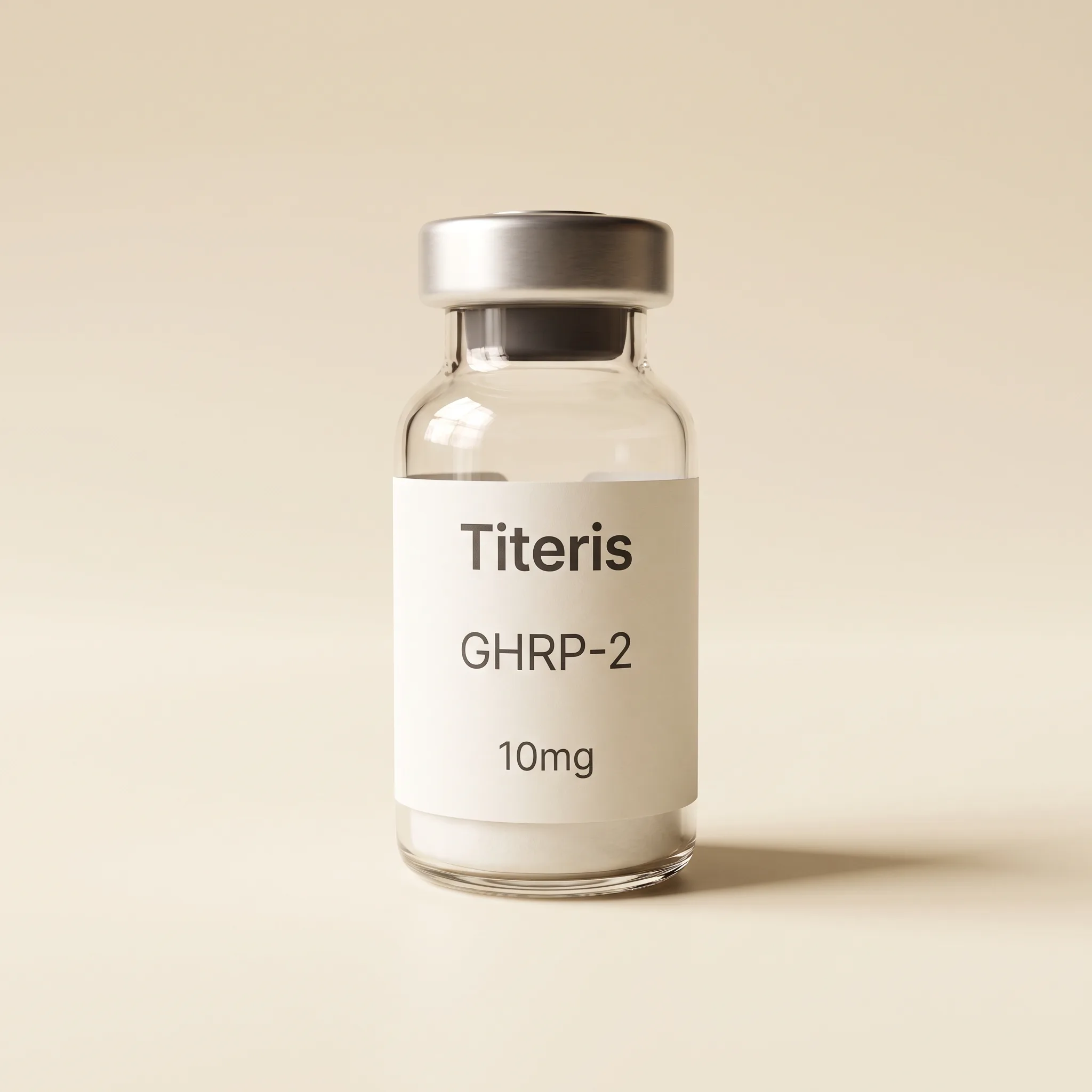
As a lyophilised (freeze-dried) white powder in a sealed glass vial. Supplied without solvent; reconstitution for laboratory use requires bacteriostatic water or sterile water depending on the specific research application. Available in a 10mg vial.