Compound Guide
GLOW: what this proprietary peptide blend is and what the research context covers
An honest explanation of GLOW: what is known about this proprietary peptide blend, what cannot be independently verified, and what the broader research literature on peptides in skin research contexts actually shows. Research use only. Proprietary peptide blend studied in skin research contexts, for research use only.
GLOW sold here is a research reference compound for in vitro and laboratory research purposes only. It is not licensed for human administration, is not a pharmaceutical product, and has not been approved by the MHRA for any clinical or therapeutic use. No verified third-party data on its composition is available. Nothing on this page constitutes medical advice or instruction for use on humans or animals.
Important notice: GLOW is a proprietary peptide blend. Its precise composition is not publicly documented and cannot be verified by any independent source known to us. On this page we describe what is known about peptides in relevant research contexts without making claims about the specific composition of this blend.
What GLOW is
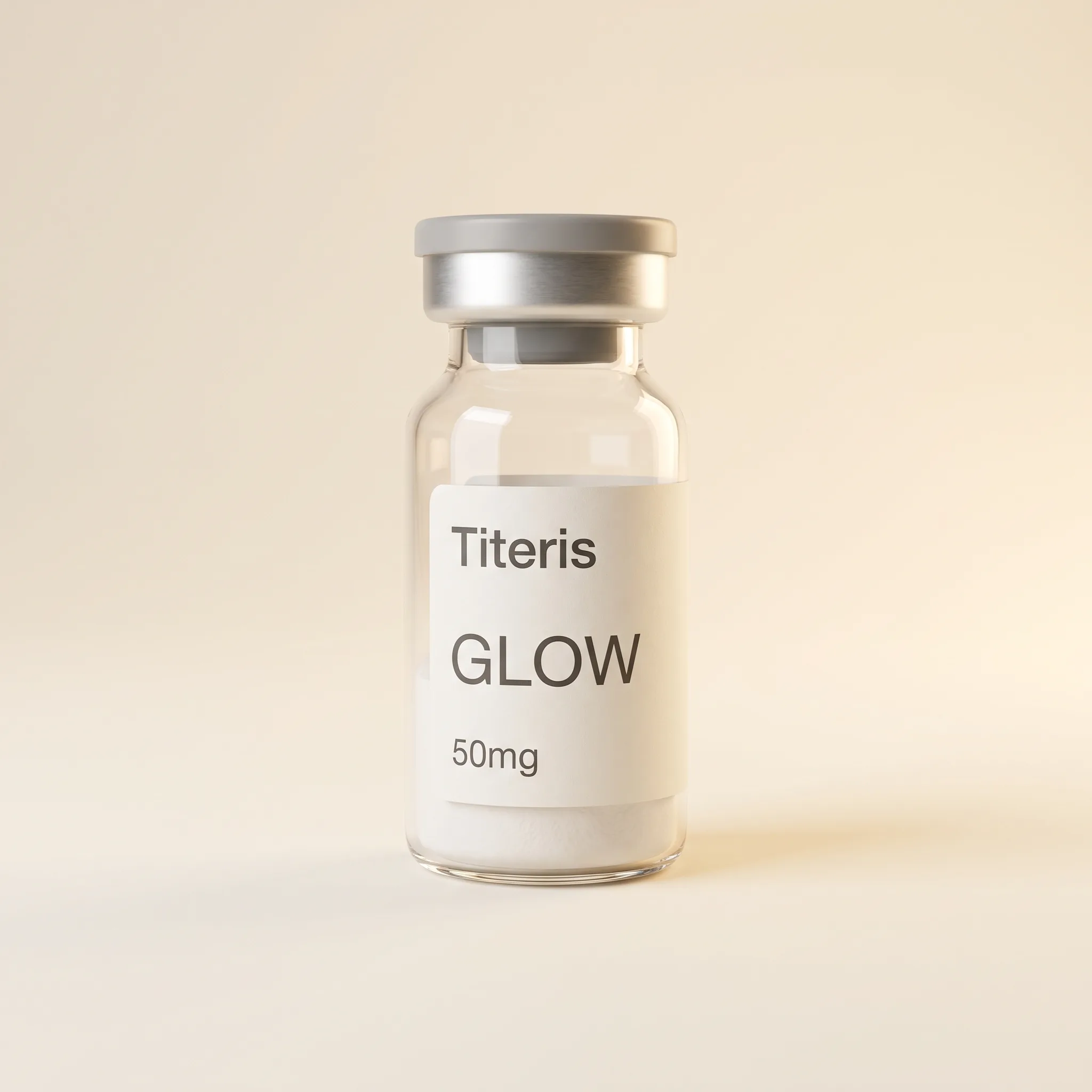
GLOW is the product name for a proprietary peptide blend positioned in skin research contexts. Proprietary blends of this kind do not have a publicly disclosed, independently verifiable composition. This distinguishes them fundamentally from chemically defined single compounds such as GHK-Cu or SNAP-8, where the molecular structure is fully known, the compound can be independently synthesised and tested, and a specific research literature is attached to a specific molecular entity.
For researchers working with a proprietary blend, this has a concrete methodological consequence: any effect observed cannot be attributed to a specific ingredient without further compositional analysis, and independent replication using another product of the same name is problematic without confirmed compositional data. That is not a comment on whether the blend has biological activity; it is a methodological observation relevant to any researcher planning to use and publish results from work with a proprietary material.
These limitations do not preclude research interest in proprietary blends. Some researchers are specifically interested in the effect of a particular commercial blend as a whole, rather than in isolating the contribution of individual components. For those research purposes, the blend as supplied is the research object of interest. The key is that the researcher understands and accounts for these methodological constraints in designing experiments and interpreting results.
Titeris offers GLOW as a research reference material for researchers interested in this specific blend, and is transparent about the compositional limitations: we make no claims about the composition that we cannot independently substantiate.
What the research literature on skin peptides shows
Since GLOW is a proprietary blend without independent compositional verification, we describe below what the broader research literature on peptides in similar research contexts has found. These findings relate to chemically defined single compounds, not to GLOW specifically:
- Peptide signalling molecules in skin biology. Short-chain peptides are an active research field in dermatology and skin biology. Various defined compounds have been investigated for effects on fibroblasts, keratinocytes, collagen synthesis pathways, and cellular renewal processes in laboratory models. These studies use chemically characterised compounds under controlled conditions.
- Cosmetic peptide research. Distinct from pharmaceutical research, there is a body of work investigating peptides for effects on skin cell biology in non-clinical skin models. This research uses cosmetic and preclinical endpoints and is methodologically different from clinical drug trials. Examples include work on GHK-Cu, SNAP-8 (Argireline-related), Matrixyl, and palmitoyl peptides.
- Limitations of proprietary blends in research settings. The scientific community has noted the difficulties in using proprietary blends for reproducible research: the absence of compositional data makes dose-response relationships for individual components impossible to establish, and replication across laboratories using material from different sources is methodologically unsound without confirmed composition.
- Caution with efficacy claims. Claims about the efficacy of proprietary blends without disclosed compositions should be evaluated with particular scepticism, as they cannot be independently assessed against a defined molecular entity with a known mechanism of action.
UK regulatory status
GLOW is not a licensed pharmaceutical product and has no MHRA approval for clinical use. As a proprietary blend without disclosed composition, its individual components cannot be individually assessed for regulatory status. It is supplied as a research reference material for laboratory use only and cannot be marketed for human application.
Our UK legal status page covers the general regulatory framework applicable to research peptides in the UK.
Laboratory context and handling
Researchers choosing to work with GLOW should design their experiments with the proprietary nature of the blend in mind. Experimental designs that analyse the blend as a whole entity (rather than attempting to attribute effects to specific components) are more methodologically coherent when working with material of undisclosed composition.
For in vitro studies, the blend can be dissolved in water or appropriate buffer systems for cell culture applications. Exact concentrations for specific assays should be determined by the researcher based on the experimental system. Storage should be dry, away from light, and cool. Standard peptide storage conditions apply.
Researchers should use standard laboratory protective equipment when handling this material and follow institutional waste disposal procedures. The compound should be treated as a substance with potential biological activity.
Publications based on work with proprietary blends should clearly identify the material, note its proprietary nature and the absence of publicly verifiable compositional data, and frame conclusions accordingly. This is standard scientific practice for transparent reporting of materials used in research.
GLOW in our catalogue
BBG50BBG70See our documentation policy for what supplier batch documentation covers, and our UK legal status page for the regulatory framing every listing follows.
Frequently asked
What is in GLOW?
GLOW is a proprietary peptide blend. Its precise composition is not publicly documented and cannot be verified by any independent source known to us. We do not make claims about the composition that we cannot independently substantiate. Researchers requiring a fully characterised compound with a known molecular structure should consider single-compound alternatives such as GHK-Cu or SNAP-8.
How does GLOW differ from chemically defined peptides like GHK-Cu?
GHK-Cu is a fully defined chemical compound with a known structure, verifiable identity, and a decades-long research literature tied to that specific molecule. GLOW is a proprietary blend without publicly available compositional data. They are methodologically very different research materials. GHK-Cu enables mechanistic research tied to a specific molecule; GLOW is studied as a blend entity, with the compositional uncertainty that entails.
Why does Titeris offer GLOW if the composition cannot be verified?
We offer it as a research material for researchers with a specific interest in this blend, and we are upfront about the limitations: no known composition, no independent verification. Informed research decisions require that transparency. Researchers can decide whether working with a proprietary blend suits their experimental goals or whether a defined compound is more appropriate.