Compound Guide
IGF-1 LR3: what the insulin-like growth factor analogue is and what the research shows
A factual explanation of IGF-1 LR3: what the Long R3 variant of IGF-1 is structurally, how it differs from native IGF-1, why its IGFBP resistance makes it a useful laboratory tool for IGF-1 signalling research, and where it stands under UK law. Supplied here strictly as a research reference compound. Nothing on this page is instruction for human use.
IGF-1 LR3 sold here is a research reference compound supplied for in vitro and laboratory research purposes only. It is not licensed for human administration and has not been approved by the MHRA for any clinical or therapeutic use. IGF-1 LR3 is listed on the WADA prohibited list. It is supplied here strictly as a research tool for in vitro laboratory experiments. Nothing on this page is instruction or endorsement of human use of this compound.
What IGF-1 LR3 is
IGF-1 LR3 (Long R3 Insulin-like Growth Factor-1) is a modified variant of insulin-like growth factor 1 (IGF-1). Native IGF-1 is a 70-amino acid peptide produced predominantly in the liver in response to growth hormone stimulation and mediates growth-stimulatory effects through IGF-1 receptors (IGF1R) expressed in muscle, bone, liver, and many other tissues.
The LR3 modification incorporates two structural changes relative to native IGF-1. The first is a substitution of arginine (R) for glutamic acid at position 3, which substantially reduces the affinity of the molecule for insulin-like growth factor binding proteins (IGFBPs). The second is an N-terminal extension of 13 amino acids. Together, these modifications dramatically extend the effective half-life of IGF-1 LR3 in aqueous conditions compared to native IGF-1. Native IGF-1 in circulation is rapidly bound by IGFBPs, which sequester it from receptor interaction; LR3's reduced IGFBP affinity means it remains free to interact with receptors over a longer period.
In laboratory cell culture settings, native IGF-1 added to media is quickly bound by IGFBP proteins present in serum, reducing its effective concentration at the receptor. IGF-1 LR3, by circumventing this IGFBP sequestration, provides more potent and sustained IGF1R activation in cell culture systems. This makes it the preferred variant for laboratory experiments where sustained IGF-1 receptor activation is the experimental objective, rather than a brief pulse followed by rapid inactivation.
IGF-1 LR3 is not a medicine. It is a research tool for studying IGF-1 receptor-mediated signalling pathways in cell models and animal experiments. It has no approved clinical application, and the research compound supplied here does not meet pharmaceutical quality standards for any therapeutic use.
What the research literature has investigated
IGF-1 LR3 is an important tool in IGF system basic research, and its applications span several fields of cell biology and physiology.
- IGF-1 receptor signalling pathways. IGF-1 receptors activate the PI3K/Akt and MAPK/ERK signalling cascades, which are central to cell growth, proliferation, survival, and metabolism. IGF-1 LR3, as an IGFBP-resistant variant, is used to activate these pathways in cell models without the confounding effect of IGFBP sequestration. This makes it a cleaner pharmacological tool than native IGF-1 for experiments focused on receptor-proximal signalling events.
- Muscle cell biology. IGF-1 is a well-established growth factor for skeletal muscle cells. IGF-1 LR3 is used in myoblast and myotube cultures as a growth factor supplement to study proliferation, differentiation, and hypertrophy-related signalling. It is a standard reagent in muscle cell biology laboratories.
- Cell proliferation and differentiation research. As a potent growth factor, IGF-1 LR3 is used in cell cultures to study proliferation and differentiation across many cell types. It is also a commonly used supplement in serum-free cell culture media where IGF-1 receptor activation is needed to maintain cell viability and function without the undefined growth factors present in serum.
- Cancer cell biology. IGF-1 receptors are overexpressed in many tumour cell lines, and the IGF signalling axis is a subject of oncology research. IGF-1 LR3 is a tool for studying IGF receptor signalling in cancer cell models, examining how receptor activation contributes to proliferation, survival signalling, and resistance to other treatments.
- Serum-free culture systems. Bioreactor and cell therapy applications often require serum-free culture conditions for regulatory and reproducibility reasons. IGF-1 LR3 is a defined growth factor component that supports cell growth in these systems with a known mechanism, unlike the undefined mixture of growth factors in serum.
IGF-1 LR3 is on the WADA prohibited list (category S2 peptide hormones and growth factors). This reflects the theoretical potential for misuse in a performance enhancement context. As a laboratory research reference compound for in vitro use, a different regulatory context applies.
UK regulatory status
IGF-1 LR3 is not a licensed medicine in the UK. It has no approved clinical application. As a growth factor, it is on the WADA prohibited list (S2 peptide hormones and growth factors), which applies in the context of competitive sport. As a research reference compound for in vitro laboratory use, it occupies a regulatory category separate from both pharmaceutical products and WADA anti-doping considerations.
Titeris supplies IGF-1 LR3 exclusively as a research reference compound for in vitro laboratory research. It is not marketed for human use, and purchasers are required to confirm they are acquiring it for legitimate laboratory research purposes. Use is restricted to those aged 18 and over. The regulatory distinction between a research compound and any potential misuse context is one we are clear about: this compound is for laboratory use only.
Our UK legal status page provides a general overview of the regulatory framework applicable to research compounds. For specific legal questions, independent legal advice is appropriate.
Storage, handling, and stability
IGF-1 LR3 is a relatively large peptide (83 amino acids including the extension) and should be stored carefully to maintain integrity. The lyophilised form is stable at minus 20 degrees Celsius in the dry state, protected from light. The vial should reach room temperature before opening to prevent condensation, and handling in a humid atmosphere should be minimised.
Reconstitution should be performed with 0.6% acetic acid as the conventional first step, as IGF-1 LR3 dissolves poorly at neutral pH. After dissolution in acetic acid, the solution can be diluted with sterile buffer or cell culture media as appropriate for the experimental concentration required. The reconstituted solution should be stored at 4 degrees Celsius and used promptly.
For longer-term storage, aliquoting the reconstituted stock and freezing aliquots at minus 20 degrees Celsius avoids repeated freeze-thaw cycles that degrade quality. Each aliquot should be thawed once and used or discarded. The relatively high cost of IGF-1 LR3 makes careful aliquoting and storage practices particularly worthwhile to avoid wastage from degradation.
Standard laboratory precautions apply: protective gloves, a lab coat, and eye protection where appropriate. As a biologically active growth factor, it should be handled with the care appropriate for compounds of this class. Disposal should follow institutional guidelines for biological and chemical waste in accordance with UK environmental regulations.
Research context: IGF-1 LR3 as a laboratory tool
IGF-1 LR3 is a research reference material for laboratory use. The reason it is preferred over native IGF-1 in many cell biology applications is precisely its IGFBP resistance: it provides a more pharmacologically clean stimulus to the IGF-1 receptor in cell culture systems where IGFBP proteins would otherwise sequester native IGF-1 before it can activate the receptor.
In practical terms, when IGF-1 LR3 is added to cell culture media, a higher proportion of the added compound reaches the IGF-1 receptor compared to native IGF-1. This means that the nominal concentration more accurately reflects the effective pharmacological stimulus, which is important for dose-response experiments and quantitative mechanistic studies. Researchers working with serum-containing media particularly benefit from this property, since serum contains substantial IGFBP concentrations.
The results obtained with IGF-1 LR3 in cell culture are characterisations of IGF-1 receptor signalling in the model system used. In vitro cell culture does not replicate the full complexity of IGF signalling in an intact organism, where IGFBP regulation, tissue-specific receptor expression, and systemic hormonal context all contribute to the physiological outcome. Researchers interpreting in vitro IGF-1 LR3 data work within these known limitations of the model system.
Titeris describes what is established about IGF-1 LR3 in the research literature without making claims beyond what in vitro and preclinical data can support. We supply the compound to support legitimate laboratory research into IGF-1 receptor biology, a topic with genuine scientific value across oncology, muscle biology, metabolic research, and biotechnology applications.
Where documentation for available batches is provided by our supplier, it is noted directly on the listing. Documentation is batch-specific. See our documentation policy page for further information.
IGF-1 LR3 in our catalogue
IGF1IGF-1 LR3, 1mg
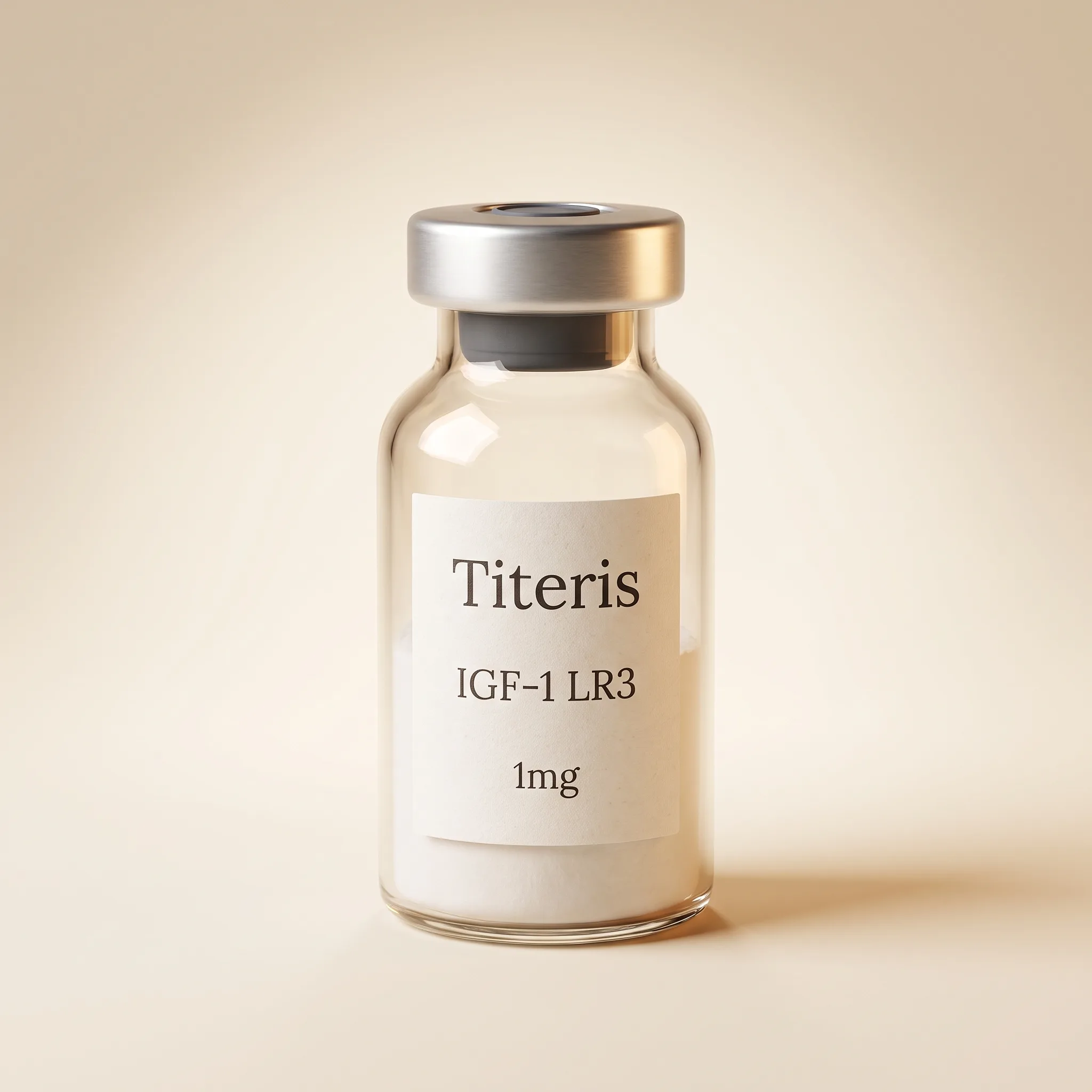
Supplied as a lyophilised vial for laboratory research use.
£94.99 Contact us to orderSee our documentation policy and our UK legal status page for the regulatory framing every listing follows.
Frequently asked
What is the difference between IGF-1 and IGF-1 LR3?
Native IGF-1 is rapidly bound by IGF binding proteins (IGFBPs) in aqueous environments including cell culture media, which sequesters it from receptor interaction. IGF-1 LR3 has an Arg3 substitution and N-terminal extension that dramatically reduce IGFBP affinity, leaving more of the added compound free to interact with IGF-1 receptors. For research purposes requiring sustained, clean IGF-1 receptor activation without IGFBP interference, LR3 is the more appropriate tool. The two compounds are not interchangeable for experimental purposes where IGFBP interaction is a variable.
How is IGF-1 LR3 used in cell culture?
IGF-1 LR3 is typically used at concentrations determined by the specific experimental objective, as a supplement in cell culture media to activate IGF-1 receptor signalling pathways or to support cell growth in serum-free conditions. The specific protocol, including concentration, timing, and combination with other factors, is the researcher's design decision and should be informed by the relevant literature for the cell type and experimental question being addressed.
Why is IGF-1 LR3 on the WADA prohibited list?
IGF-1 and its analogues can stimulate muscle growth and regeneration through IGF-1 receptor activation. The WADA prohibited list (S2 growth factors and related substances) reflects the theoretical potential for performance enhancement through this mechanism in competitive sport. This classification applies to athletes in competition and does not affect the status of IGF-1 LR3 as a legitimate laboratory research reference compound for in vitro use.
How is it supplied and what solvent is used for reconstitution?
As a lyophilised white powder in a sealed glass vial (1mg per vial). Reconstitution for laboratory use should be performed with 0.6% acetic acid as the primary solvent, as IGF-1 LR3 has improved solubility at acidic pH. The acetic acid solution can then be diluted with sterile buffer or culture media to the required working concentration. We stock 0.6% acetic acid as a separate item for this purpose.