Compound Guide
Ipamorelin: what it is, and what the research actually shows
A plain, cited explanation of ipamorelin: its mechanism as a selective growth hormone releasing peptide (GHRP), how its selectivity profile compares to older GHRPs, what the animal and human research has studied, and why it's often studied alongside CJC-1295. Research use only. Nothing here is instruction for human use.
What ipamorelin is
Ipamorelin is a pentapeptide (5 amino acids) growth hormone releasing peptide that acts as a ghrelin receptor (GHSR-1a) agonist. Its mechanism is to stimulate the pituitary gland to release growth hormone (GH) in a pulsatile pattern similar to physiological GH release. It was developed in the 1990s and is one of several GHRPs studied as research tools for probing the GH axis.
The selectivity profile is what distinguishes ipamorelin from earlier GHRPs like GHRP-2 and GHRP-6. Older GHRPs also activate GHSR-1a but they trigger significant elevations in cortisol and prolactin, which complicates their use as research tools for studying GH specifically. Ipamorelin's receptor binding appears more selective for the GH secretagogue pathway, producing GH release with substantially less cortisol and prolactin stimulation than the older peptides in both animal and human studies. This selectivity is one reason it's been a preferred research tool for GH axis studies.
What the research has studied
GH selectivity data
Raun et al. (1998, European Journal of Endocrinology) published the foundational characterisation of ipamorelin: a potent, highly selective GH secretagogue that doesn't significantly stimulate ACTH or cortisol at doses that fully activate GH release. That selective profile was confirmed in subsequent work and is what most ipamorelin research citations refer back to.
Human studies
Several early human pharmacokinetic and pharmacodynamic studies were conducted in the late 1990s and 2000s, primarily by Novo Nordisk (which developed ipamorelin under the internal designation NNC 26-0161). These characterised GH pulse responses to single and multiple doses in healthy volunteers and in individuals with GH deficiency. The human data confirmed the animal selectivity findings: ipamorelin produced GH pulses without the cortisol elevation associated with GHRP-6. Phase 2 development for GH deficiency was pursued by Helsinn Therapeutics, though no pharmaceutical product reached approval.
Studied alongside CJC-1295
In the research literature, ipamorelin is frequently studied in combination with CJC-1295 (a GHRH analogue). The rationale is mechanistic: GHRH (which CJC-1295 mimics) and ghrelin/GHSR agonists (which ipamorelin mimics) act on different receptors and different steps in GH secretion, and their effects are additive in animal studies. CJC-1295 sustains GHRH signalling over a longer period; ipamorelin triggers pulsatile GHSR-mediated GH release. The combination is studied to understand how these two pathways interact, not because there's a clinical protocol to follow. We sell this combination as a separate blend listing: see our CJC-1295 + Ipamorelin page.
UK regulatory status
Ipamorelin is not a controlled substance in the UK. It's not a licensed medicine and has no MHRA approval for any clinical use. It's prohibited by WADA in competitive sport at all times. As a research reference compound it can be sold, bought, and held as a laboratory material, subject to the constraint that it cannot be marketed or supplied for human or veterinary use. See our UK legal status page.
Ipamorelin in our catalogue
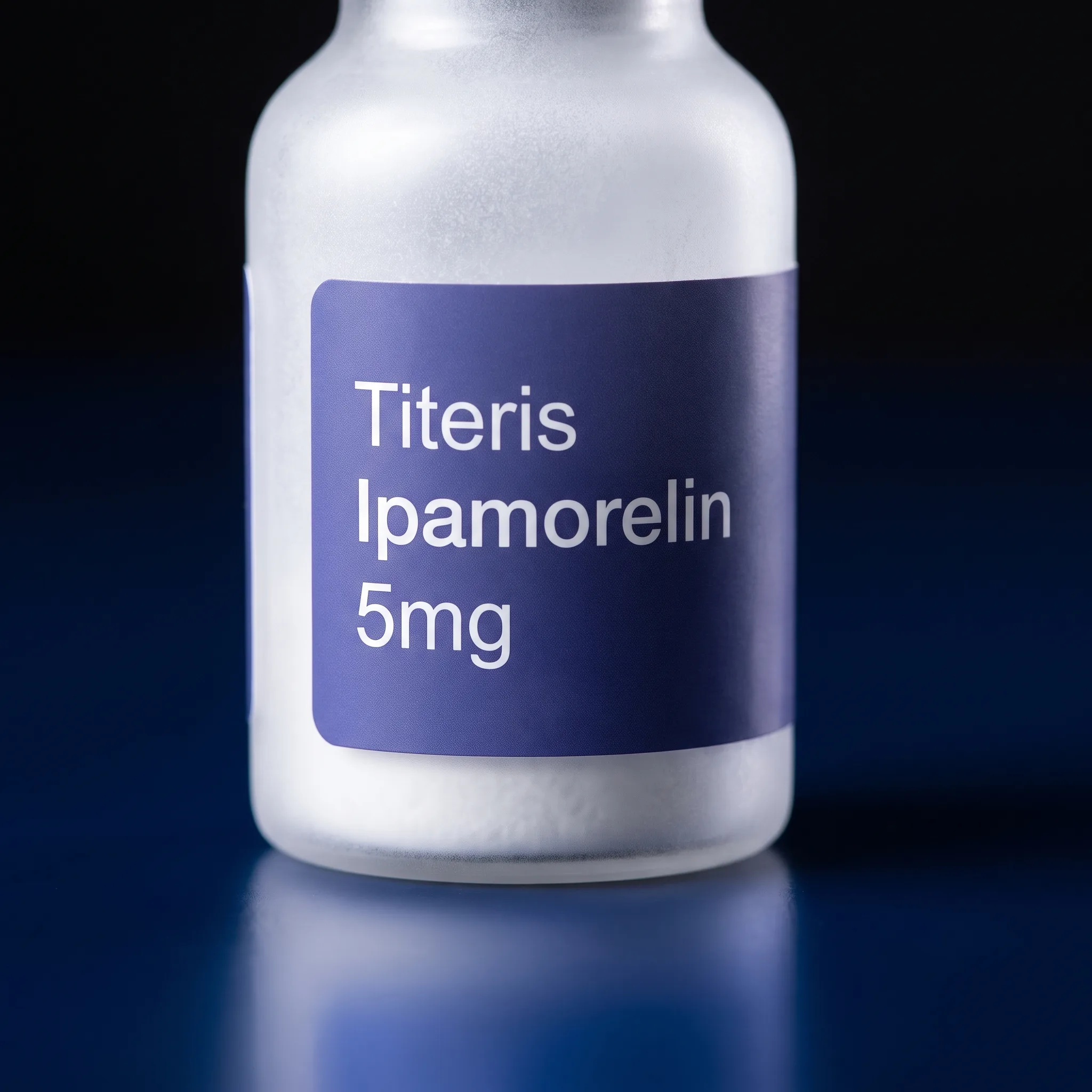 IP-5
IP-5Ipamorelin, 5mg
Supplied as a lyophilised vial for laboratory research use.
£17.99 Contact us to orderIP-10Ipamorelin, 10mg
Supplied as a lyophilised vial for laboratory research use.
£26.99 Contact us to orderIpamorelin is also available as part of our CJC-1295 + Ipamorelin blend. See our documentation policy for what supplier batch documentation covers.
Frequently asked
How does ipamorelin differ from GHRP-6 or GHRP-2?
All three are GHSR-1a agonists that stimulate GH release. The difference is selectivity. GHRP-2 and GHRP-6 also trigger significant cortisol and prolactin elevation at research doses, which complicates their use as specific GH research tools. Ipamorelin produces GH release with substantially less cortisol and prolactin stimulation, as confirmed in both animal studies and the Raun et al. 1998 human pharmacology data. That selectivity is why ipamorelin displaced the older peptides as a preferred GHRP in research literature.
Why is ipamorelin often studied with CJC-1295?
CJC-1295 is a GHRH analogue that acts on the GHRH receptor, stimulating GH secretion through a different pathway than the ghrelin/GHSR route that ipamorelin uses. In animal studies these two pathways are additive. CJC-1295 sustains GHRH-type signalling over hours; ipamorelin triggers acute pulsatile GH release through GHSR. Researchers studying GH axis modulation combine them to probe how the two pathways interact. We sell the combination as a single blend: CJC-1295 + Ipamorelin.
Is ipamorelin banned in sport?
Yes. WADA prohibits all GHRPs including ipamorelin at all times (in and out of competition) as GH-releasing peptides. This is separate from its UK legal status as a research compound.
How is it supplied?
As a lyophilised white powder in a sealed glass vial, available in 5mg and 10mg sizes. Supplied without solvent for laboratory research use. Batch documentation status is stated directly on the listing page where available.