Compound Guide
Melanotan II: what the melanocortin peptide is and what the research actually shows
A plain explanation of Melanotan II: its structure as a cyclic melanocortin receptor agonist, why it occupies a different regulatory category from Melanotan I, what the research literature has actually examined, and its status under UK law. For research use only. Nothing here is instruction for human use.
Melanotan II is NOT approved for human use in the UK and is banned from cosmetic sale. The UK Medicines and Healthcare products Regulatory Agency (MHRA) has taken enforcement action against the supply of Melanotan II for tanning or other human use purposes. Supply for cosmetic tanning or human injection is illegal in the UK. This compound is offered on this site exclusively as a research reference compound for in vitro and laboratory research use only. This is the most prominent regulatory notice on this page.
What Melanotan II is
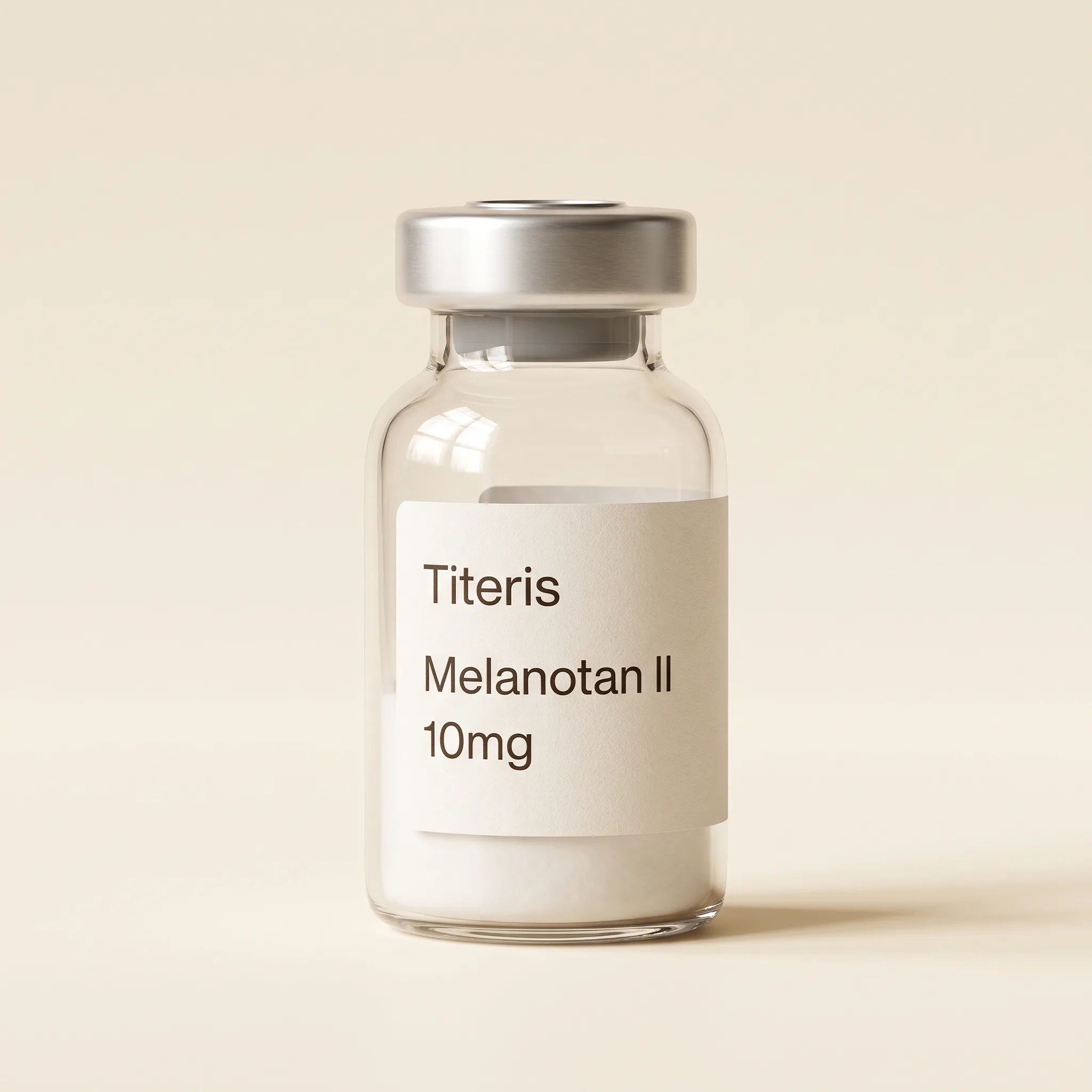
Melanotan II is a synthetic cyclic heptapeptide developed as an analogue of alpha-melanocyte-stimulating hormone (alpha-MSH). Unlike Melanotan I (afamelanotide), which binds selectively to MC1R, Melanotan II has a broader melanocortin receptor activity profile: it binds to and activates MC1R, MC3R, MC4R and MC5R.
Structurally, Melanotan II is distinguished from Melanotan I by a D-phenylalanine substitution at position 7 and a C-terminal amide group. These modifications produce a cyclic peptide with a different binding profile compared to both native alpha-MSH and to Melanotan I. The cyclisation provides resistance to proteolytic degradation, but the receptor binding profile is substantially broader.
The broader receptor activity is the central fact about Melanotan II for research purposes. MC4R activation in animal models is linked to effects on energy balance, appetite suppression, and sexual function. MC3R is involved in energy homeostasis. MC5R is expressed in exocrine glands. When Melanotan II activates all four receptor subtypes simultaneously, the observed effects in research models reflect the combined activation of multiple distinct pathways, making interpretation more complex than with a selective agonist.
Melanotan II is not a licensed medicine in the UK. It has no MHRA approval for any indication and is not approved for cosmetic use. As a research reference compound for laboratory use, it is a chemically defined molecule for basic research into melanocortin receptor pharmacology.
What the research literature has examined
The research literature on Melanotan II covers preclinical and some early clinical work, but no regulatory approval for any therapeutic indication has resulted from this research:
MC4R pharmacology
MC4R is a research target in the fields of obesity research and sexual dysfunction research. Melanotan II is used as a research tool for MC4R studies in cell models and animal experiments. The receptor's role in energy balance and food intake regulation has made it a focus of pharmaceutical research, though compounds developed for this pathway differ from Melanotan II itself. PT-141 (bremelanotide), a related melanocortin peptide acting on MC4R, received FDA approval in the United States for hypoactive sexual desire disorder, but PT-141 and Melanotan II are different compounds with different structures.
Melanogenesis research
Like Melanotan I, Melanotan II activates MC1R in melanocytes. For research specifically examining MC1R-mediated melanogenesis without confounding signals from other receptor subtypes, Melanotan I is the more appropriate tool given its selectivity. Melanotan II can still be used in comparative studies where the relative contribution of different receptor subtypes to a given response is the question being studied.
Early clinical pilot studies
Early clinical pilot studies examining Melanotan II were conducted in the 1990s. These studies did not lead to any pharmaceutical approval and identified safety concerns that contributed to the compound not advancing through clinical development. The research history of Melanotan II illustrates a common pattern in pharmacology: preclinical interest does not automatically translate to clinical success or regulatory approval.
Comparative melanocortin receptor studies
One of the legitimate uses of Melanotan II as a research tool is in comparative studies alongside selective receptor agonists and antagonists. By comparing responses to Melanotan II against MC1R-selective agonists like Melanotan I, researchers can attempt to isolate the contribution of specific receptor subtypes to observed effects. This kind of comparative pharmacology requires well-characterised reference compounds with known receptor selectivity profiles.
Laboratory context
Research reference compounds used in laboratory settings operate in a fundamentally different context from pharmaceutical products used clinically. In a laboratory, Melanotan II would be applied to cell cultures or model systems at defined concentrations to study receptor binding, downstream signalling cascades, or related mechanistic questions. Laboratory results are interpreted within the constraints of the model system and are not directly transferable to human physiology. Reproducibility of peptide experiments depends on compound quality, storage conditions, cell model selection, and protocol details.
UK regulatory status
Melanotan II is not approved for human use in the UK. It has no MHRA licence for any clinical indication. The MHRA has issued warnings about Melanotan II being sold illegally as a cosmetic tanning product and has taken enforcement action against such supply.
In the UK, supply of an unlicensed medicine for human use is an offence under the Human Medicines Regulations 2012. The MHRA classifies Melanotan II supplied for tanning or injection purposes as falling within unlicensed medicine supply. The position under cosmetics regulation is separately restrictive: the EU Scientific Committee on Consumer Safety (SCCS) determined Melanotan II is not safe for cosmetic use, and this finding informs UK regulatory positions post-Brexit.
A research reference compound containing the same molecule, supplied strictly for in vitro laboratory research, operates under a different regulatory framework. It is not a licensed medicine, cannot be marketed for human use, and must be supplied only for legitimate laboratory research purposes. Titeris does not supply Melanotan II for any purpose other than laboratory research. Nothing on this site constitutes an instruction or invitation to administer Melanotan II to a human or animal.
Our UK legal status page provides a fuller explanation of the regulatory framework for research compound supply.
Storage and handling notes
Melanotan II as a lyophilised research reference material should be stored dry, away from light, and at -20°C to maintain chemical integrity. The lyophilisation process removes water from the sample and creates a dry, stable matrix. When retrieving a vial from frozen storage, allow it to reach room temperature in closed condition before opening, to prevent moisture condensation on the peptide.
Reconstitution for laboratory use involves dissolving the lyophilised material in an appropriate diluent (bacteriostatic water or sterile water depending on the research application). Reconstituted solutions should be kept at 4°C and used promptly. Repeated freeze-thaw cycles of reconstituted solutions degrade the peptide and should be avoided. Where extended storage of reconstituted material is needed, aliquoting into single-use portions is the appropriate approach.
Standard laboratory precautions for compounds with potential biological activity apply: protective gloves, laboratory coat, and appropriate eye protection. As a research reference material rather than a licensed medicine, it does not come with pharmaceutical safety data sheets. Researchers operate according to their own institutional safety guidelines and professional judgement.
Disposal of residues should follow institutional chemical waste protocols in line with UK environmental regulations.
Melanotan II in our catalogue
MT2Melanotan II, 10mg
Supplied as a lyophilised vial for laboratory research use only.
£24.99 Contact us to orderFor laboratory use only. Not for human or veterinary consumption. See our documentation policy and UK legal status page.
Frequently asked
Why is Melanotan II regulated differently from Melanotan I in the UK?
Melanotan I (afamelanotide) has a licensed pharmaceutical application as Scenesse for erythropoietic protoporphyria, having gone through full clinical development and regulatory review. Melanotan II has no such licence and was determined by the EU Scientific Committee on Consumer Safety not to be safe for cosmetic use. The MHRA has taken enforcement action against Melanotan II supply for tanning purposes. As a result, Melanotan II sold for human use purposes is illegal in the UK. As a research reference compound for laboratory use, it operates under a different regulatory framework.
What is the difference between Melanotan II and PT-141?
PT-141 (bremelanotide) is a cyclic heptapeptide acting primarily on MC4R, which received FDA approval in the United States for hypoactive sexual desire disorder in premenopausal women. Melanotan II is a related compound with a different structure and broader receptor activity across MC1R, MC3R, MC4R and MC5R. PT-141 has a pharmaceutical approval; Melanotan II does not. They are related but distinct compounds.
Can Melanotan II be used for tanning in the UK?
No. The MHRA has been explicit that Melanotan II sold for tanning or human injection constitutes unlicensed medicine supply and is illegal. Titeris supplies Melanotan II exclusively as a research reference compound for laboratory use. Any use for cosmetic tanning or human administration is outside what this site permits and is illegal in the UK.
How is Melanotan II supplied?
As a lyophilised (freeze-dried) peptide in a sealed glass vial, supplied for laboratory use only. Not as a cosmetic or therapeutic product. Available in a 10mg vial.