Compound Guide
Oxytocin Acetate: what the neuropeptide is and what the research shows
A factual explanation of oxytocin: what the cyclic nonapeptide neuropeptide is structurally, what its broad range of functions in neuroscience and neuroendocrinology research encompasses, and where it stands under UK law. Supplied here strictly as a research reference compound for laboratory use. Nothing on this page is instruction for human use.
Oxytocin acetate sold here is a research reference compound supplied for in vitro and laboratory research purposes only. It is not licensed for human administration and has not been approved by the MHRA for any clinical use in this form. Oxytocin is a licensed prescription-only medicine when supplied as a pharmaceutical product for specific obstetric and gynaecological indications. The research compound and the pharmaceutical product are different categories. Nothing on this page is instruction or invitation to administer this compound to a human or animal.
What oxytocin is
Oxytocin is a cyclic nonapeptide (nine amino acids) synthesised in the hypothalamus and released from the posterior pituitary gland. Structurally, it has a disulfide bridge between positions 1 and 6 (between the cysteine residues), which is essential for maintaining the correct conformation of the molecule and its receptor-binding activity. Disruption of this disulfide bond inactivates the peptide. The cyclic structure imparted by this disulfide bond distinguishes oxytocin from linear peptides and is a key determinant of its selectivity for the oxytocin receptor (OXTR).
Oxytocin is closely related structurally to vasopressin (arginine vasopressin, AVP or ADH), sharing the first six amino acids but differing at positions 3 and 8. Despite this structural similarity, the two peptides bind preferentially to different receptor families: OXTR for oxytocin, and V1a, V1b, and V2 receptors for vasopressin. There is some cross-reactivity at high concentrations, which is a consideration in experimental design when using supraphysiological concentrations in vitro.
Oxytocin receptors (OXTR) are G protein-coupled receptors expressed widely throughout the brain and peripheral tissues, including the uterus, mammary gland, heart, kidney, and gastrointestinal tract. The brain expression includes areas involved in social behaviour, stress response, memory, and reward, which explains the breadth of research interest in oxytocin's neuromodulatory functions.
As a licensed pharmaceutical (Syntocinon and other brands in the UK), oxytocin is used for specific obstetric indications: induction of labour, augmentation of labour, and facilitation of milk ejection. These clinical applications are well-established and use GMP-manufactured pharmaceutical-grade oxytocin under medical supervision. The research reference compound supplied here is a different product category and does not have the same quality specifications as a pharmaceutical product.
What the research has investigated
Oxytocin has an unusually broad and active research literature, spanning reproductive physiology, neuroscience, social behaviour, stress biology, and psychiatry.
- Social bonding behaviour. In animal models, particularly in voles and rodents, oxytocin is a well-characterised molecule involved in social bonding and maternal behaviour. The role of OXTR signalling in pair bonding in prairie voles is one of the most cited examples in the behavioural neuroscience literature. These preclinical data established the research interest in oxytocin's social functions, though translating findings from animal social behaviour to human social complexity involves significant limitations that researchers in the field acknowledge.
- HPA axis interaction. Oxytocin interacts with the hypothalamus-pituitary-adrenal (HPA) axis, which governs the stress response. In animal models, oxytocinergic signalling has been associated with anxiolytic-like effects. The cellular and circuit mechanisms underlying this interaction remain an active area of investigation.
- Clinical research in psychiatric conditions. There is a body of clinical research on intranasal oxytocin in autism spectrum disorder and other conditions involving social cognition. This is an active and contested area: the mechanistic link between intranasal administration and central OXTR activation is debated, and the clinical trial results have been mixed. The scientific community has become more cautious about early claims from this research area as replication attempts have yielded inconsistent results.
- Reproductive physiology research. Oxytocin receptors in uterine smooth muscle and mammary gland are well-characterised pharmacological targets. The signalling pathways downstream of OXTR activation in these tissues are thoroughly studied and form the mechanistic basis for the compound's clinical obstetric use. Research in this area is well-grounded in established receptor pharmacology.
- Cardiovascular and renal research. OXTR expression in cardiac and renal tissue has generated interest in oxytocin's roles beyond reproduction and social behaviour. Research in these areas is at a more preclinical stage but represents a growing literature.
The oxytocin research literature is notably broad, which has contributed to popular science coverage that sometimes overstates the certainty of findings. The "love hormone" or "bonding hormone" framing is a simplification. Preclinical data from animal models are not directly transferable to complex human social behaviour, and the clinical research in psychiatric contexts has produced results that are considerably more nuanced than initial popular accounts suggested.
UK regulatory status
Oxytocin is a licensed medicine in the UK and is a prescription-only medicine (POM) for its approved obstetric and gynaecological indications. As a pharmaceutical product, it is subject to full MHRA regulatory oversight and can only be dispensed through authorised clinical channels under medical supervision.
A research reference compound containing oxytocin acetate, supplied for in vitro laboratory research and strictly not for human use, occupies a different regulatory category from the pharmaceutical product. It is not a licensed medicine in this form, is not subject to prescription requirements as a research material, and cannot be marketed or supplied for human administration. Titeris supplies oxytocin acetate only as a research reference compound, and the supply terms require purchasers to confirm they are acquiring it for legitimate laboratory research purposes. Use is restricted to those aged 18 and over.
Our UK legal status page provides a general overview of the regulatory context for research compounds. For specific legal questions, independent legal advice is appropriate.
Storage, handling, and stability
Oxytocin as a cyclic peptide with a disulfide bond requires careful storage to maintain integrity. The lyophilised form should be stored at minus 20 degrees Celsius in the dry state, protected from light. The disulfide bond can be reduced under strongly reducing conditions, and oxidative degradation can also occur under inappropriate storage conditions, so maintaining the cold chain and avoiding prolonged exposure to air after opening are important.
Before opening, the vial should be allowed to reach room temperature to prevent condensation. Reconstitution with bacteriostatic water is appropriate for most laboratory applications. The reconstituted solution should be stored at 4 degrees Celsius and used within a timescale appropriate to the compound's aqueous stability. Preparing aliquots and storing them at minus 20 degrees Celsius for single-use thaw is the recommended approach if the compound will be used across multiple experiments over time.
Standard laboratory precautions apply: protective gloves, a lab coat, and eye protection where appropriate. As a research reference compound, oxytocin acetate does not have a pharmaceutical-grade safety data sheet. Researchers follow their institutional protocols and professional judgement regarding handling of biologically active peptide compounds.
Disposal of unused compound should follow institutional guidelines for chemical and biological waste in accordance with UK environmental regulations.
Research context: oxytocin in basic science
Oxytocin is a research reference material for laboratory use. The laboratory context differs fundamentally from clinical or therapeutic applications. In controlled in vitro experiments, the compound is applied in defined concentrations to cell cultures or other model systems, and the results characterise the molecule's behaviour in those models. These findings cannot be directly extrapolated to the intact human organism, where hormonal systems operate within a complex network of feedback mechanisms and contextual variables that cell culture cannot replicate.
For neuroscience laboratories, oxytocin is used in OXTR binding and activation studies, in neuronal culture experiments investigating downstream signalling cascades, and in ex vivo tissue preparations from animal models examining electrophysiological or pharmacological responses. The availability of a defined reference compound with consistent identity is important for experimental reproducibility in these contexts.
For reproductive biology laboratories, OXTR pharmacology in uterine smooth muscle or mammary gland preparations is a well-established experimental paradigm. Oxytocin is a standard agonist tool in these preparations, and concentration-response relationships have been characterised in these systems over many years of published research.
Titeris takes a transparent approach: we describe what is known about oxytocin without making claims beyond what the evidence supports. The research literature on oxytocin is substantial in some areas and contested in others, and we represent that accurately. Nothing on this site presents oxytocin as having any specific effect in humans based on in vitro or animal data alone.
Where documentation for available batches is provided by our supplier, it is noted on the listing. Documentation is batch-specific. See our documentation policy page for further detail.
Oxytocin acetate in our catalogue
OT2Oxytocin Acetate, 2mg
Supplied as a lyophilised vial for laboratory research use.
£14.99 Contact us to orderOT10Oxytocin Acetate, 10mg
Supplied as a lyophilised vial for laboratory research use.
£54.99 Contact us to orderSee our documentation policy and our UK legal status page for the regulatory framing every listing follows.
Frequently asked
Is oxytocin really the "love hormone"?
That is a popular science simplification. Oxytocin is a neuropeptide with diverse functions in animal models involving social bonding, stress, reproductive physiology, and other areas. The translation of animal model findings to human social complexity is scientifically contested, and the clinical literature on intranasal oxytocin in psychiatric conditions has produced mixed results. As a laboratory research compound for OXTR studies, it is a well-defined molecule with clear receptor pharmacology. The "love hormone" framing overstates both the certainty and the specificity of the available evidence.
What is the difference between oxytocin and vasopressin?
Both are cyclic nonapeptides sharing the first six amino acids but differing at positions 3 and 8. They bind preferentially to different receptor families: oxytocin to OXTR, and vasopressin to V1a, V1b, and V2 receptors. They mediate different physiological effects, though there is some cross-reactivity at high concentrations. In experimental systems, using the correct concentration range and including appropriate controls helps distinguish receptor-specific effects from cross-reactivity.
How is oxytocin acetate supplied as a research compound?
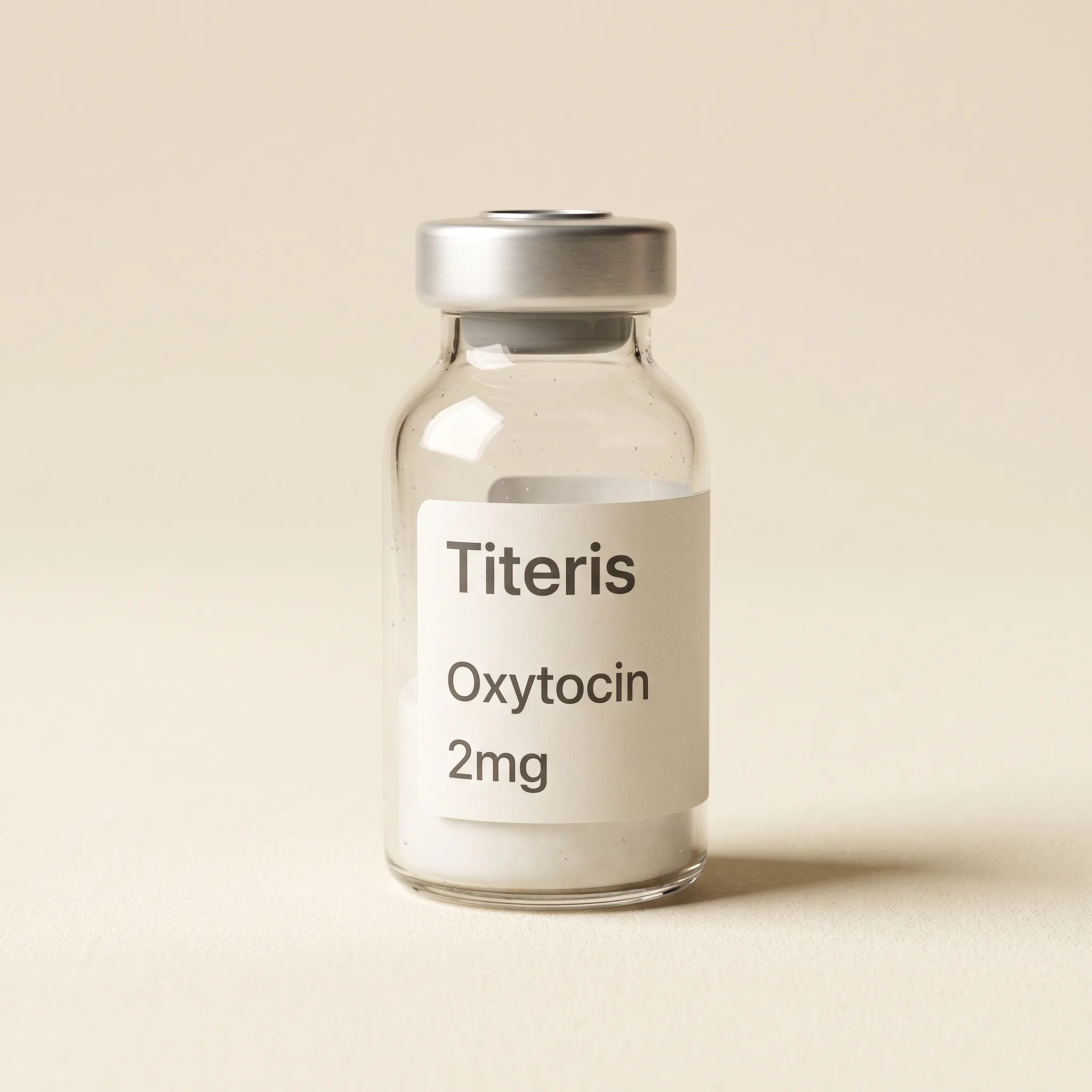
As a lyophilised peptide in a sealed glass vial, available in 2mg and 10mg sizes. It is supplied without solvent; reconstitution for laboratory use requires bacteriostatic water. Batch documentation status, where available from our supplier, is stated directly on the listing.
Is oxytocin a controlled substance in the UK?
Oxytocin is a prescription-only medicine when supplied as a pharmaceutical product for clinical obstetric use. It is not a controlled drug under the Misuse of Drugs Act. As a research reference compound for in vitro laboratory use, it occupies a different regulatory category from the pharmaceutical product. Nothing on this site supplies oxytocin for human use, and every listing is strictly for research purposes only.