Compound Guide
Semax + Selank Blend: what the combined Russian neuropeptide research compounds are
A plain explanation of Semax and Selank as combined research materials: what both compounds are structurally, what separate research literatures exist for each, and what UK regulatory status applies. For research use only. Nothing here is instruction for human use.
Semax + Selank Blend sold here is a research reference compound for in vitro and laboratory research purposes only. It is not licensed for human administration, is not a pharmaceutical product, and has not been approved by the MHRA for any clinical or therapeutic use. The research applications discussed on this page are from published scientific literature and are referenced for scientific context only. They are not an endorsement of human use of this compound. If you have questions about anxiety, cognitive function, or related health matters, consult a registered healthcare professional.
What Semax and Selank are
Semax is a synthetic heptapeptide with the sequence Met-Glu-His-Phe-Pro-Gly-Pro, derived from the ACTH(4-7) fragment and developed at the Russian State Research Institute of Highly Pure Biopreparations. Selank is a synthetic heptapeptide with the sequence Thr-Lys-Pro-Arg-Pro-Gly-Pro (TKPRPGP), derived from the tuftsin tetrapeptide Thr-Lys-Pro-Arg, with a C-terminal Pro-Gly-Pro extension added to improve metabolic stability. Both compounds were developed in Russia, and both hold Russian pharmaceutical approvals that do not extend to the UK or EU.
Semax is approved in Russia as a nasal pharmaceutical product for ischaemic stroke and cognitive disorders. Selank is approved in Russia as an anxiolytic nasal spray. Neither compound has received MHRA approval for any indication in the UK, and neither is available through the UK healthcare system as a licensed medicine.
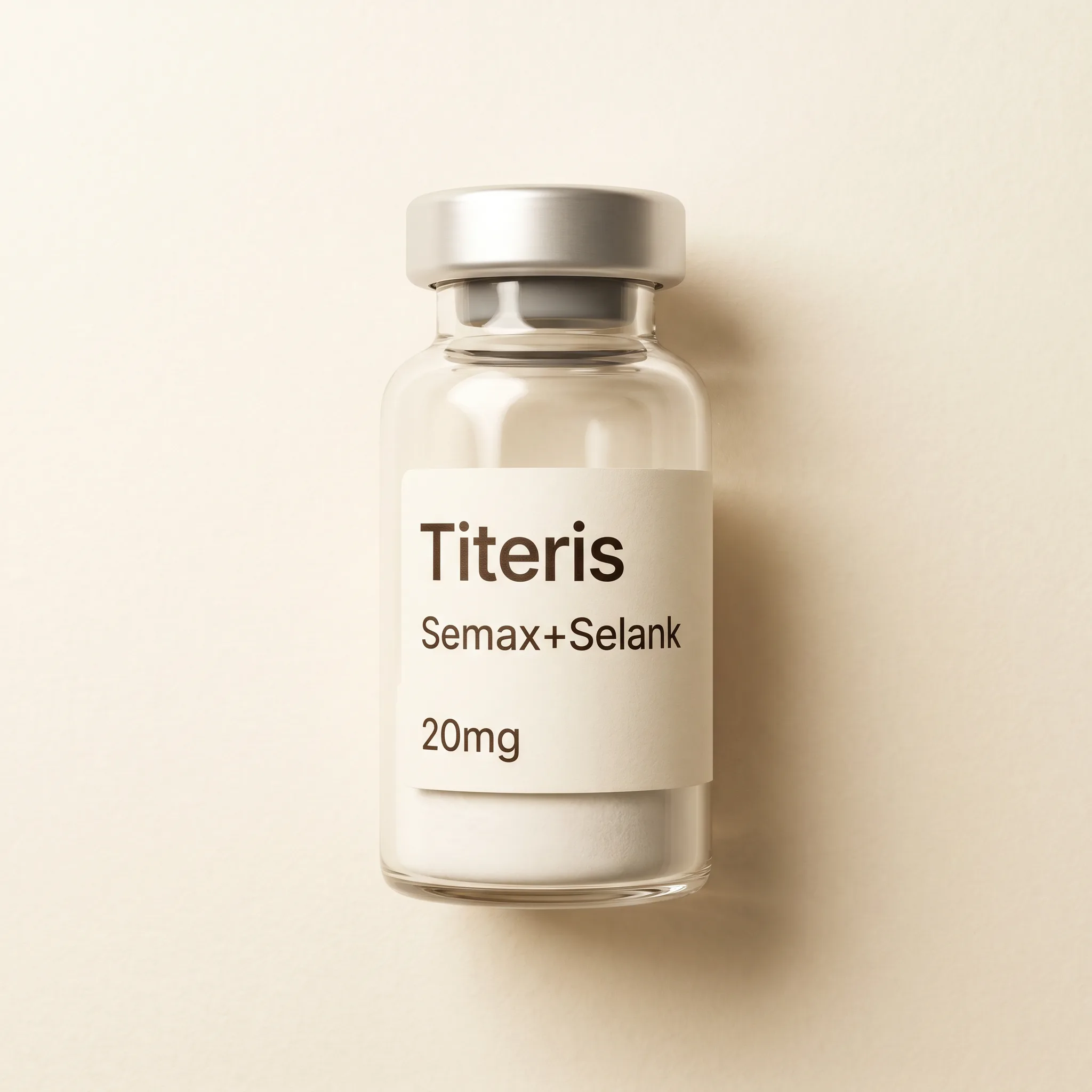
As a combined research blend, this product provides researchers with both compounds in a single vial, supplied as 10mg Semax and 10mg Selank per 20mg vial. This configuration is suited to research protocols that wish to investigate both ACTH fragment signalling and tuftsin receptor mechanisms simultaneously, or to compare the effects of the two peptides under identical conditions without separate reconstitution.
Both compounds are for research use only. The blend is not a pharmaceutical product, not for human use, and not approved by the MHRA for any clinical application.
What the research shows for each compound
Semax and Selank have separate research literatures that researchers should consider independently:
Semax research
- ACTH fragment pharmacology. Semax activates melanocortin receptors and has been described in preclinical studies as having effects on BDNF and NGF expression in hippocampal tissue in animal models. The ACTH fragment scaffold has a long history in neuroscience research for mnemonic and cognitive effects in preclinical systems.
- Russian clinical studies. Semax has been evaluated in Russian clinical studies for ischaemic conditions and cognitive function. These studies form the basis of its Russian approval. The clinical data are published in the literature, but they have not undergone EMA or MHRA regulatory review and do not constitute evidence in the UK regulatory sense.
- Neurotrophin research. The proposed connection between Semax administration and changes in BDNF and NGF levels in preclinical models is an active area of basic neuroscience research. Whether this effect is mediated through melanocortin receptors or other pathways is a question that continues to be investigated.
Selank research
- Tuftsin derivative pharmacology. Tuftsin is an endogenous tetrapeptide with immunomodulatory properties. Selank, as a stabilised tuftsin analogue with the Pro-Gly-Pro extension, shows anxiolytic properties in animal models without the sedative effects associated with benzodiazepines. This profile makes it of interest to anxiety neuroscience research.
- GABAergic and serotonergic modulation. Selank has been described in preclinical studies as modulating GABAergic and serotonergic systems, both of which are relevant to anxiety regulation. These preclinical data are the mechanistic basis for the anxiolytic activity observed in animal models.
- Russian clinical anxiety studies. Russian clinical studies of Selank in anxiety disorders have been published. These studies have not undergone EMA or MHRA review and do not constitute clinical evidence in the UK regulatory context, but they provide mechanistic context for the research literature.
Combination research rationale
The simultaneous study of both compounds is a research approach relevant for protocols investigating cognitive and anxiolytic signalling pathways together. The two compounds act through distinct mechanisms, with Semax primarily engaging melanocortin receptor pathways and Selank working through tuftsin receptor and GABAergic systems. Laboratories studying the interaction between these systems, or designing research protocols with multiple neurobiological readouts, may find value in having both compounds co-formulated in a single preparation.
Mechanistic background: two distinct neuropeptide scaffolds
Understanding Semax and Selank as research tools requires understanding their distinct structural origins and proposed mechanisms, which are different in important ways.
Semax draws on the melanocortin receptor pharmacology of ACTH fragments. The ACTH(4-7) core sequence, Met-Glu-His-Phe, is the minimal active fragment for melanocortin receptor interactions. The Pro-Gly-Pro extension in Semax improves stability compared to the minimal fragment. Research using Semax as a tool is concerned with melanocortin receptor biology, neurotrophin signalling, and the cognitive effects of these pathways, which have been studied across a range of animal models.
Selank draws on the tuftsin pharmacology. Tuftsin (Thr-Lys-Pro-Arg) is a fragment of the heavy chain of IgG that is cleaved by leucine aminopeptidase and carboxypeptidase B. In its natural form it is rapidly degraded. Selank's Pro-Gly-Pro extension stabilises the molecule and extends its effective half-life, which is the key innovation that distinguishes it from tuftsin itself. The proposed anxiolytic mechanism involves GABA receptor modulation and serotonergic effects, pathways that are distinct from those engaged by Semax.
For researchers using the Semax + Selank blend, the key experimental design consideration is that the two compounds act through different receptor systems and signalling pathways. This means that observed effects in a given assay may reflect the contribution of either or both compounds, and disentangling these contributions requires parallel single-compound controls. Including Semax alone, Selank alone, and the blend in the same experiment is the appropriate approach for understanding the relative contributions of each component.
The combination in a single vial is a practical convenience for researchers who have already established single-compound activity in their system and wish to investigate potential interactions. It is not intended to imply that the combination has been characterised as a fixed-ratio formulation with defined combined properties, as that characterisation would require its own experimental programme.
UK regulatory status
Neither Semax nor Selank is a licensed medicine in the UK. Their Russian pharmaceutical approvals are not recognised by the MHRA. Both compounds are not available through the UK healthcare system. As research reference compounds for in vitro laboratory use, this blend is provided under a research-use-only framework and cannot be marketed or supplied for human use. Every listing on this site follows this research-use-only framework.
See our UK legal status page for the broader regulatory framework that applies to research peptide compounds in the UK.
Semax + Selank Blend in our catalogue
CS20Semax + Selank Blend, 20mg
10mg Semax and 10mg Selank per vial. Lyophilised for laboratory research use.
£54.99 Contact us to orderSee our documentation policy for what supplier batch documentation covers, and our UK legal status page for the regulatory framing every listing follows.
Laboratory context: how the Semax + Selank Blend is used in basic research
This blend is a research reference material for laboratory use. Controlled in vitro experiments using the blend, or either compound individually, address questions in melanocortin receptor pharmacology, tuftsin biology, neurotrophin regulation, and anxiety-related neurobiological pathways. Results from these experiments must be interpreted within the specific model system used and cannot be extrapolated to human clinical outcomes without extensive further validation.
Titeris supplies the Semax + Selank Blend as a lyophilised combination of both peptides in a single sealed glass vial, 20mg total weight. Storage at -20 degrees Celsius in the dry state is recommended. After reconstitution in bacteriostatic water, the solution should be used promptly or stored at 4 degrees Celsius for short-term use. Aliquoting before freezing is recommended to preserve both components across multiple experiments.
For researchers who need to test each compound separately first before working with the combination, Titeris may be able to supply Semax and Selank as individual research reference materials. Contact us for more information on single-compound availability.
Research reference materials like this blend are not clinical investigational products and have not been reviewed by the MHRA for any therapeutic application. Handling should follow institutional laboratory safety guidelines. Standard protective equipment and disposal under institutional chemical waste guidelines under UK environmental regulations apply.
Frequently asked
What is tuftsin and how does it relate to Selank?
Tuftsin is an endogenous tetrapeptide (Thr-Lys-Pro-Arg) derived from the Fc region of IgG heavy chains by enzymatic cleavage. It has immunomodulatory properties in its natural form but is rapidly degraded. Selank is a stabilised analogue of tuftsin with a C-terminal Pro-Gly-Pro extension that increases metabolic stability and extends half-life, enabling more sustained engagement with its target systems in preclinical experimental settings.
Are Semax and Selank the same compound?
No. Semax is derived from the ACTH fragment scaffold and engages melanocortin receptors. Selank is derived from tuftsin and has a different receptor profile with proposed effects on GABAergic and serotonergic systems. They have different amino acid sequences, different structural origins, and different preclinical pharmacological profiles. The blend contains both compounds for researchers who wish to investigate both systems simultaneously.
How is the blend supplied as a research reference material?
As a lyophilised combination of both peptides in a single sealed glass vial, 20mg total (10mg Semax and 10mg Selank). Supplied without solvent; reconstitution for laboratory use requires bacteriostatic water or sterile water depending on the specific research protocol.
Is the Semax + Selank Blend legal to buy in the UK?
As research reference compounds for in vitro laboratory use, neither Semax nor Selank is a controlled substance in the UK, and they can be supplied under a research-use-only framework. They cannot be marketed or supplied for human use. Every listing on this site is for research use only. See our UK legal status page for more detail.