Compound Guide
Sermorelin Acetate: what the GHRH(1-29) analogue is and what the research shows
A plain explanation of Sermorelin: how this N-terminal fragment of GHRH functions as a research tool, what the older clinical literature covers, and where the compound stands under UK law today. Research use only. Nothing here is guidance for human use.
Sermorelin Acetate sold here is a research reference compound for in vitro and laboratory research purposes only. It is not licensed for human administration, is not a pharmaceutical product, and has not been approved by the MHRA for any clinical or therapeutic use. GHRH(1-29) analogue, research use only. The applications discussed on this page are drawn from published research literature and historical clinical data, provided for scientific context only. They are not an endorsement of human use. If you have questions about growth hormone health, consult a registered healthcare professional.
What Sermorelin is
Sermorelin is the N-terminal fragment of human growth hormone-releasing hormone (GHRH), comprising amino acids 1 through 29 of the full 44-amino acid native sequence. This fragment is formally designated GHRH(1-29)-NH2, where the NH2 notation indicates that the C-terminus is amidated rather than free-acid, which was the formulation used in the pharmaceutical product Geref.
The retention of biological activity in this truncated fragment is not coincidental. The N-terminal portion of GHRH carries the primary receptor-binding and receptor-activating pharmacophore. The C-terminal portion of native GHRH contributes to plasma stability and receptor selectivity but is not strictly necessary for receptor activation. Sermorelin therefore represents the minimum active fragment of GHRH that can meaningfully engage the GHRH receptor (GHRHR) in a research or clinical context.
Compared with newer GHRH analogues such as Tesamorelin (GHRH with a fatty acid modification) and CJC-1295 (with or without the drug affinity complex), Sermorelin has no modifications to resist DPP-4 enzymatic cleavage and no albumin-binding extension. Its plasma half-life is consequently measured in minutes rather than days. This short half-life was a limitation of Geref as a therapeutic, since it required frequent administration, but it is scientifically interesting for research purposes: a short-lived GHRH stimulus enables time-resolved studies of pituitary GH reserve and hypothalamic-pituitary axis responsiveness.
Sermorelin is supplied as the acetate salt, which is the most common and stable form for lyophilised peptide preparations. The acetate counterion improves solubility and shelf stability and was the formulation used in the original pharmaceutical product. The acetate salt designation does not alter the biological activity of the peptide itself.
The compound was originally developed in the 1970s and 1980s as part of efforts to characterise GHRH receptor pharmacology following the isolation of native GHRH in the early 1980s. Sermorelin thus has a longer research history than most modern research peptides, which is reflected in the comparatively large body of older scientific literature.
What the research has examined
Sermorelin has a relatively broad older literature as the first clinically used GHRH analogue:
- GH stimulation testing. Sermorelin was used clinically as a diagnostic tool for GH deficiency. A defined Sermorelin stimulus allowed measurement of pituitary GH reserve: the pituitary's capacity to release GH in response to GHRH stimulation. This diagnostic approach underpinned part of the data package that supported Geref's approval. In this context, the compound's short half-life was a feature rather than a limitation, since a brief, well-defined stimulus followed by serial GH sampling is the basis of a stimulation test.
- Age-related GH-axis research. Hypothalamic GHRH secretion declines with age, which contributes to the reduction in pulsatile GH output seen across adulthood. Sermorelin was used in older research as a pharmacological challenge to assess how pituitary responsiveness to GHRH changes over time. These studies helped characterise the relative contributions of hypothalamic and pituitary factors to age-related GH decline.
- Sleep-related GH secretion. GH is released preferentially during slow-wave sleep stages, with the majority of daily GH output occurring in the first few hours of sleep. GHRH has been investigated in connection with sleep architecture, and Sermorelin has appeared in research examining GHRH administration and sleep-stage GH patterns. This is a distinct research area from the diagnostic applications and represents basic science into GH pulse physiology.
- Paediatric GH-axis research. From the therapeutic application in children with GH deficiency, Sermorelin contributed data on pituitary responsiveness in that population. These data relate to the pharmaceutical formulation under clinical conditions and are not applicable to a research reference compound used outside those conditions.
- Receptor pharmacology. As the first synthetic GHRH fragment to see widespread research use, Sermorelin served as a reference ligand in early GHRHR pharmacology studies, contributing to the mapping of which segments of the GHRH molecule are necessary for receptor binding and activation.
The older literature on Sermorelin is more extensive than for many newer research peptides, a direct consequence of its earlier clinical application. Researchers should note that those data relate to the pharmaceutical medicine, not to a research reference compound.
Mechanism: GHRH receptor agonism
Sermorelin binds the GHRH receptor (GHRHR), a G-protein coupled receptor expressed primarily on somatotroph cells in the anterior pituitary. GHRHR coupling to Gs activates adenylate cyclase, raising intracellular cyclic AMP (cAMP), which through protein kinase A signalling promotes both GH gene transcription and GH vesicle exocytosis. The net result is an increase in circulating GH.
The rapid enzymatic clearance of Sermorelin by DPP-4 and other peptidases means that its biological effect in a living system is brief and self-limiting. This kinetic profile is mechanistically distinct from that of DAC-modified CJC-1295, which has a half-life measured in weeks through albumin binding. For researchers interested in the short-pulse GH physiology that characterises normal pituitary secretion, Sermorelin's rapid clearance is relevant; for studies wanting sustained GHRHR activation, a longer-acting analogue may be more appropriate.
Sermorelin does not directly affect GHSR-1a (the ghrelin receptor) and therefore does not reduce somatostatin tone through the same pathway as GHRP compounds. For studies wanting to isolate GHRH receptor pharmacology from GHSR-1a effects, Sermorelin is a clean GHRH receptor agonist without that confounding signal.
UK regulatory status
Sermorelin is not approved by the MHRA for any clinical indication in the UK. Geref, the pharmaceutical Sermorelin acetate product, was previously approved in the US for GH deficiency diagnostics and paediatric GH therapy but was withdrawn from the market when manufacture was discontinued. That withdrawal predated the compound's more recent interest as a research tool. The withdrawal was a commercial and manufacturing decision, not a safety finding.
As a GHRH analogue, Sermorelin is listed on the WADA prohibited list under the S2 category. This applies in the sporting context. As a research reference compound for laboratory use, the regulatory category is different: it is not a licensed medicine, cannot be marketed for human use, and is supplied by Titeris strictly for research purposes.
Our UK legal status page explains the regulatory framework that applies to research peptides in the UK in more detail.
Laboratory context and handling
In laboratory settings, Sermorelin is used to probe GHRH receptor pharmacology in cell cultures, to characterise pituitary GH secretion dynamics in explant or animal models, and in comparative studies alongside newer GHRH analogues to understand how modifications to the native sequence affect receptor binding, selectivity, and half-life.
For in vitro work, typical applications include GHRHR binding assays using competitively labelled Sermorelin or displacement studies with the research compound and a labelled reference ligand, cAMP accumulation assays measuring downstream signalling in GHRHR-expressing cells, and GH secretion assays in primary pituitary cell cultures.
Reconstitution for laboratory use is typically with sterile water or bacteriostatic water. Sermorelin has good solubility in aqueous solvents at typical research concentrations. After reconstitution, storage at four degrees Celsius with prompt use is standard; aliquoting to avoid repeated freeze-thaw cycles is recommended for longer-term storage of the reconstituted solution.
The lyophilised powder should be stored at minus twenty degrees Celsius, dry and away from light. Sermorelin's 29-amino acid sequence does not contain methionine, which reduces oxidation risk relative to some other research peptides, but standard peptide storage conditions should still be followed.
Sermorelin as a research reference material is not a clinical investigational product and has not been manufactured to the GMP standards required for clinical trial use. Results from in vitro or preclinical work should be interpreted and published with that distinction clearly stated.
Sermorelin Acetate in our catalogue
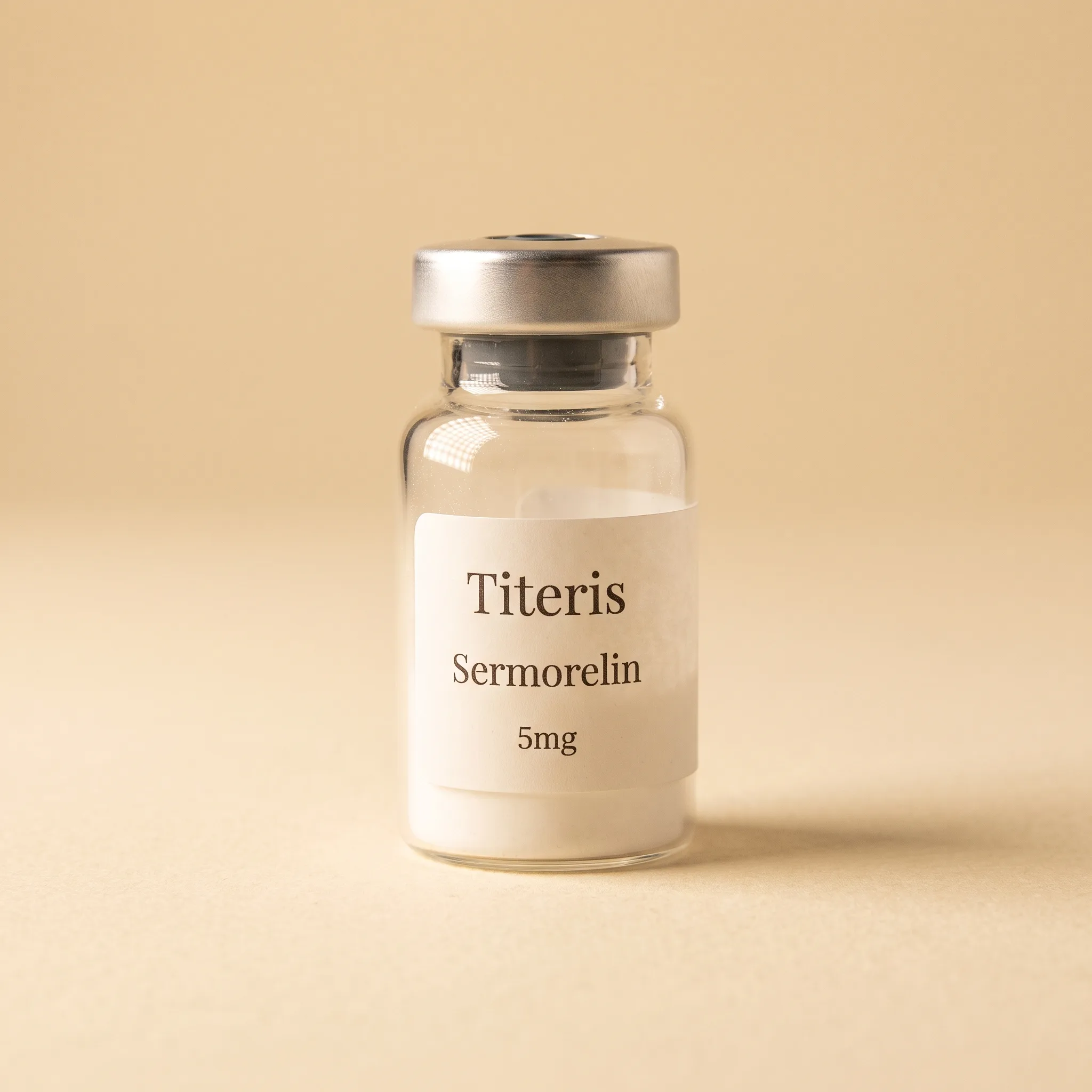
SMO5Sermorelin Acetate, 5mg
Supplied as a lyophilised vial for laboratory research use.
£32.99 Contact us to orderSMO10Sermorelin Acetate, 10mg
Supplied as a lyophilised vial for laboratory research use.
£59.99 Contact us to orderSee our documentation policy for what supplier batch documentation covers, and our UK legal status page for the regulatory framing every listing follows.
Frequently asked
What is the difference between Sermorelin and Tesamorelin?
Sermorelin is GHRH(1-29) without modification, with a plasma half-life measured in minutes. Tesamorelin is GHRH(1-44) with a trans-3-hexenoic acid modification at the N-terminus that improves stability against enzymatic degradation and extends its half-life. Tesamorelin is approved in the US as Egrifta for HIV-associated lipodystrophy. Sermorelin's pharmaceutical product (Geref) was withdrawn from the market when manufacture was discontinued. Both are available as research reference compounds from Titeris.
Was Sermorelin ever approved as a medicine?
Yes, in the US. Geref (Sermorelin acetate) was approved by the FDA for GH deficiency diagnostics and for the treatment of inadequate GH secretion in children. The product was withdrawn from the market when its manufacturer discontinued production. The withdrawal was a commercial decision, not a safety-related one. No MHRA approval for Sermorelin exists in the UK. The research reference compound is not a substitute for the former pharmaceutical product.
Why is Sermorelin supplied as the acetate salt?
Sermorelin Acetate is the most stable salt form for storage and lyophilisation. The acetate counterion improves solubility and shelf stability, which are practical considerations for a research compound that may be stored for extended periods. This is a standard formulation choice for lyophilised peptides and does not affect the biological activity of the peptide itself.
How is it supplied?
As a lyophilised (freeze-dried) white powder in a sealed glass vial. Supplied without solvent; reconstitution for laboratory use requires sterile water or bacteriostatic water. Available in 5mg and 10mg vials.