Compound Guide
SNAP-8: what the octapeptide is and what the research shows
A plain explanation of SNAP-8: what this synthetic octapeptide is, how it relates to the SNAP-25 protein sequence and the SNARE complex, and what the research literature on SNARE-modulating peptides has examined. Octapeptide studied in the context of expression wrinkle research, for research use only.
SNAP-8 sold here is a research reference compound for in vitro and laboratory research purposes only. It is not licensed for human administration, is not a pharmaceutical product, and has not been approved by the MHRA for any clinical or therapeutic use. Nothing on this page constitutes medical advice or instruction for use on humans or animals.
What SNAP-8 is
SNAP-8 is a synthetic octapeptide developed as a research analogue of an N-terminal sequence of the SNAP-25 protein (Synaptosomal-Associated Protein 25). SNAP-25 is a membrane-anchored protein that functions as a component of the SNARE complex, the molecular machinery responsible for fusing synaptic vesicles with the presynaptic membrane during neurotransmitter release.
The SNARE complex forms when SNAP-25 interacts with syntaxin and synaptobrevin (VAMP) to create the four-helix bundle that drives membrane fusion. The N-terminal domain of SNAP-25 contributes specific helices to that bundle. SNAP-8 was designed to competitively occupy that binding position, interfering with SNARE complex assembly and consequently modulating acetylcholine release at the neuromuscular junction in laboratory models.
The conceptual relationship to botulinum toxin (Botox) is often the first question researchers raise. Botulinum toxin cleaves SNARE proteins irreversibly and completely blocks neurotransmitter release at the neuromuscular junction. SNAP-8 is a short peptide that competes for a binding site in SNARE complex assembly, producing effects in cell models that are weaker, more targeted, and reversible compared to the toxin. SNAP-8 is not a botulinum toxin, does not work by the same mechanism, and is not pharmacologically equivalent. The conceptual link is that both modulate the same SNARE-dependent process at the neuromuscular junction, but via entirely different chemical classes and mechanistic routes.
SNAP-8 is not a finished cosmetic product, not a pharmaceutical, and not a botulinum toxin substitute. It is a research reference material for studies of SNARE complex biology and neuromuscular signalling in laboratory settings.
What the research has examined
SNAP-8 has a specific research context spanning SNARE complex biology and cosmetic peptide investigation:
- SNARE complex research. The SNARE complex is a fundamentally important mechanism for vesicle fusion across all cell types, not exclusively neurons. Research into SNARE complex assembly, regulation, and inhibition uses a variety of experimental tools, including synthetic peptides that compete with endogenous SNARE protein interactions. SNAP-8 has been used in this context as a research tool for studying SNARE complex formation in cell models.
- Cosmetic peptide research. SNAP-8 has been investigated in cosmetic research settings examining effects on muscle contraction-related processes in cell models, particularly in the context of expression wrinkle research. These studies are not clinical drug trials and use cosmetic research endpoints, which differ methodologically from pharmaceutical clinical investigation.
- Comparison with Argireline. Argireline (Acetyl-Hexapeptide-3, also called Acetyl-Hexapeptide-8) is a shorter six-amino acid analogue derived from the same N-terminal SNAP-25 region. The research literature comparing these two compounds has investigated whether the additional two amino acids in SNAP-8 provide a broader contact surface with the SNARE complex and potentially a different potency profile in cell models. The methodological literature on these two compounds overlaps substantially.
- Peptide libraries for neuromuscular research. SNAP-8 is part of a class of peptides synthesised for basic research into neuromuscular transmission mechanisms. Understanding the molecular requirements for SNARE complex inhibition by competitive peptides contributes to the broader field of vesicle biology.
- Structure-activity relationship studies. The availability of both SNAP-8 (8 amino acids) and shorter analogues like Argireline (6 amino acids) enables structure-activity relationship studies examining how peptide length and sequence affect SNARE complex binding affinity and downstream effects on neurotransmitter release in cell models.
Mechanism: SNARE complex inhibition
The SNARE complex forms through a zippering mechanism in which the helical domains of syntaxin, SNAP-25 (contributing two helices), and VAMP align into a tight four-helix bundle. This zippering process pulls the vesicle and target membranes together, driving fusion and releasing vesicle contents. In neurons, this releases neurotransmitters including acetylcholine into the synaptic cleft.
SNAP-8, as an analogue of the N-terminal domain of SNAP-25, competes with that domain for participation in the four-helix bundle. By occupying part of the SNARE assembly interface, SNAP-8 can reduce the efficiency of SNARE complex formation in cell models and consequently reduce acetylcholine exocytosis in neuromuscular cell systems. The competitive inhibition is concentration-dependent and reversible, in contrast to the covalent and essentially irreversible cleavage produced by botulinum toxin.
The SNARE complex is not exclusive to synapses; it is a general mechanism for membrane fusion found in many cell types, including skin cells involved in secretory processes. This broader relevance to vesicle biology is one reason SNARE-modulating peptides attract research interest beyond pure neuroscience.
It is important to note that in vitro observations of SNAP-8's effects on SNARE complex formation or neurotransmitter release in cell models do not directly translate to efficacy predictions for any application outside those controlled experimental conditions. Cell models are reductive representations of complex biological systems, and findings from them require extensive further investigation before any conclusions about human applications could be justified.
UK regulatory status
SNAP-8 is not a licensed pharmaceutical product and has no MHRA approval for any clinical indication. It is not on the WADA prohibited list. As a research reference compound for laboratory use, it is distinct from regulated pharmaceutical medicines and cannot be marketed for human use.
SNAP-8 is distinct from botulinum toxin preparations, which are prescription-only medicines in the UK regulated by the MHRA and require prescription and administration by qualified healthcare practitioners. SNAP-8 is a short synthetic peptide, not a toxin preparation, and is regulated as a research compound rather than as a medicine.
Our UK legal status page provides further detail on the regulatory framework for research peptides in the UK.
Laboratory context and handling
In laboratory settings, SNAP-8 is used in SNARE complex inhibition studies, competitive binding assays examining SNAP-25 peptide interactions, and in vitro studies of neuromuscular junction physiology using appropriate cell models. The compound can also be used in comparative studies with Argireline and other SNAP-25-derived peptides to map structure-activity relationships in this compound class.
Reconstitution for laboratory use is typically with sterile water or bacteriostatic water. SNAP-8 is water-soluble at typical research concentrations. After reconstitution, store at four degrees Celsius and use promptly; aliquoting is recommended to avoid repeated freeze-thaw cycles for any material intended for use over a longer period.
The lyophilised vial should be stored at minus twenty degrees Celsius, dry and away from light. SNAP-8 does not contain particularly sensitive amino acids (no methionine, cysteine, or tryptophan in the eight-residue sequence), but standard peptide storage conditions should be maintained to preserve the integrity of the material over time.
Standard laboratory safety equipment should be used when handling SNAP-8: gloves, lab coat, and eye protection where relevant. Disposal should follow institutional chemical waste procedures. The compound should be treated as a substance with potential biological activity as a matter of standard practice.
SNAP-8 in our catalogue
SNP10See our documentation policy for what supplier batch documentation covers, and our UK legal status page for the regulatory framing every listing follows.
Frequently asked
Is SNAP-8 the same as Botox?
No. Botulinum toxin (Botox) is a protein neurotoxin that irreversibly cleaves SNARE proteins, completely blocking neurotransmitter release at the neuromuscular junction. SNAP-8 is a short synthetic octapeptide that competitively inhibits SNARE complex assembly in cell models. The two operate via entirely different chemical classes, different mechanisms, and with fundamentally different potency and reversibility profiles. SNAP-8 is a research compound; botulinum toxin preparations are prescription-only medicines regulated for specific clinical indications.
What is the difference between SNAP-8 and Argireline?
Argireline (Acetyl-Hexapeptide-3, or Acetyl-Hexapeptide-8) has six amino acids; SNAP-8 has eight. Both are derived from the same N-terminal SNAP-25 sequence region. SNAP-8 is proposed to have a wider contact surface with the SNARE complex due to its additional amino acids, though the precise pharmacological consequences of this structural difference in cell models is the subject of ongoing comparative research.
Is SNAP-8 approved for human use in the UK?
No. SNAP-8 has no MHRA approval for any clinical indication. It is not a pharmaceutical product, not a licensed cosmetic active for consumer use, and is supplied by Titeris strictly as a research reference compound for laboratory research purposes only.
How is SNAP-8 supplied?
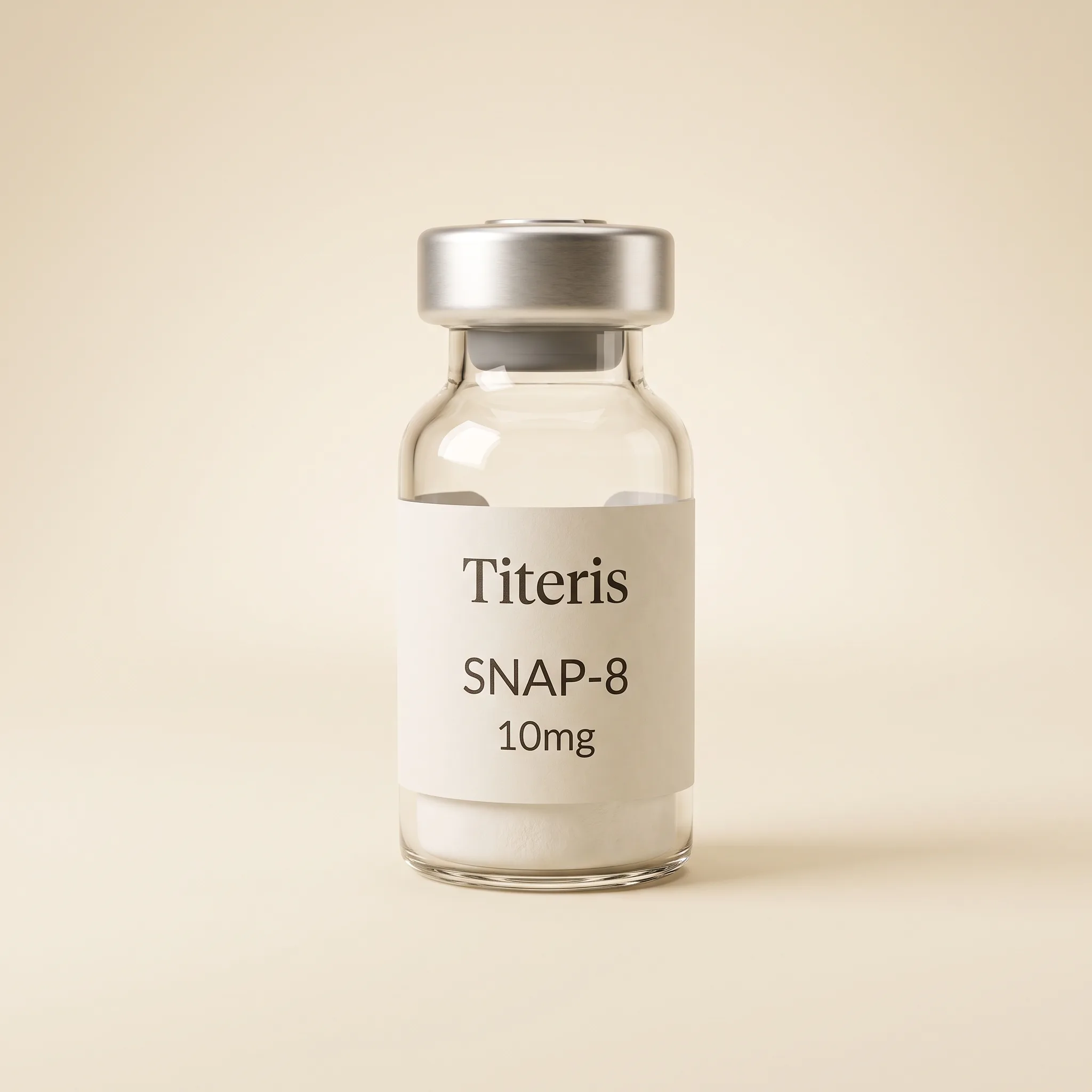
As a lyophilised (freeze-dried) white powder in a sealed glass vial. Supplied without solvent; reconstitution for laboratory use requires sterile water or bacteriostatic water depending on the specific research application. Available in a 10mg vial.