Compound Guide
SS-31 (Elamipretide): what the mitochondria-targeted tetrapeptide is and what the research actually shows
A plain, factual explanation of SS-31: how the peptide targets mitochondria, what role cardiolipin plays in that mechanism, and what the research literature has actually examined. Research use only. Nothing on this page is instruction for human use.
SS-31 (Elamipretide) sold here is a research reference compound for in vitro and laboratory research purposes only. It is a mitochondria-targeted tetrapeptide supplied strictly for research use only. It is not licensed for human administration, is not a pharmaceutical product, and has not been approved by the MHRA for any clinical or therapeutic use. The research applications discussed on this page are from published literature and are referenced for scientific context only. If you have health concerns, consult a registered healthcare professional.
What SS-31 is
SS-31, also known by the research name Elamipretide, is a synthetic tetrapeptide with the sequence D-Arg-2',6'-Dmt-Lys-Phe-NH2. The unusual amino acid composition, particularly the inclusion of 2',6'-dimethyltyrosine as a building block, is not accidental: it is matched to the function of the peptide. SS-31 selectively concentrates in the inner mitochondrial membrane and binds to cardiolipin.
Cardiolipin is a phospholipid found almost exclusively in the inner mitochondrial membrane. It is necessary for the structural integrity of the respiratory chain complexes and the ATP synthase. With ageing and under oxidative stress, cardiolipin structure is altered, impairing mitochondrial function. This is the biological context in which SS-31 is of interest as a research tool for studying mitochondrial mechanisms.
SS-31 is not a vitamin, a dietary supplement, or a medicine. It is a chemically defined compound for basic research into mitochondrial function. The SS peptides (Szeto-Schiller peptides) were developed in the laboratory of Hazel Szeto, from which the designation derives. As a research reference material, it is supplied as a lyophilised tetrapeptide for use in controlled laboratory experiments. It must not be used for human or veterinary administration.
The cardiolipin mechanism
SS-31 crosses the outer mitochondrial membrane passively and concentrates in the inner mitochondrial membrane through electrostatic interactions. There it binds to cardiolipin. This binding appears to reduce the displacement of cytochrome c from cardiolipin, an event that plays a role in initiating the mitochondrial apoptosis cascade.
Cardiolipin is necessary for the formation of so-called supercomplexes (respirasomes) from multiple respiratory chain complexes. These supercomplexes are more efficient than individual free complexes. The stabilisation of cardiolipin structure by SS-31 is discussed as a possible mechanism for the observed effects on mitochondrial efficiency in laboratory models. This remains an active research area without a definitive settled consensus.
The 2',6'-dimethyltyrosine residue in SS-31's sequence contributes to its ability to scavenge reactive oxygen species in the mitochondrial environment, which is an additional feature relevant to oxidative stress research. The combination of cardiolipin binding and local antioxidant activity makes SS-31 a compound with multiple potential mechanisms relevant to mitochondrial biology, which is one reason it appears across several research areas.
From a structural biology perspective, the interaction between SS-31 and cardiolipin involves the specific molecular geometry of the tetrapeptide. The presence of the two positively charged residues (D-Arg and Lys) enables electrostatic attraction to the negatively charged phosphate groups of cardiolipin, while the aromatic residues (2',6'-Dmt and Phe) insert into the lipid bilayer. Understanding this binding geometry is an area of ongoing research interest.
What the research has examined
SS-31 has a comparatively substantial preclinical literature and has been the subject of several early-phase clinical investigations. The breadth of research interest reflects the fundamental importance of cardiolipin to mitochondrial function across many cell types.
Cardiovascular models
In animal models for heart failure and ischaemic heart disease, SS-31 has been studied for effects on mitochondrial function and tissue integrity following ischaemic insult. There were early-phase clinical studies with elamipretide in heart failure populations, conducted with the clinical investigational product under controlled conditions. Those trial data refer to the pharmaceutical investigational compound, not to a research reference material from the laboratory supply chain.
Mitochondrial ageing research
Age-related changes in mitochondrial function, including alterations to cardiolipin composition and respiratory chain efficiency, are an active area of basic research. SS-31 is used as a laboratory tool in cell culture experiments examining age-related mitochondrial biology, where researchers apply the compound to aged cell lines or primary cells to characterise the role of cardiolipin in respiratory chain function.
Kidney research
Kidney cells have particularly high mitochondrial energy requirements, and renal tubular cells are sensitive to mitochondrial dysfunction. Laboratory studies examining SS-31 in kidney cell models have looked at effects on mitochondrial membrane potential, ATP production, and cell viability under stress conditions. These in vitro findings in kidney models represent basic pharmacology data, not clinical outcomes.
Skeletal muscle and exercise physiology
Some preclinical studies have examined SS-31 in skeletal muscle cell models and animal exercise experiments focused on mitochondrial function under physiological stress. The role of cardiolipin in supporting the efficiency of oxidative phosphorylation in muscle cells is a relevant area of basic research, and SS-31 provides a tool for manipulating this system in laboratory settings.
Neuroscience and neurodegeneration models
Neurons are highly dependent on mitochondrial ATP production and are vulnerable to mitochondrial dysfunction. SS-31 has been used in laboratory models examining neuronal mitochondrial biology, including in cell culture models relevant to neurodegenerative disease research. As with all other research applications, these are in vitro or preclinical studies, not clinical applications.
UK regulatory status
Elamipretide (the clinical name for SS-31) is not a licensed medicine in the UK. It has been investigated in clinical trials for specific cardiovascular indications but has not received MHRA marketing authorisation for any indication. Clinical use in the UK would occur within authorised clinical trials only, using pharmaceutical-grade investigational products.
A research reference compound containing SS-31, synthesised for in vitro laboratory research and supplied strictly under a research-use-only framework, occupies a separate regulatory category from a pharmaceutical product. It is not a licensed medicine, is not subject to prescribing requirements, and cannot be marketed or supplied for human use. Titeris operates strictly within the research-use-only framework. Every listing on this site is for research use only, and nothing here is an instruction or invitation to administer SS-31 to a human or animal.
Our UK legal status page provides an overview of the regulatory framework applicable to research compounds in the UK. Specific legal questions about the regulatory status of research compounds in a particular institutional context should be addressed with a solicitor specialising in medicines regulation.
Laboratory context: how SS-31 is used in basic research
In the laboratory, SS-31 is used as a research reference compound for controlled in vitro experiments. The laboratory context is fundamentally different from clinical or therapeutic applications. Common laboratory applications include mitochondrial membrane potential assays, respiratory chain complex activity measurements, cardiolipin binding studies using isolated mitochondria or mitoplasts, reactive oxygen species detection assays in cell culture models, and investigation of apoptotic pathway intermediates.
The defined chemical identity of SS-31 as a synthetic tetrapeptide is important for experimental reproducibility. When the same compound is used across different laboratories, the known chemical structure is a constant rather than a variable. This is particularly important for mitochondrial research, where differences in reagent quality can significantly affect assay outcomes.
A methodological distinction worth noting for researchers: SS-31 is not equivalent to mitochondria-targeting antioxidants like MitoQ or SkQ1, which use a triphenylphosphonium cation to drive accumulation in mitochondria through membrane potential. SS-31 uses a different mechanism to access the inner membrane and acts specifically via cardiolipin binding. This makes it a structurally and mechanistically distinct research tool for studies comparing different approaches to mitochondrial targeting.
Proper storage of the lyophilised tetrapeptide maintains chemical integrity over time. Storage at -20°C in the dry state is appropriate. After reconstitution in a suitable solvent, the compound should be stored at 4°C and used promptly. Repeated freeze-thaw cycles of the reconstituted solution degrade quality and should be avoided.
Standard laboratory safety procedures apply: gloves, lab coat, and appropriate eye protection. Disposal follows institutional chemical waste guidelines.
SS-31 in our catalogue
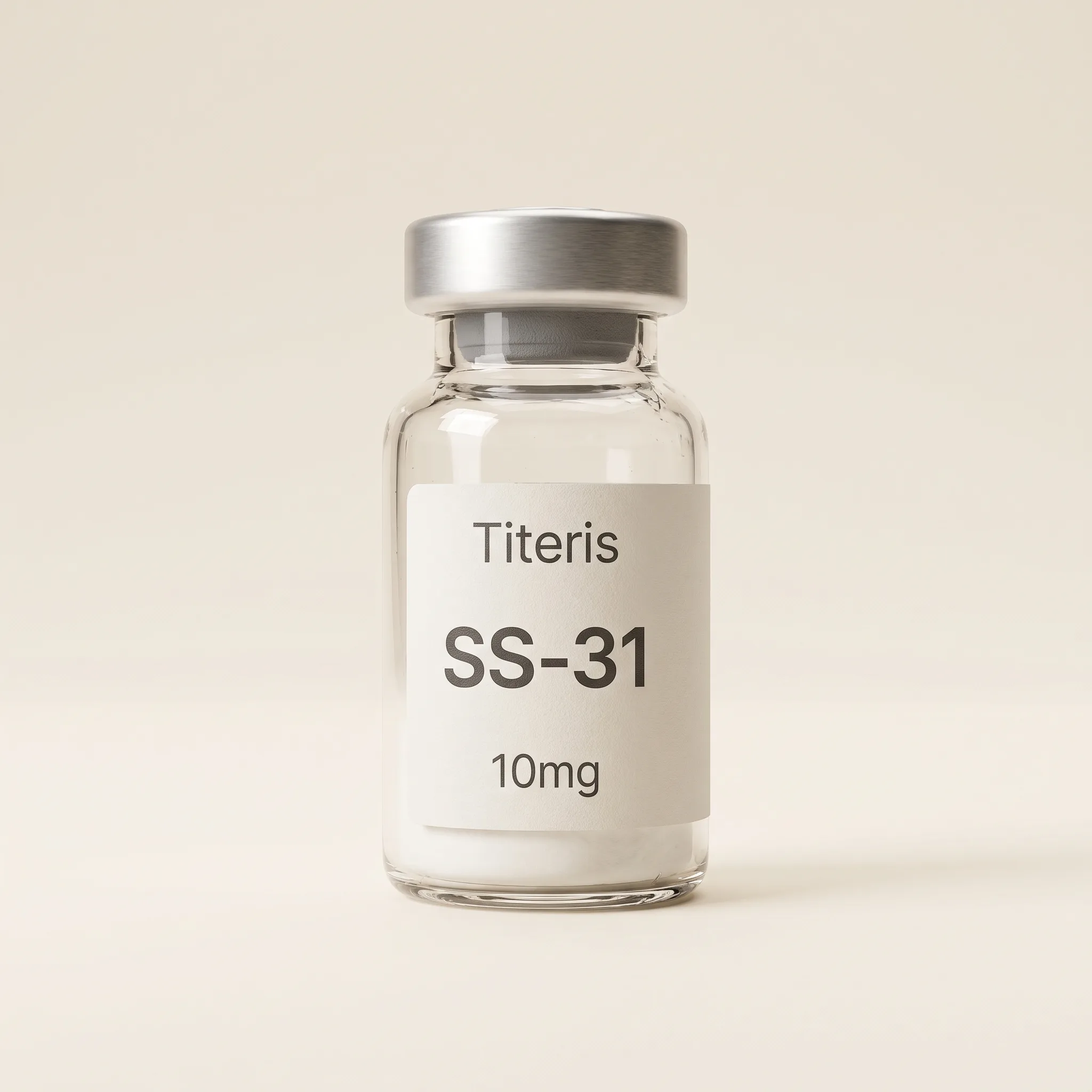
2S10SS-31 (Elamipretide), 10mg
Supplied as a lyophilised vial for laboratory research use only.
£47.99 Contact us to order2S50SS-31 (Elamipretide), 50mg
Supplied as a lyophilised vial for laboratory research use only.
£164.99 Contact us to orderSee our documentation policy for what supplier batch documentation covers, and our UK legal status page for the regulatory framing every listing follows.
Frequently asked
Why is SS-31 also called Elamipretide?
SS-31 is the original research designation from the Szeto laboratory where the SS peptides were developed. Elamipretide is the International Non-proprietary Name assigned for the clinical development programme. Both names refer to the same tetrapeptide with the sequence D-Arg-2',6'-Dmt-Lys-Phe-NH2.
What is the difference between SS-31 and MitoQ?
MitoQ and SkQ1 use a positively charged triphenylphosphonium group to drive accumulation in mitochondria via membrane potential. SS-31 reaches the inner membrane by a different mechanism without an external charge group, and acts specifically through cardiolipin binding. This makes SS-31 a structurally and mechanistically distinct research tool for mitochondrial targeting studies, and direct comparisons between the two approaches are a legitimate area of basic pharmacology research.
How is SS-31 supplied?
As a lyophilised tetrapeptide in a sealed glass vial, available in 10mg and 50mg sizes. Supplied without solvent; reconstitution for laboratory use requires an appropriate diluent for the specific research application. This is a research reference compound, not a pharmaceutical product for human use.
Is SS-31 legal to buy in the UK?
As a research reference compound for in vitro laboratory use, SS-31 occupies a different regulatory category from a licensed medicine. It cannot be marketed, sold, or supplied for human use. Every listing on this site is for research use only. Our UK legal status page provides a fuller explanation.
What is cardiolipin and why does it matter for mitochondrial research?
Cardiolipin is a unique phospholipid found almost exclusively in the inner mitochondrial membrane. It is required for the structural integrity of respiratory chain supercomplexes (respirasomes) and the ATP synthase. Alterations to cardiolipin composition and quantity are associated with age-related decline in mitochondrial function and with pathological states in tissues with high energy demands. SS-31's ability to bind cardiolipin makes it a relevant tool for studying these processes in vitro.