Compound Guide
Survodutide: what the GLP-1/glucagon dual agonist is and what the research actually shows
A plain, factual explanation of survodutide: how the combined GLP-1 and glucagon receptor mechanism works, what has been investigated in preclinical and clinical research literature, and how a research reference compound differs from a licensed medicine. Research use only. Nothing on this page is instruction for human use.
Survodutide sold here is a research reference compound for in vitro and laboratory research purposes only. It is a GLP-1/glucagon dual agonist supplied strictly as a research reference compound, not licensed for human use. It has not been approved by the MHRA for any clinical or therapeutic application. The clinical and preclinical applications discussed on this page are from published research literature and are referenced for scientific context only. If you have questions about metabolic health, consult a registered healthcare professional.
What survodutide is
Survodutide is a synthetic dual agonist that simultaneously binds GLP-1 receptors and glucagon receptors. This dual agonism strategy is pharmacologically interesting because GLP-1 and glucagon, despite their opposing effects on blood glucose regulation, share common signalling pathways in energy homeostasis. GLP-1 reduces glucagon secretion and slows gastric emptying; glucagon itself stimulates hepatic glucose production but also stimulates energy expenditure in brown adipose tissue.
Structurally, survodutide is a peptide analogue with a modified amino acid sequence and an attached fatty acid chain for extended half-life. The research interest lies in the interplay between the two receptor systems in metabolic models. GLP-1 receptors are expressed in the pancreas, brain, gut, heart, and kidneys; glucagon receptors are most prominently expressed in the liver, kidneys, and brown adipose tissue. Activating both receptor types with a single molecule allows researchers to examine combined effects that would be difficult to study with separate compounds applied independently.
Survodutide was developed by Boehringer Ingelheim for a clinical development programme, including in non-alcoholic steatohepatitis (NASH) and obesity research. Those clinical studies use a GMP-produced investigational medicinal product, not a laboratory research compound. As a research reference material, survodutide is the lyophilised peptide for laboratory use. It is not a medicine and must not be used for human administration.
What the research has examined
The research literature on survodutide divides into preclinical pharmacology and early clinical studies. The distinction between data from the pharmaceutical investigational product and what would apply to a laboratory research compound is important to maintain throughout.
Preclinical pharmacology
In animal models, researchers have studied combined GLP-1 and glucagon receptor agonism for effects on hepatic lipid accumulation, energy expenditure, and body weight. The rationale is that glucagon receptor agonism may provide metabolic effects beyond what GLP-1 receptor agonism alone delivers, particularly in the liver and in thermogenic tissue. Preclinical observations formed the mechanistic basis for advancing survodutide into clinical research.
The glucagon receptor as a research target is an active field in its own right. Glucagon does not only stimulate hepatic glucose production; it also plays a role in lipolysis and in the thermogenic activity of brown adipose tissue. This broader role in energy metabolism is the reason glucagon receptor agonism has been explored as a complement to GLP-1 receptor agonism in research aiming to understand additive metabolic effects.
NASH and liver research
Survodutide has been the subject of clinical studies for non-alcoholic steatohepatitis, a condition characterised by liver fat accumulation and inflammation. NASH research is pharmacologically challenging because the liver is affected by multiple metabolic inputs, and compounds that address both lipid metabolism and hepatic glucose handling are of interest to researchers studying liver disease pathophysiology. The glucagon receptor component of survodutide's mechanism has particular relevance here, given the liver's central role in glucagon signalling.
These clinical studies use the pharmaceutical investigational product under controlled conditions. The data from those trials characterise the pharmaceutical compound in a clinical context. They are not data about a research reference compound in a laboratory setting, and should not be used as such.
Obesity and body weight research
Early clinical studies have examined survodutide for changes in body weight in human participants. These studies use the pharmaceutical product under clinical trial conditions. The mechanism by which dual GLP-1 and glucagon receptor agonism may affect body weight is an area of active research interest in basic metabolic pharmacology, and survodutide's pharmacological profile makes it a relevant compound for researchers studying these receptor systems in cell culture or animal models.
Dual receptor mechanism research
From a basic pharmacology perspective, a compound that co-activates GLP-1 and glucagon receptors raises mechanistic questions about receptor cross-talk, downstream signalling pathway interactions, and the relative contributions of each receptor system to observed outcomes. These are questions that can be studied in laboratory settings using receptor-expressing cell lines and appropriate reporter systems. Survodutide as a research reference compound enables this type of experiment.
Mechanism: why dual agonism at GLP-1 and glucagon receptors is a research focus
The mechanistic interest in dual GLP-1 and glucagon receptor agonism comes from the observation that the two receptor systems have complementary but distinct roles in metabolic regulation. GLP-1 receptors are the primary target of compounds like semaglutide and tirzepatide; their activation drives insulin secretion in a glucose-dependent manner, reduces glucagon secretion, and modulates appetite through central nervous system pathways. Glucagon receptors, by contrast, when activated, stimulate hepatic glucose output in the short term but also activate thermogenic pathways in brown adipose tissue and influence lipid metabolism.
The apparent paradox of simultaneously activating GLP-1 receptors, which reduce glucagon, and glucagon receptors, which drive glucagon-mediated effects, is central to the research interest. In metabolic models, the net effect of combined activation appears to depend on the relative balance of each receptor's contribution and the tissue distribution of each receptor type. Liver-dominant glucagon signalling is modulated by the simultaneous insulin-stimulating effects of GLP-1 receptor activation, producing a different metabolic outcome than either receptor activation alone.
In laboratory research, the question of how simultaneous activation of GLP-1 and glucagon receptors affects cell signalling downstream is a legitimate mechanistic question. Both receptors signal primarily through cyclic AMP, but the downstream effects and tissue-specific gene expression changes differ. Researchers using survodutide in cell culture experiments can characterise these downstream effects in receptor-expressing model systems.
The fatty acid chain modification on survodutide that enables albumin binding and extended half-life is similar in concept to modifications used on semaglutide. This similarity makes survodutide useful for researchers studying the pharmacokinetics of albumin-binding peptide modifications as a general drug delivery strategy, independently of its receptor pharmacology.
UK regulatory status
Survodutide is not a licensed medicine in the UK. It is in clinical development for specific indications including NASH and obesity, but does not have MHRA marketing authorisation for any indication. Clinical use in the UK occurs within authorised clinical trials only, using pharmaceutical-grade investigational products manufactured under GMP standards.
A research reference compound containing survodutide, synthesised for in vitro laboratory research and supplied strictly under a research-use-only framework, occupies a different regulatory category from a pharmaceutical product. It is not a licensed medicine, is not subject to prescribing requirements, and cannot be marketed or supplied for human use. Titeris operates strictly within this framework. Every listing on this site is for research use only, and nothing on this site is an instruction or invitation to administer survodutide to a human or animal.
Researchers working with survodutide as a reference compound should be aware of the applicable regulatory framework for their institutional context. The UK legal status page provides an overview of the framework applicable to research compounds in the UK. Specific legal questions should be addressed with a solicitor specialising in medicines regulation.
Laboratory context: how survodutide is used in basic research
In the laboratory, survodutide is used as a research reference compound for controlled in vitro experiments. Common applications include receptor binding affinity studies using cell lines expressing GLP-1 receptors and/or glucagon receptors, cell signalling experiments examining downstream pathway activation such as cyclic AMP production, and comparative studies contrasting the effects of dual versus single receptor activation.
For researchers studying the GLP-1 receptor and glucagon receptor as separate targets, or their potential interaction, survodutide provides a tool for exploring what happens when both receptors are activated simultaneously by a single compound. This differs from co-application of separate GLP-1 and glucagon receptor agonists, where independent binding kinetics and receptor occupancy patterns may produce different experimental outcomes.
Proper storage of the lyophilised reference material is important. Storage at -20°C in the dry state maintains chemical integrity over time. Reconstitution should use an appropriate solvent such as bacteriostatic water, and the reconstituted solution should be stored at 4°C and used promptly. Repeated freeze-thaw cycles after reconstitution degrade compound quality and should be avoided.
Research reference materials are not clinical investigational products. They have not undergone regulatory review for therapeutic use by the EMA or MHRA, and the quality standards applicable to pharmaceutical manufacturing do not apply to research reference compounds. Researchers should take this into account when designing experiments and interpreting results.
Standard laboratory safety procedures apply when handling survodutide. Gloves, lab coat, and appropriate eye protection are standard. Disposal of surplus material should follow institutional chemical waste guidelines under the applicable UK waste regulations.
Survodutide in our catalogue
Sur10Survodutide, 10mg
Supplied as a lyophilised vial for laboratory research use only.
£114.99 Contact us to orderSee our documentation policy for what supplier batch documentation covers, and our UK legal status page for the regulatory framing every listing follows.
Frequently asked
What is the difference between survodutide and semaglutide?
Semaglutide is a pure GLP-1 receptor agonist. Survodutide additionally binds glucagon receptors, producing a different pharmacological profile. Glucagon receptor agonism adds effects on hepatic metabolism and energy expenditure that are not present with GLP-1 receptor agonism alone. As research reference compounds, both are distinct molecules with different receptor target profiles and different applications in laboratory experiments.
What does dual agonism mean for survodutide?
Dual agonism means that survodutide simultaneously activates two different receptor types: GLP-1 receptors and glucagon receptors. Both receptors have different tissue distributions across the body and mediate different physiological signals. Simultaneous activation of both receptors with a single compound allows researchers to study combined effects that would be difficult to achieve by applying separate agonists independently.
Why is glucagon receptor agonism relevant to metabolic research?
Glucagon activates not only hepatic glucose production but also stimulates energy expenditure in brown adipose tissue and plays a role in lipolysis. This broader role in energy metabolism makes the glucagon receptor a relevant research target in metabolic pharmacology, particularly when researchers are interested in hepatic lipid metabolism and thermogenic energy expenditure rather than glucose management alone.
Is survodutide legal to buy in the UK?
As a research reference compound for in vitro laboratory use, survodutide occupies a different regulatory category from a licensed medicine. It cannot be marketed, sold, or supplied for human use. Every listing on this site is for research use only. Our UK legal status page provides a fuller explanation of the framework.
How is survodutide supplied?
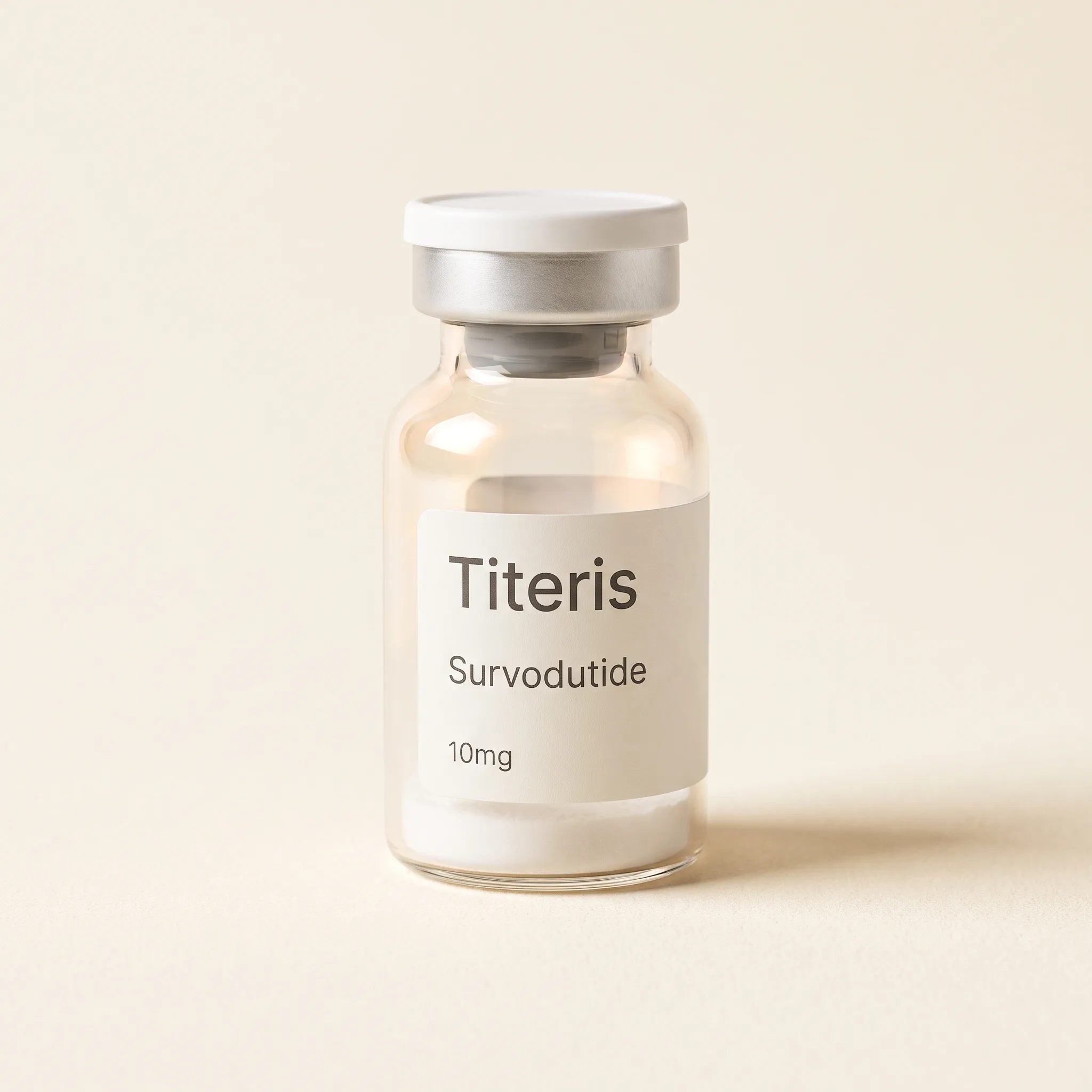
As a lyophilised (freeze-dried) white powder in a sealed glass vial, available in 10mg. Supplied without solvent; reconstitution for laboratory use requires bacteriostatic water or another appropriate diluent for the specific research application. This is a research reference compound, not a pharmaceutical product.
Storage and handling notes
Lyophilised peptide reference materials should be stored dry, away from light, and at low temperature. For survodutide, storage at -20°C in the dry state is appropriate for maintaining chemical integrity over time. Allow the vial to equilibrate to room temperature before opening to prevent condensation. Avoid opening in humid conditions.
After reconstitution in a suitable solvent, the solution should be stored at 4°C and used promptly. Avoid repeated freeze-thaw cycles of the reconstituted solution, as this degrades peptide quality through mechanical stress on the molecule's structure. Where multiple aliquots are required, freeze individual portions rather than repeatedly thawing a single vial.
Standard laboratory protective equipment applies: gloves, lab coat, and appropriate eye protection. Disposal should follow your institution's chemical waste guidelines under the applicable UK waste regulations.