Compound Guide
Tesamorelin + Ipamorelin Blend: what the GHRH/GHRP combination is and what the research shows
A plain explanation of the Tesamorelin and Ipamorelin combination: how the two compounds address different receptor systems in the GH axis, why this pairing is studied in research settings, and where the blend stands under UK law. Research use only. Nothing here is guidance for human use.
Tesamorelin + Ipamorelin Blend sold here is a research reference compound for in vitro and laboratory research purposes only. It is not licensed for human administration, is not a pharmaceutical product, and has not been approved by the MHRA for any clinical or therapeutic use. Combined GHRH and GHRP blend, research use only. The applications discussed on this page are drawn from published research literature and are provided for scientific context only. They are not an endorsement of human use. If you have questions about endocrine health, consult a registered healthcare professional.
What the Tesamorelin + Ipamorelin Blend is
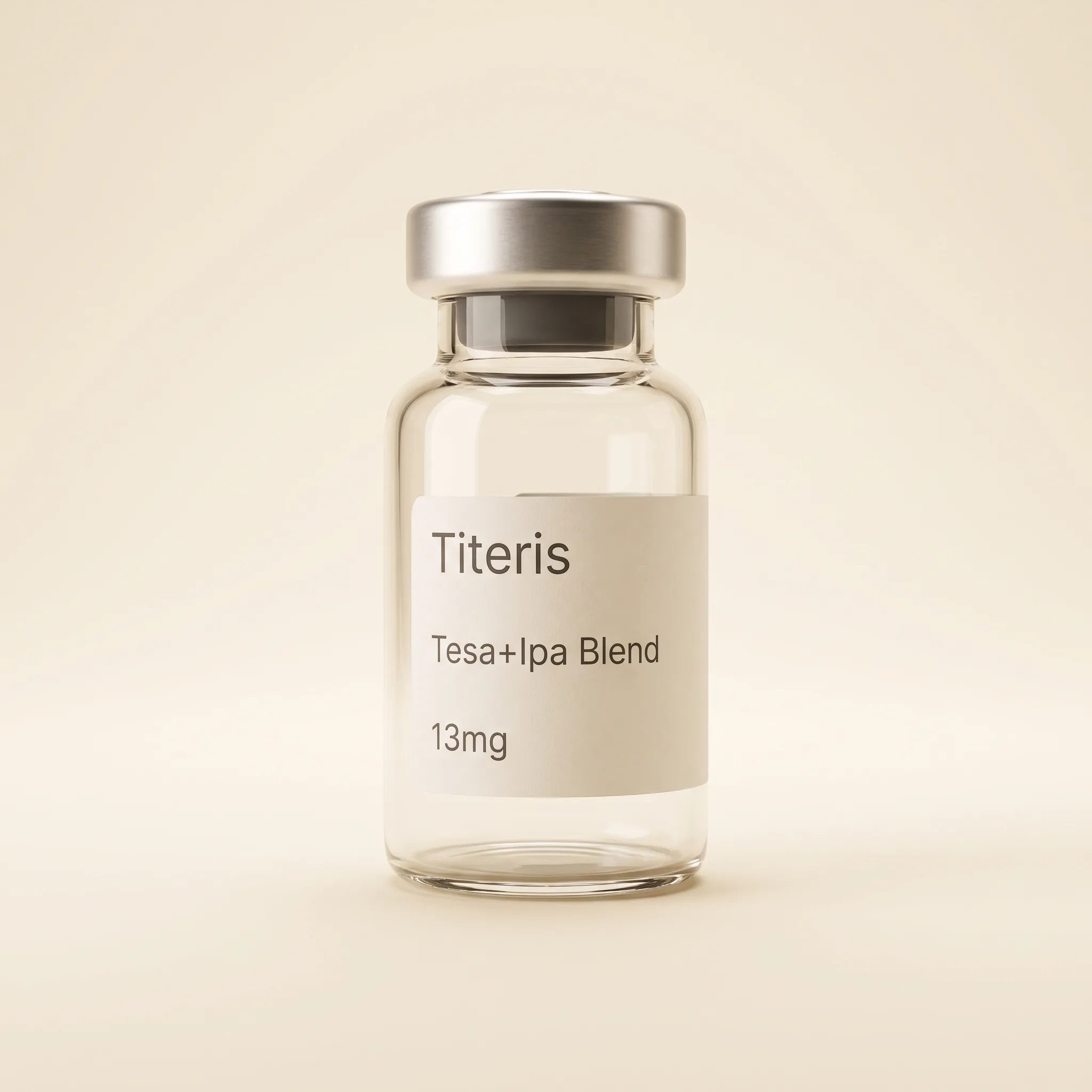
This blend contains Tesamorelin (10mg) and Ipamorelin (3mg) in a single lyophilised vial. The two compounds target the growth hormone axis through different receptor systems: Tesamorelin binds GHRH receptors in the pituitary and stimulates GH synthesis and secretion, while Ipamorelin is a GHSR-1a agonist that stimulates GH release through a separate receptor pathway.
Tesamorelin is the synthetic form of growth hormone-releasing hormone (GHRH), specifically GHRH(1-44) with a trans-3-hexenoic acid modification at the N-terminus that improves stability against rapid enzymatic degradation. This modification is what distinguishes Tesamorelin from Sermorelin, which is the shorter GHRH(1-29) fragment without that modification. In the United States, Tesamorelin is approved under the brand name Egrifta for HIV-associated lipodystrophy. That pharmaceutical approval applies to the licensed medicine; the research reference compound shares the peptide sequence but is a different product category entirely.
Ipamorelin is a pentapeptide GHSR-1a agonist developed specifically for its selectivity profile. Among GHRP-class compounds, Ipamorelin produces strong GH release with minimal concurrent stimulation of cortisol and ACTH, which makes it particularly useful for research protocols where isolating GH-axis effects matters.
The combination format in a single vial is practical for laboratory experiments that want to activate both pathways simultaneously. Since GHRH and GHRP work through different receptor systems, they act synergistically: GHRH stimulates GH synthesis and baseline secretion, while Ipamorelin reduces somatostatin-mediated inhibition of GH release, amplifying the net GH output. This two-pathway activation is well-documented in research literature as producing a larger GH response than either compound alone.
The 10mg Tesamorelin to 3mg Ipamorelin ratio corresponds to a format used in GH-axis research. It is not a clinical dosing recommendation of any kind; it reflects a research-oriented combination ratio suited to laboratory investigation of synergistic GH-axis stimulation.
What the research has examined
GHRH and GHRP combination protocols are an established research paradigm in GH-axis science:
- Synergistic GH release. The combination of GHRH and GHRP compounds produces a larger GH output in animal models than either class alone. GHRH drives GH synthesis and secretion; GHRP reduces somatostatin-mediated inhibition of GH release, so the two pathways complement each other at the mechanistic level. This synergy is the scientific rationale for combination formats.
- Tesamorelin in lipodystrophy research. The clinical literature on Tesamorelin focuses on HIV-associated visceral fat accumulation, the indication for which Egrifta is approved in the US. Those studies were conducted with the pharmaceutical medicine under controlled clinical conditions, not with a research reference compound. The evidence base belongs to the licensed product.
- Ipamorelin selectivity. Ipamorelin has the most selective GH-releasing profile of the known GHRP compounds: no significant cortisol or prolactin stimulation at research concentrations. That selectivity makes it a valuable tool for experiments where clean GH-axis stimulation is needed without confounding stress-axis signals.
- Pulsatile GH secretion models. Ipamorelin without long-acting modifications produces shorter GH pulses than some other GHRP compounds. For research into GH secretion dynamics and pulse shape, the Tesamorelin-Ipamorelin combination provides a model where both the amplitude (Tesamorelin component) and the pulsatile character (Ipamorelin component) can be studied.
- Comparative GH-axis research. Studies comparing GHRH analogues and GHRP compounds with different characteristics have built much of the mechanistic understanding of how the two receptor systems interact. Combination studies help researchers map the receptor pharmacology of both pathways simultaneously.
Mechanism: two pathways, one axis
The GH secretion system has two main stimulatory inputs: GHRH acting on the GHRH receptor (GHRHR) and ghrelin or ghrelin mimetics acting on GHSR-1a. Both receptors are expressed on somatotroph cells in the anterior pituitary. Activation of either receptor alone produces GH release, but activation of both together produces a synergistic response that exceeds simple addition of the two effects.
The mechanism of synergy involves partly independent intracellular signalling: GHRHR activates adenylate cyclase and raises cAMP, while GHSR-1a activates phospholipase C and raises intracellular calcium. Both pathways ultimately converge on GH vesicle exocytosis, but they do so via different second messenger systems, which is why co-activation amplifies rather than simply duplicates the response.
Somatostatin, the inhibitory regulator of GH release, is suppressed more effectively when both pathways are active. GHRP compounds, including Ipamorelin, reduce somatostatin tone at the level of the hypothalamus, which creates a more permissive environment for GHRH-driven GH release from the pituitary. This is the core mechanistic rationale for combination protocols in GH-axis research.
UK regulatory status
Both Tesamorelin and Ipamorelin are listed on the WADA prohibited list under the S2 category (peptide hormones, growth factors, related substances, and mimetics). This prohibition applies in the context of competitive sport and does not affect the status of the research reference compound for laboratory use.
Tesamorelin is not approved by the MHRA for any clinical indication in the UK. In the US, Egrifta (Tesamorelin) is approved for HIV-associated lipodystrophy; no equivalent approval exists under UK or EU regulatory frameworks. Ipamorelin is similarly not approved as a pharmaceutical product in the UK. The research reference compound blend sold here is not a pharmaceutical product, is not for human use, and is supplied strictly for laboratory research purposes.
Our UK legal status page provides a fuller explanation of how research peptides are regulated in the UK.
Laboratory context and handling
The Tesamorelin-Ipamorelin Blend is supplied as a lyophilised research reference material intended for in vitro and preclinical laboratory research. It is not a clinical product and does not meet the manufacturing standards required for human administration.
In laboratory settings, GHRH/GHRP combination protocols are used in pituitary cell cultures, hypothalamic-pituitary axis explant models, and whole-animal pharmacology studies (the latter under appropriate institutional ethics approvals). The blend format simplifies the experimental setup by providing both compounds in a pre-combined lyophilised form rather than requiring separate reconstitution and mixing.
Reconstitution should use bacteriostatic water or sterile water, depending on the specific research protocol and downstream assay requirements. Storage of the lyophilised vial should be at minus twenty degrees Celsius, dry and away from light. After reconstitution, the solution should be stored at four degrees Celsius and used promptly, or aliquoted for individual use to avoid repeated freeze-thaw degradation.
Both component peptides have well-defined chemical structures. Tesamorelin is a 44-amino acid peptide with a fatty acid modification; Ipamorelin is a pentapeptide. Both can be confirmed by mass spectrometry. The defined chemical identity of both components is a prerequisite for reproducible research results.
Researchers working with this material should follow their institution's protocols for compounds with potential biological activity. Protective equipment, including gloves and a lab coat, is standard practice. Disposal should follow institutional chemical waste procedures.
Tesamorelin + Ipamorelin Blend in our catalogue
T113Tesa+Ipa Blend, 13mg
Lyophilised vial (10mg Tesamorelin + 3mg Ipamorelin) for laboratory research use.
£74.99 Contact us to orderSee our documentation policy for what supplier batch documentation covers, and our UK legal status page for the regulatory framing every listing follows.
Frequently asked
Why the 10mg Tesamorelin to 3mg Ipamorelin ratio?
This ratio corresponds to a commonly used combination format in GHRH/GHRP research literature. It is not a clinical dosing recommendation; it is a research format designed for laboratory experiments studying synergistic GH-axis stimulation. The specific ratio used in any research protocol should be determined by the researcher based on the experimental system and the questions being investigated.
Why Ipamorelin rather than GHRP-2 or GHRP-6 in this blend?
Ipamorelin has the most selective GH-releasing profile among GHRP compounds: no significant cortisol or prolactin stimulation. For combination protocols where isolating the GH-axis effect without stress-axis interference is the research goal, Ipamorelin is the preferred GHRP component. GHRP-2 and GHRP-6 produce more cortisol co-secretion, which can complicate interpretation in certain experimental designs.
Is Tesamorelin approved as a medicine in the UK?
No. In the US, Tesamorelin (Egrifta) is approved for HIV-associated lipodystrophy. There is no MHRA approval for Tesamorelin in the UK for any clinical indication. The research reference compound sold here is not a pharmaceutical product and is supplied strictly for laboratory research use only.
How is the blend supplied?
As a lyophilised (freeze-dried) powder in a sealed glass vial containing 10mg Tesamorelin and 3mg Ipamorelin combined. Supplied without solvent; reconstitution for laboratory use requires bacteriostatic water or sterile water depending on the research protocol.