Compound Guide
Thymosin Alpha-1: what the thymic peptide is and what the research actually shows
A plain explanation of Thymosin Alpha-1 (Ta1): what this 28-amino-acid thymic peptide is, what immunomodulatory properties the research literature describes, and what the data on clinical applications actually says. UK regulatory context included. For research use only. Nothing here is instruction for human use.
Thymosin Alpha-1 sold here is a research reference compound for in vitro and laboratory research purposes only. It is not licensed for human administration, is not a pharmaceutical product, and has not been approved by the MHRA for any clinical or therapeutic use. The research applications discussed on this page are from published scientific literature and are referenced for scientific context only. They are not an endorsement of human use of this compound. If you have questions about immune function or related health matters, consult a registered healthcare professional.
What Thymosin Alpha-1 is
Thymosin Alpha-1 (abbreviated as Ta1 or T-alpha-1) is a 28-amino-acid peptide that was isolated and characterised from Thymosin Fraction 5, a preparation derived from thymic tissue. The peptide carries an N-terminal acetyl group, which contributes to its stability compared to unmodified peptides. In the thymus gland, Thymosin Alpha-1 is involved in T-cell development and maturation, which is the biological rationale for its use as an immunology research tool.
As a synthetic peptide, Ta1 is commercially available under the brand name Zadaxin, marketed by SciClone Pharmaceuticals, and is approved in some countries outside the EU and the United States for specific indications including hepatitis B, hepatitis C, and as a vaccine adjuvant. In the EU and the US, Zadaxin does not hold a marketing authorisation as a licensed medicine. It has not received MHRA approval for any indication in the UK.
As a research reference material, Ta1 is used in immunology studies, particularly for investigations into T-cell activation, dendritic cell modulation, and cytokine regulation. These are legitimate areas of basic science inquiry, and Thymosin Alpha-1 has an established presence in the immunology research literature as a result.
Understanding the distinction between the pharmaceutical product Zadaxin and a research reference compound containing the same molecule is important. Zadaxin is manufactured under pharmaceutical GMP standards for clinical use. A research reference material is supplied for in vitro laboratory investigation, not for clinical or therapeutic purposes. The molecule is the same; the regulatory category, quality standards, and intended use are entirely different.
What the research has examined
Thymosin Alpha-1 has a substantial preclinical and clinical research literature. The key areas covered in that literature are:
- Hepatitis treatment research. Clinical studies on Ta1 in chronic hepatitis B and hepatitis C have been conducted in several countries, including Italy and China. These studies relate to the clinical investigational product Zadaxin, not to laboratory research materials. The clinical evidence base for Zadaxin in these indications is what underpins its approval in markets where it is licensed.
- Dendritic cell activation. In laboratory models, Ta1 activates dendritic cells and stimulates the production of type-I interferons. This mechanism is the basis for the research interest in Ta1 in the context of infectious disease immunology, where dendritic cell function plays a key role in initiating adaptive immune responses.
- T-cell differentiation research. As a thymus-derived peptide, Ta1 has modulatory effects on T-cell subpopulations in laboratory models, particularly on regulatory T-cells and the balance between Th1 and Th2 responses. This work sits within the broader field of T-cell immunology and is of interest to researchers studying immune regulation.
- Vaccine adjuvant research. Ta1 has been investigated as a vaccine adjuvant in both preclinical and clinical studies, with the goal of enhancing the immune response to vaccines. This is a distinct research application from its use in chronic viral disease management.
- Sepsis research. In clinical pilot studies, Ta1 has been investigated in the context of sepsis. These studies are published in the literature, but they represent exploratory work rather than large-scale pivotal trials. Their findings should be read with appropriate caution about effect size and generalisability.
The overall evidence base for Thymosin Alpha-1 is more extensive than for many research peptides, given its history as a clinical candidate and its approval as Zadaxin in some markets. Researchers using it as a laboratory tool have a reasonably rich literature to draw on for mechanistic context, while remaining clear that the research material and the pharmaceutical product occupy different regulatory and quality categories.
Mechanism: how Thymosin Alpha-1 works in laboratory models
Thymosin Alpha-1 is understood to act through multiple mechanisms in laboratory models, with effects observed at the level of innate and adaptive immunity. The N-terminal acetylation of the peptide appears to be important for its biological activity, as deacetylated forms show reduced potency in some assay systems.
In dendritic cell biology, Ta1 has been shown in laboratory experiments to stimulate toll-like receptor signalling pathways, leading to increased production of type-I interferons and other pro-inflammatory cytokines that are important for antiviral responses. This mechanism connects Ta1 to the innate immune system as well as to its effects on adaptive immunity.
Effects on T-cell populations include modulation of CD4 and CD8 T-cell activation and maturation. In experimental systems, Ta1 has been observed to shift the balance between regulatory T-cells and effector T-cells, which is relevant to understanding immune tolerance and autoimmunity research as well as infection biology.
The thymic context of Ta1 is worth understanding mechanistically. The thymus is the organ where T-cells develop and mature. Thymosin Alpha-1 was originally isolated from thymic tissue because it was hypothesised that the thymus produces peptide factors that instruct T-cell development. Whether Ta1 functions in this way physiologically, or whether its effects in experimental systems reflect a pharmacological activity distinct from its physiological role, is a nuance that researchers working in this area should be aware of.
UK regulatory status
Thymosin Alpha-1 as a pharmaceutical product, specifically Zadaxin, is not licensed in the UK or the EU. It is not approved by the MHRA for any therapeutic indication, and it is not available through the UK healthcare system as a licensed medicine. Researchers in the UK who are aware of Zadaxin's approvals in other markets should note that those approvals do not extend to the UK.
As a research reference compound for in vitro laboratory use, Thymosin Alpha-1 is supplied under a research-use-only framework. It is not a licensed medicine, not for human use, and not subject to prescribing requirements. Titeris does not market Thymosin Alpha-1 for any clinical application, and every listing on this site is explicitly for laboratory research purposes only.
See our UK legal status page for the broader regulatory framework that applies to research peptide compounds in the UK.
Thymosin Alpha-1 in our catalogue
TA5Thymosin Alpha-1, 5mg
Supplied as a lyophilised vial for laboratory research use.
£44.99 Contact us to orderTA10Thymosin Alpha-1, 10mg
Supplied as a lyophilised vial for laboratory research use.
£69.99 Contact us to orderSee our documentation policy for what supplier batch documentation covers, and our UK legal status page for the regulatory framing every listing follows.
Laboratory context: how Thymosin Alpha-1 is used in basic research
Thymosin Alpha-1 is a research reference material for laboratory use. The laboratory context differs fundamentally from clinical or therapeutic applications. Controlled in vitro experiments are conducted in which the compound is applied at defined concentrations to cell cultures, primary cells, or other model systems. Results from these laboratory experiments cannot be directly extrapolated to human physiology without additional validation steps.
For immunology research laboratories, Ta1 is a useful tool precisely because it has defined molecular targets and a substantial published literature providing mechanistic context. Researchers designing experiments with Ta1 can build on existing knowledge about its effects on dendritic cells, T-cell subsets, and cytokine production when formulating their experimental hypotheses.
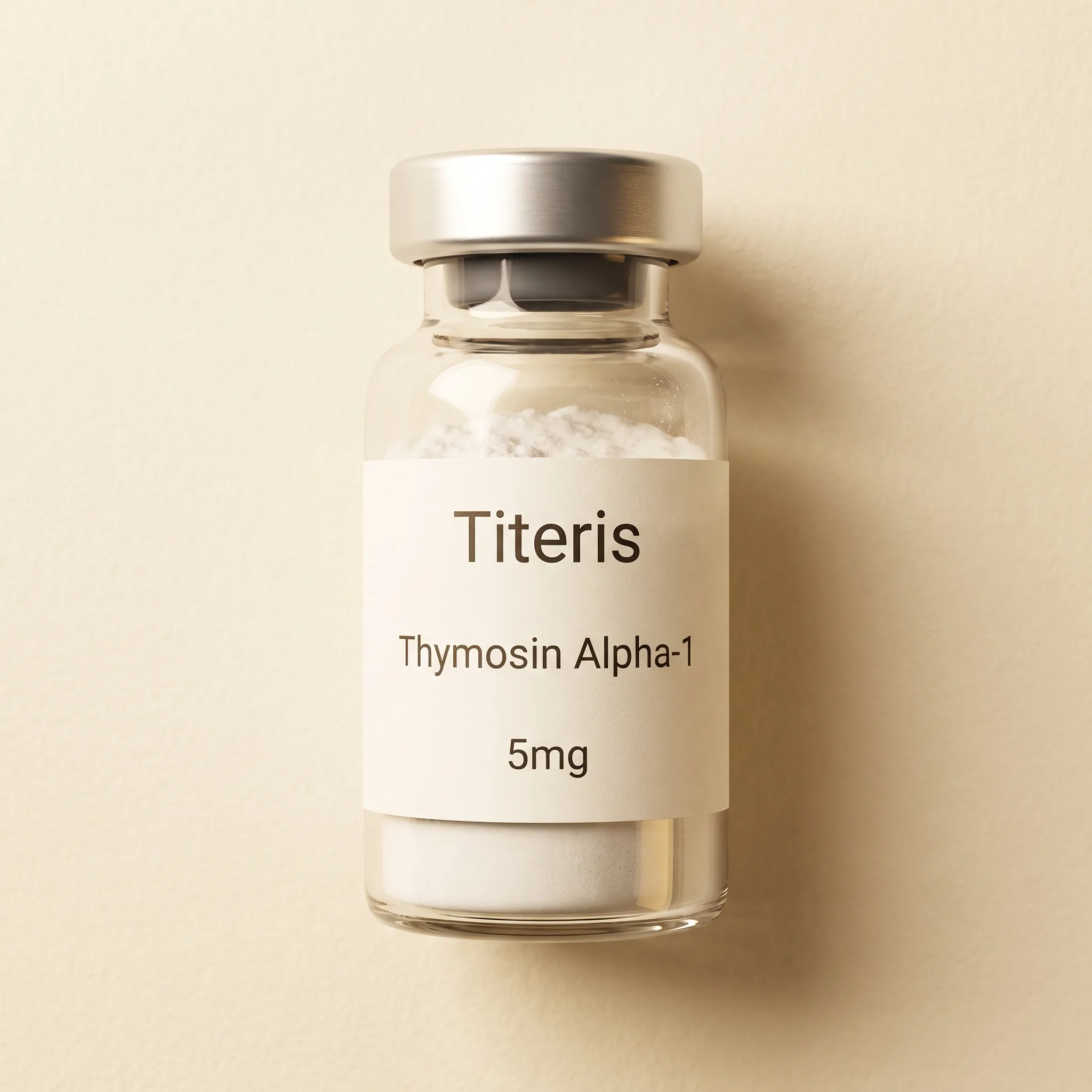
Titeris supplies Thymosin Alpha-1 as a lyophilised, N-terminally acetylated peptide in sealed glass vials. Batch documentation, where available from our supplier, is stated on the specific listing rather than as a blanket claim. The chemical identity of the material is verifiable from its defined amino acid sequence.
Storage at -20 degrees Celsius in the dry state is appropriate for lyophilised Ta1. After reconstitution in bacteriostatic water or sterile water, the solution should be kept at 4 degrees Celsius and used promptly. Repeated freeze-thaw cycles degrade peptide quality and should be avoided. For long-term reconstituted storage, single-use aliquots are recommended.
Research reference materials like Ta1 have not undergone MHRA or EMA review for therapeutic applications. They are not GMP clinical products. The difference matters when interpreting experimental data and when operating within institutional regulatory frameworks.
Handling should follow laboratory standards for compounds with potential biological activity. Standard personal protective equipment, gloves, lab coat, and eye protection, applies. Disposal should follow institutional chemical waste guidelines under UK environmental regulations.
Frequently asked
Is Thymosin Alpha-1 the same as Thymosin Beta-4 (TB-500)?
No. Thymosin Alpha-1 and Thymosin Beta-4 are structurally and functionally distinct peptides that were both isolated from thymosin fractions of thymic tissue. Ta1 has primarily T-cell modulatory effects in laboratory models. Thymosin Beta-4 (TB-4) is associated with actin sequestration and tissue repair signalling. They are different compounds with different mechanisms and research applications.
Where is Zadaxin approved as a medicine?
Zadaxin holds marketing authorisations in several countries outside the EU for hepatitis B, hepatitis C, and as a vaccine adjuvant, including in China and Italy, among others. In the EU and the United States there is no marketing authorisation. The MHRA has not approved Zadaxin for any indication in the UK.
How is Thymosin Alpha-1 supplied as a research reference material?
As a lyophilised, N-terminally acetylated peptide in a sealed glass vial, available in 5mg and 10mg sizes. Supplied without solvent; reconstitution for laboratory use requires bacteriostatic water or sterile water depending on the specific research application.
Is Thymosin Alpha-1 legal to buy in the UK?
As a research reference compound for in vitro laboratory use, Thymosin Alpha-1 is not a controlled substance and can be supplied under a research-use-only framework. It cannot be marketed or supplied for human use. Every listing on this site is for research use only. See our UK legal status page for more detail.