Compound Guide
Melanotan I: what the MC1R agonist is and what the research actually shows
A plain explanation of Melanotan I (afamelanotide): its structure as a selective melanocortin-1 receptor agonist, the pharmaceutical context of its licensed application in erythropoietic protoporphyria, what the research literature has examined, and where it stands under UK law. For research use only. Nothing here is instruction for human use.
Melanotan I sold here is a research reference compound for in vitro and laboratory research purposes only. It is not licensed for human administration, is not a pharmaceutical product, and has not been approved by the MHRA for any clinical or therapeutic use. The pharmaceutical applications discussed on this page refer to a licensed medicine (Scenesse/afamelanotide) that is a categorically different product from the research reference material supplied here. If you have questions about skin conditions or any medical matter, consult a registered healthcare professional.
Melanotan I is not approved for cosmetic or clinical use in humans in the UK. Its use as a cosmetic tanning agent or as a self-administered injection is not authorised and could be treated as unlicensed medicine supply. As a research reference material for laboratory use, a different regulatory framework applies. This notice is an integral part of this product page.
What Melanotan I is
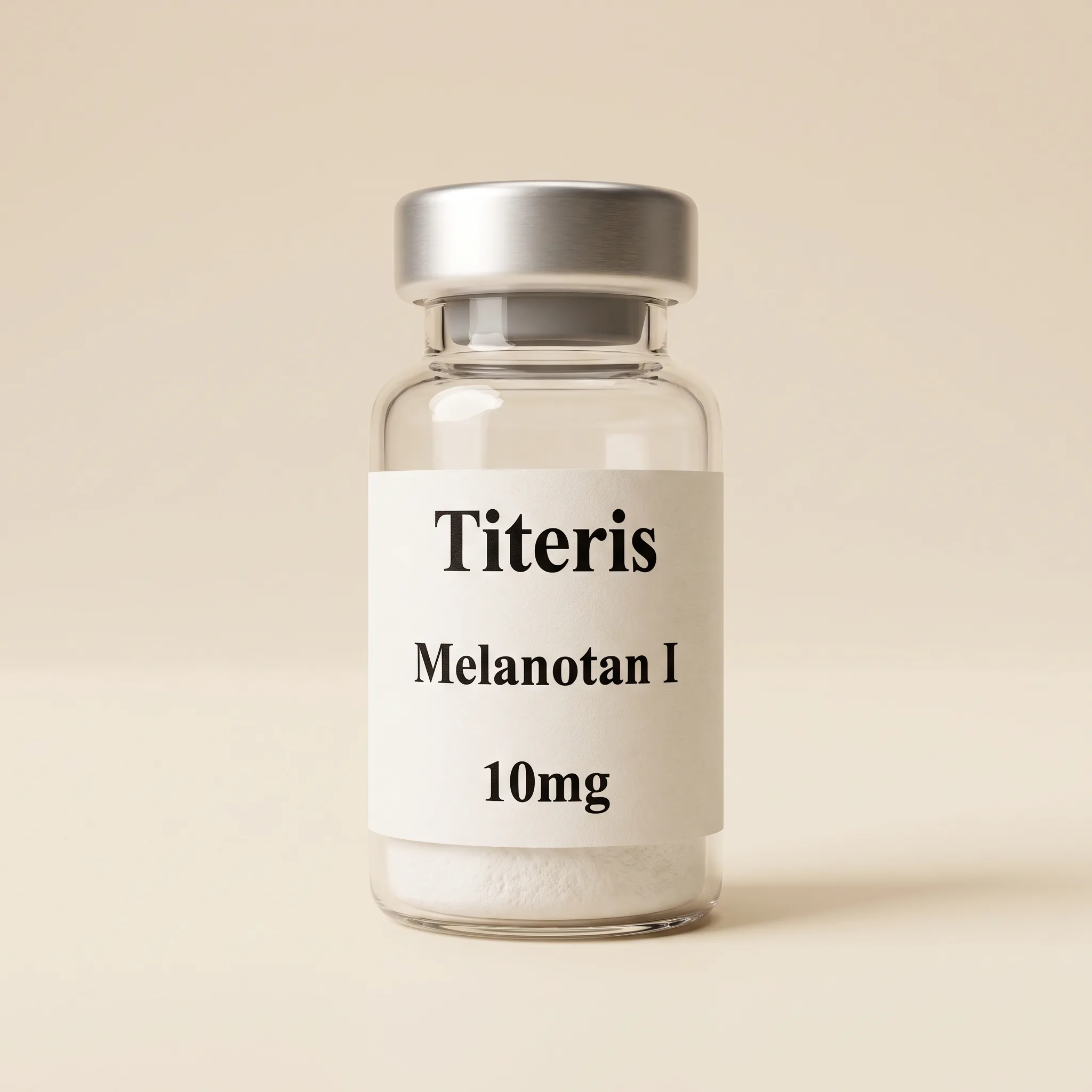
Melanotan I, also known as afamelanotide, is a synthetic analogue of alpha-melanocyte-stimulating hormone (alpha-MSH). Alpha-MSH is a 13-amino-acid peptide that binds to melanocortin receptors, with MC1R being the primary receptor responsible for melanin production in melanocytes.
Structurally, Melanotan I is a cyclic analogue. It contains a ring structure formed by an amide bond between aspartate and lysine residues, which makes it significantly more resistant to enzymatic degradation than native alpha-MSH. This structural feature also gives it a higher binding affinity for MC1R than the endogenous hormone itself. Compared to Melanotan II, Melanotan I is notably more receptor-selective: it binds primarily at MC1R without the broader melanocortin receptor activity seen with Melanotan II.
Afamelanotide has been developed into a licensed pharmaceutical product in the UK and EU under the brand name Scenesse, approved for erythropoietic protoporphyria (EPP) by the European Medicines Agency. That pharmaceutical product and the research reference material share the same amino acid sequence but are categorically different products: one is a GMP-manufactured licensed medicine supplied through authorised clinical channels; the other is a research compound for laboratory use.
MC1R is the primary receptor linking melanocortin signalling to melanin production. When MC1R is activated in melanocytes, the intracellular cAMP cascade drives upregulation of tyrosinase and related enzymes, ultimately increasing melanin synthesis. The specificity of Melanotan I for MC1R, compared to the broader receptor activity of other melanocortin peptides, makes it a particularly useful tool for MC1R-focused research questions.
In biochemical terms, the cyclic structure of Melanotan I is the key feature distinguishing it from both native alpha-MSH and from Melanotan II. The ring prevents the conformational flexibility that makes linear peptides susceptible to rapid proteolytic cleavage. This extended stability is part of what made afamelanotide suitable for pharmaceutical development: a longer-acting analogue that could be administered less frequently than a native peptide would require.
What the research literature has examined
Melanotan I has a comparatively well-developed research history because afamelanotide has been studied clinically as a pharmaceutical candidate:
Erythropoietic protoporphyria
Afamelanotide is the most clinically studied melanocortin analogue. EPP is a rare metabolic disorder caused by a deficiency of ferrochelatase, the enzyme that catalyses the final step of haem synthesis. The result is accumulation of protoporphyrin IX, which causes severe phototoxic reactions on sun exposure. The clinical research into afamelanotide for EPP was conducted using the GMP pharmaceutical product, not a laboratory research compound. Those trial data relate to a specific pharmaceutical dosing protocol in a clinical population under a licensed medicine framework.
Photodermatosis research
Beyond EPP, afamelanotide has been investigated in various photodermatoses and light-related skin conditions. The research interest stems from the role of MC1R activation in increasing skin melanin content, which in principle provides some degree of UV protection. Again, published clinical research in this area relates to the pharmaceutical product under controlled conditions, not to research reference materials.
MC1R pharmacology
As a selective MC1R agonist, Melanotan I is a valuable research tool for fundamental pharmacology of the melanocortin-1 receptor. MC1R has roles beyond simple pigmentation: it is involved in anti-inflammatory signalling, UV-response pathways, and has been studied in the context of skin cancer risk modulation. The selectivity of Melanotan I for MC1R, compared to Melanotan II which also activates MC3R, MC4R and MC5R, makes it the preferred tool for studies specifically examining MC1R-mediated pathways without confounding signals from other receptor subtypes.
Melanogenesis research
Melanin production in melanocytes is an active research field. MC1R agonists including Melanotan I are used as tools in cell biology studies examining melanogenesis, the signalling cascades downstream of MC1R, and the regulation of tyrosinase activity. In vitro experiments in melanocyte cell lines and related cell models are the typical context for this kind of research.
Laboratory context
Research compounds used in laboratory settings serve a fundamentally different purpose from pharmaceutical products used in clinical settings. In a laboratory, Melanotan I would typically be applied to cell cultures or other model systems at defined concentrations to study receptor binding, downstream signalling, or related biochemical questions. Results from such experiments are not directly transferable to predictions about human physiology. Researchers interpret laboratory data within the methodological constraints of the model system used.
For laboratory use, the chemical identity and consistency of the reference material are important. Batch documentation, where available from the supplier, is described on our documentation policy page. Where batch documentation exists, it is associated with the specific batch, not with the product line as a whole.
Melanotan I versus Melanotan II: the receptor selectivity difference
The two compounds are often discussed together but represent meaningfully different research tools. Melanotan I (afamelanotide) binds selectively to MC1R. Melanotan II is a cyclic heptapeptide with a D-phenylalanine substitution and C-terminal amide group, and it activates a broader range of melanocortin receptors: MC1R, MC3R, MC4R and MC5R.
This broader receptor activity has significant implications for research. MC4R activation is associated with effects on energy balance, appetite regulation, and sexual function in animal models. MC3R has roles in energy homeostasis. MC5R is expressed in exocrine glands. Melanotan II activating all four receptors simultaneously means its effects in research models are the result of multiple receptor pathways, which complicates interpretation.
For researchers specifically interested in MC1R-mediated signalling, Melanotan I is the more appropriate tool because it isolates the MC1R pathway without introducing off-target signals from other melanocortin receptors. For researchers interested in broader melanocortin system effects, particularly those involving MC4R, Melanotan II may be the relevant comparator.
In regulatory terms, the two compounds also sit differently. Melanotan I has a licensed pharmaceutical application as Scenesse for EPP. Melanotan II has no licensed pharmaceutical application in the UK or EU, and the EU Scientific Committee on Consumer Safety has determined it is not safe for cosmetic use. The regulatory contexts are distinct and both are described on our legal status page.
UK regulatory status
Afamelanotide (Scenesse) has received approval in the UK for the treatment of erythropoietic protoporphyria. As a licensed pharmaceutical product, it is a prescription-only medicine supplied through authorised clinical channels. That approval relates to the GMP pharmaceutical product, not to research reference materials sharing the same molecular structure.
Melanotan I is not approved for cosmetic use in the UK. Using it as a tanning injection or for any cosmetic purpose would be outside licensed use and could constitute unlicensed medicine supply under UK medicines law. The MHRA takes enforcement action in this area.
A research reference compound containing the same molecule, synthesised for in vitro laboratory research, is regulated differently. It is not a licensed medicine, is not subject to prescribing requirements in the same way, and cannot be marketed for human use. The line between research compound supply and unlicensed medicine supply is one Titeris does not blur. Every listing here is for research use only, and nothing on this site is an instruction or invitation to administer Melanotan I to a human or animal.
For a fuller explanation of how research compound supply relates to UK medicines law, see our legal status page.
Storage and handling notes for laboratory use
Lyophilised peptide reference materials are generally stored dry, away from light, and at low temperature to maintain chemical integrity over time. Freeze-drying removes water from the sample and creates a dry, stable matrix that remains usable for research purposes considerably longer than a reconstituted solution.
For Melanotan I as a lyophilised research material, storage at -20°C in dry conditions is the standard recommendation. The vial should be allowed to reach room temperature in closed condition before opening, to prevent moisture condensation inside. Once a vial has been opened, the protective inert atmosphere is no longer present, so prompt use or careful resealing is appropriate.
Reconstitution for laboratory use typically involves bacteriostatic water or sterile water, depending on the specific research application. Reconstituted solutions should be kept at 4°C and used promptly. Repeated freeze-thaw cycles of reconstituted solutions degrade the peptide through mechanical stress on the structure and should be avoided where possible. Aliquoting into single-use portions before freezing is the standard approach when extended storage of reconstituted material is needed.
Disposal of Melanotan I residues should follow institutional guidelines for chemical waste, in line with applicable UK environmental regulations. Researchers working with this material should follow their institution's standard operating procedures for compounds with potential biological activity.
Melanotan I in our catalogue
MT1Melanotan I, 10mg
Supplied as a lyophilised vial for laboratory research use only.
£24.99 Contact us to orderFor laboratory use only. Not for human or veterinary consumption. See our documentation policy and UK legal status page.
Frequently asked
What is the difference between Melanotan I and afamelanotide?
They are the same molecule. Afamelanotide is the international non-proprietary name (INN) for the compound; Melanotan I is the research compound name used before pharmaceutical development gave it a formal INN. Scenesse is the brand name of the pharmaceutical product containing afamelanotide that is licensed for EPP. The research reference compound sold here is the same molecule but is not a pharmaceutical product, not manufactured under GMP for clinical use, and is supplied strictly for laboratory research.
Why is Melanotan I more receptor-selective than Melanotan II?
The structural difference between the two compounds accounts for their different receptor binding profiles. Melanotan I's cyclic structure with amide bond between Asp and Lys residues confers selectivity for MC1R. Melanotan II has a D-phenylalanine substitution and a cyclic structure that gives it activity at MC1R, MC3R, MC4R and MC5R. For research specifically targeting MC1R-mediated signalling, Melanotan I is the appropriate tool because it does not introduce activity at other melanocortin receptor subtypes.
Is Melanotan I legal to purchase in the UK?
Afamelanotide (Scenesse) as a licensed pharmaceutical product requires a prescription in the UK and is only available through authorised clinical channels. As a research reference compound for in vitro laboratory use, Melanotan I occupies a different regulatory category. It cannot be marketed or supplied for human use. Every listing on this site is for research use only. The distinction is explained in more detail on our UK legal status page.
What is EPP and what is afamelanotide's role in it?
Erythropoietic protoporphyria is a rare genetic disorder involving deficiency of ferrochelatase, causing protoporphyrin IX accumulation and severe phototoxic skin reactions on sun exposure. Afamelanotide (Scenesse), the licensed pharmaceutical product, was approved in the EU for EPP based on clinical trial data showing it could increase sun exposure tolerance in affected patients. That clinical application relates to the pharmaceutical product under a licensed medicine framework, not to the research reference compound sold here.
How is Melanotan I supplied?
As a lyophilised (freeze-dried) white powder in a sealed glass vial, supplied without solvent. Reconstitution for laboratory use requires bacteriostatic water or sterile water depending on the research application. Available in a 10mg vial. Batch documentation, where available from our supplier, is described on our documentation policy page.