Compound Guide
Pinealon: what the pineal tripeptide is and what the research shows
A plain explanation of Pinealon (EDR): what the tripeptide Glu-Asp-Arg is, in which Russian research tradition it was developed, and what the literature on pineal tripeptides actually establishes. UK regulatory context included. For research use only. Nothing here is instruction for human use.
Pinealon sold here is a research reference compound for in vitro and laboratory research purposes only. It is not licensed for human administration, is not a pharmaceutical product, and has not been approved by the MHRA for any clinical or therapeutic use. The research applications discussed on this page are from published scientific literature and are referenced for scientific context only. They are not an endorsement of human use of this compound. If you have questions about cognitive health or age-related matters, consult a registered healthcare professional.
What Pinealon is
Pinealon is a synthetic tripeptide with the amino acid sequence Glu-Asp-Arg (EDR). It belongs to the class of compounds called cytomedines, a group of short-chain peptide bioregulators developed within the Russian research tradition, principally by Vladimir Khavinson and colleagues at the Saint Petersburg Institute of Biogerontology. The same research group developed Epithalon (AEDG tetrapeptide) and a range of other short peptides associated with specific organ systems.
Pinealon is associated in the Khavinson cytomedicine framework with the pineal gland, also known as the epiphysis or pineal body. The pineal gland is a small endocrine structure that produces melatonin and plays a role in circadian rhythm regulation and light-dependent seasonal physiology. In the cytomedicine theoretical framework, short peptides derived from or associated with particular organs are proposed to act as bioregulators for those organ systems. Pinealon's association with the pineal gland reflects this assignment within that research tradition.
Pinealon and related tripeptides are described in the Khavinson literature as transcriptional modulators that are proposed to bind to promoter regions of genes. This mechanistic theory is detailed within the publications of this research group but has not been independently validated at a large scale in other laboratories, which is an important methodological consideration for researchers evaluating the available data.
Pinealon is not a drug, not a licensed medicine, and not approved for any human therapeutic application. It is a laboratory research compound supplied for in vitro investigation.
What the research has examined
Pinealon has a research literature concentrated within a specific Russian research tradition. Understanding the provenance and methodological character of this literature is important for correctly evaluating it:
- Cytomedicine research tradition. Pinealon is part of the cytomedicine research developed by Khavinson and colleagues over many decades. This research school has a distinct theoretical basis and its own publication channels, many of which are Russian-language journals or specialised international journals with limited independent peer review of the underlying mechanistic claims.
- Pineal gland biology context. The pineal gland produces melatonin and is involved in circadian and seasonal physiology. This places it in a well-established area of neuroscience and endocrine science. The Khavinson cytomedicine tradition associates Pinealon with pineal functions as part of its theoretical framework, though the specific mechanisms proposed remain to be independently validated.
- Cell culture experiments. Like other Khavinson tripeptides, Pinealon has been investigated in cell culture experiments, with published reports of effects on cell proliferation and oxidative stress markers. These are in vitro data from a specific research group, and independent replication is very limited.
- Limited independent replication. A key methodological fact about Pinealon is that the main research base comes from a single Russian research group. Independent replication by Western research laboratories is very limited. This does not mean the findings are wrong, but it does mean that the evidence should be treated as preliminary and that researchers using Pinealon as a laboratory tool are working with a compound at an early stage of independent scientific validation.
For researchers interested in the cytomedicine research tradition, the biology of short regulatory peptides, or the pineal gland research context, Pinealon provides a defined compound with a documented history in the Khavinson literature. Its limitations as a research tool should be weighed against this context.
The cytomedicine framework and short peptide biology
The theoretical framework underlying Pinealon and the other Khavinson peptides proposes that the body uses short peptides, typically two to four amino acids in length, as organ-specific regulatory signals. The hypothesis is that these peptides, derived from or produced by specific tissues, can enter cells and interact with chromatin to modulate gene transcription. This represents a mechanism distinct from receptor-mediated peptide signalling and has been the subject of considerable research within the Khavinson group.
The claim that short peptides can bind to specific DNA sequences and modulate transcription is biologically plausible in principle: some short peptide sequences are known to interact with nucleic acids, and peptide-based transcriptional regulation is documented in certain biological contexts. Whether the specific sequences in Pinealon and related compounds achieve organ-specific transcriptional regulation in the manner proposed is a question that requires independent experimental validation.
The pineal gland biology that provides context for Pinealon is well-established independently of the cytomedicine framework. Melatonin synthesis and secretion, the role of the suprachiasmatic nucleus in circadian regulation, and the interaction between light input and pineal function are documented across a broad, internationally replicated literature. Pinealon's connection to this biology via the cytomedicine framework is a theoretical one that researchers should evaluate carefully.
For researchers using Pinealon as a laboratory reference material, the practical approach is to work with it as a short peptide with a defined sequence and to investigate its biological effects empirically in the chosen model system, rather than assuming the theoretical mechanisms proposed in the source literature will hold under different experimental conditions. Appropriate controls and orthogonal measurement approaches strengthen any conclusions drawn.
UK regulatory status
Pinealon is not a licensed medicine in the UK. It has not received MHRA approval for any indication and has no approved therapeutic application anywhere. It is not a controlled substance under the Misuse of Drugs Act 1971. As a research reference compound for in vitro laboratory use, Pinealon is provided under a research-use-only framework and cannot be marketed or supplied for human use.
See our UK legal status page for the broader regulatory framework that applies to research peptide compounds in the UK.
Pinealon in our catalogue
PN10Pinealon, 10mg
Supplied as a lyophilised vial for laboratory research use.
£32.99 Contact us to orderSee our documentation policy for what supplier batch documentation covers, and our UK legal status page for the regulatory framing every listing follows.
Laboratory context: how Pinealon is used in basic research
Pinealon is a research reference material for laboratory use. Given the concentrated evidence base from a single research tradition, laboratories using Pinealon should approach it as a compound for which independent experimental validation is particularly important. Controlled in vitro experiments that test specific mechanistic hypotheses, with appropriate positive and negative controls, are the right approach when working with compounds at this stage of characterisation.
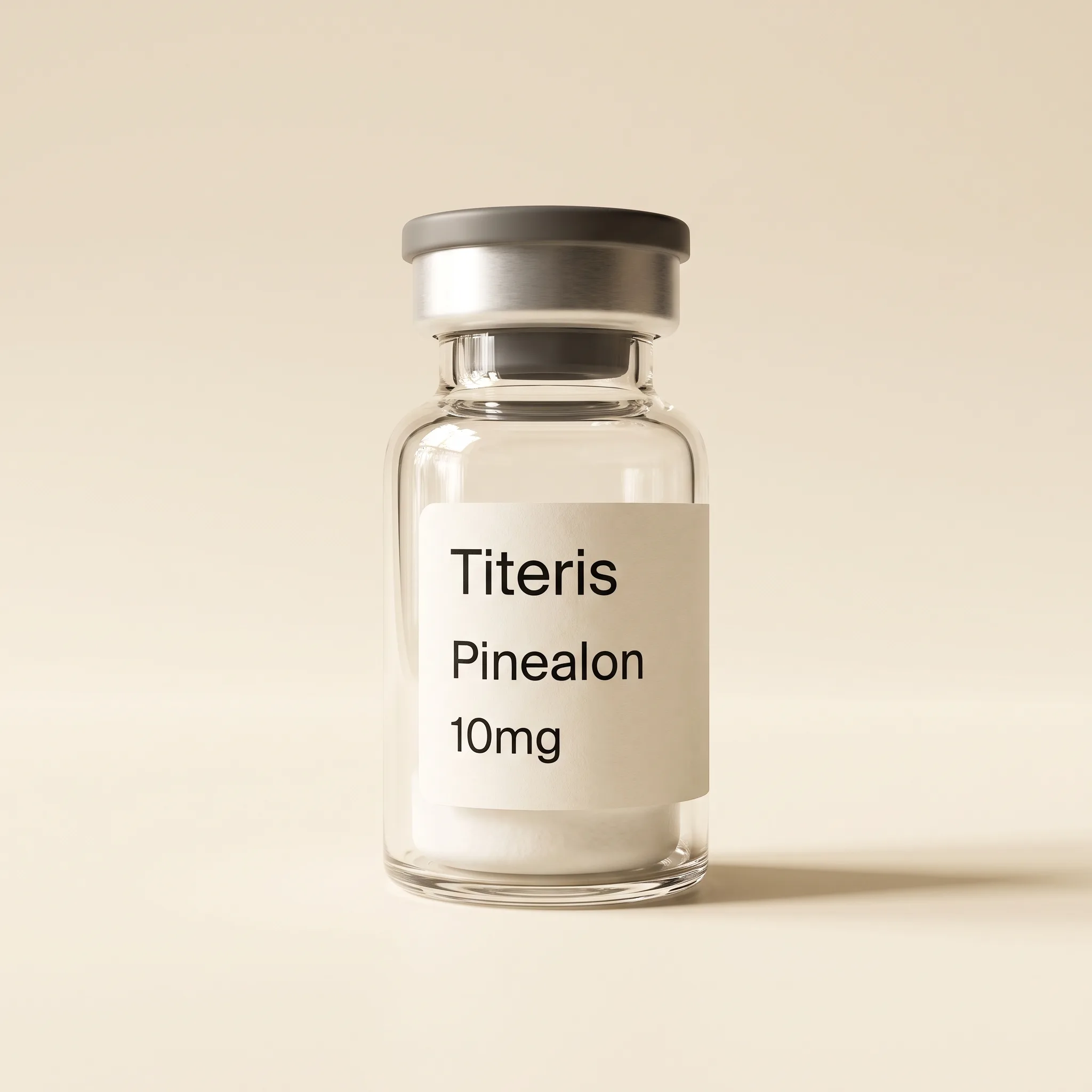
Titeris supplies Pinealon as a lyophilised tripeptide in a sealed glass vial. Its defined chemical identity, the Glu-Asp-Arg sequence, means researchers know exactly what they are working with. Storage at -20 degrees Celsius in the dry state is recommended. After reconstitution in bacteriostatic water or sterile water, the solution should be used promptly or stored at 4 degrees Celsius for short-term use.
For researchers comparing Pinealon with other Khavinson peptides such as Epithalon, the similar research tradition and methodological context of both compounds means that the same critical evaluation applies to both. Our Epithalon page provides additional context on the cytomedicine research tradition and its methodological characteristics.
Research reference materials like Pinealon are not clinical investigational products and have not been reviewed by the MHRA or EMA for any therapeutic application. Handling should follow institutional laboratory safety guidelines. Standard protective equipment and disposal under institutional chemical waste guidelines under UK environmental regulations apply.
Frequently asked
What are cytomedines?
Cytomedines, also written as cytomedins, are short-chain peptide bioregulators developed in the cytomedicine research tradition associated with Khavinson and colleagues. The theory proposes that tissues produce organ-specific short peptides that act as transcriptional regulators for those same tissues. Each peptide in the cytomedicine framework is associated with a specific organ or tissue system, and Pinealon is associated with the pineal gland.
What is the difference between Pinealon and Epithalon?
Both Pinealon (EDR tripeptide) and Epithalon (AEDG tetrapeptide) come from the Khavinson cytomedicine research tradition and are both associated with the pineal gland in that framework. Pinealon is a tripeptide and Epithalon is a tetrapeptide, giving them different chemical properties. Both have similar evidence base characteristics: concentrated within a single Russian research group, with limited independent replication from Western laboratories.
How is Pinealon supplied as a research reference material?
As a lyophilised tripeptide in a sealed glass vial, available in 10mg size. Supplied without solvent; reconstitution for laboratory use requires bacteriostatic water or sterile water depending on the specific research application.
Is Pinealon legal to buy in the UK?
As a research reference compound for in vitro laboratory use, Pinealon is not a controlled substance and can be supplied under a research-use-only framework. It cannot be marketed or supplied for human use. Every listing on this site is for research use only. See our UK legal status page for more detail.